How to Develop a
Specialized
Transportation
Enhancement
Program
Final Report
Submitted by
William T. Davis, Project Manager
Blair Senior Services, Inc.
1320 12th Avenue
Altoona, PA 16601
Prepared for
Project ACTION
National Easter Seal Society
700 Thirteenth Street, N.W.
Suite 200
Washington, DC 20005
Assistance derived from the Federal Transit Act, as amended, through a Cooperative Agreement with the U.S. Department, Federal Transit Administration and Project ACTION of the National Easter Seal Society.
Doc No: 95-0112
ACKNOWLEDGMENTS
The staff of the Specialized Transportation Program (STEP) of Blair Senior Services, Inc. would like to acknowledge the following individuals and organizations for their support and assistance in contributing to the success of this project:
Blair Senior Services, Inc., Board of Directors
Blair Senior Services, Inc., David M. Slat, Executive Director
STEP staff: Ann Hull, Vanessa McCune, Howard Ermin, Linda Stovall
Office of Vocational Rehabilitation, Thomas Wyland, District Administrator
Altoona Metro Transit, AMTRAN, Eric Wolf, Director of Planning & Marketing
The Blair Transportation Accessibility Coalition and its present membership:
Adult Center for Exceptional Learning
Altoona Council of the Blind
Blair County Association for the Blind
Blair County Commissioners
Blair County Human Services
Blindness and Visual Services
Center for Independent Living of South-central PA
Central PA Amputee Support Group
City of Altoona
Easter Seal Society of Blair County
Home Nursing Agency
Mercy Regional Health System
Blair County Mental Health & Mental Retardation Office
National Organization of disABILITY
Open Doors for the Handicapped, Blair Chapter
Pennsylvania Department of Transportation, District 9 Office
Skills of Central PA
* and interested area residents.
Table of Contents
INTRODUCTION 5
Statement of Need 5
Program Overview 6
Organizational Background 9
Community Background 10
Summary 11
PROJECT INITIATIVES
Needs Assessment 12
Training 21
Public Relations 25
Other Endeavors 29
APPENDICES
Information & Referral Checklist 33
Problem Log 34
Problem Log Procedure 36
Key Informant Interviews 37
Transportation User Survey 39
Transportation Provider Questionnaire 42
Accessible Trans. Service Example 44
Fixed-Route Observational Review 45
Bus Shelter Evaluation Summary 46
User Training Outline 48
Pre & Post User Training Questionnaire 50
Tips for First Time Rider 51
Get Moving "2" Informational Release 52
Poster/Flier Sample 53
Ramp & Curb Cut Application 54
ADA Task Force Announcement 55
Resource & Information Library 56
INTRODUCTION
This success of this Specialized Transportation Enhancement Program (STEP) resulted from a combined effort of Communication, Commitment, Cooperation, and Conflict Resolution among individuals and organizations within our Community, dedicated to a common goal of identifying and reducing mobility barriers. The following pages describe how to develop a STEP Program, or incorporate STEP into an existing agency or program.
STATEMENT OF NEED
Mobility is a fundamental element which enables individuals to participate in the vast array of social, medical and economic activities necessary for survival in today's complex society. Most people who drive take for granted the freedom and flexibility afforded them by their personal vehicles. The goal of STEP is to extend this freedom and flexibility to each member of the community. In order to best serve persons with disabilities in the community, a partnership must be forged between transportation providers, human service agencies and consumers with disabilities, both current and potential. The groundwork for connecting these distinct groups has proven to be the American with Disabilities Act of 1990 (ADA). This law has been a catalyst for awareness and change of the mobility rights for persons with disabilities. A tremendous challenge faces communities. How can an effective partnership, concerned with planning, service provision, funding and communication, be organized to best serve the entire community? Transportation expertise, disability awareness, funding and staff availability are not housed within one organization. Further, task forces, sub-committees and public forums elicit valuable ideas, but often lack the resources and coordination commitment necessary for implementation. How can an unbiased, well-informed corroboration of diverse entities bridge the needs of persons with disabilities to a viable, yet affordable, transportation system? Further, once practical systems are in place, how will the training needs required for persons with disabilities, transportation providers and sponsoring agencies be encouraged, coordinated and implemented?
PROGRAM OVERVIEW
The Specialized Transportation Enhancement Program (STEP) of Blair Senior Services Inc., Altoona, Pennsylvania, set out to improve and expand transportation services to persons with disabilities. STEP's goals were to identify and overcome transportation barriers through cooperative efforts, while encouraging awareness and individual responsibility for transportation issues for persons with disabilities. STEP accomplished these goals by:
creating a single point of intake, coordination and marketing.
developing formats to assess the needs of both the passenger with a disability and the transportation provider.
strengthening local advocacy groups in recruitment, coordination and information sharing.
serving as a catalyst and liaison to increase communication among persons with disabilities, human service agencies and private/public transportation providers.
assisting transportation providers, service agencies and persons with disabilities in developing training to access transportation.
Through this cooperative effort, STEP included the entire community in its campaign to educate and raise awareness of issues regarding mobility barriers for persons with disabilities. The success of STEP can be linked to its simple, direct and positive approach. First, STEP established itself as the information focal point for specialized transportation in the area. STEP stressed the needs of the consumer, yet never lost sight of the operational and economical reality of direct service. STEP increased communication and cooperation among transportation providers, consumers, advocacy groups and support agencies. As STEP began its public campaign, all of the above-mentioned groups, for varying reasons, recognized benefits in their commitment and cooperation on mobility issues and transportation access. Rather than a fragmented format of review and comment, the entire community was unified into a common effort and forum. Once the lines of communication were open, STEP worked to impress upon each faction their individual responsibilities, which were the key toward improving the system as a whole.
Prior to this open dialog, some groups felt the responsibility for public enhancements laid with another. Even the most earnest efforts did not involve enough coordination to be successful. Each interested party worked in isolation to develop policies and procedures to enhance mobility. Providers developed securement procedures without consulting passengers. Support agencies developed travel training procedures without involving the transit provider or passengers with disabilities already utilizing the system.
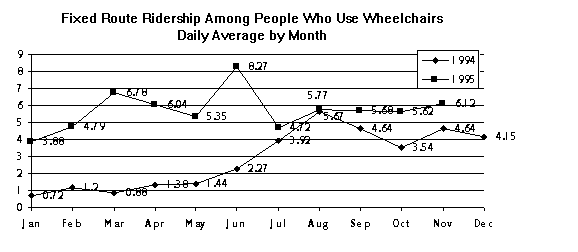
STEP coordinated these individual efforts and produced tangible results within the community. During STEP's initial year of operation, the daily ridership among passengers with wheelchairs increased dramatically on fixed-route service. Conversely, comparing the first four months of 1995 versus the same period in 1993, Complementary Paratransit decreased nearly 200 trips per month. Ridership trends are changing, as a result of STEP.
 The net trip cost of Complementary Paratransit service to the transit authority was $4.25. Each time STEP was responsible for an individual using the fixed-route service, rather than the Complementary Paratransit service, transit not only saved $4.25 per trip, but added revenue from a fixed-route fare. The passenger also saved. The per-trip fare to utilize Complementary Paratransit was $2.20. STEP promoted utilizing fixed-route service, and strongly encouraged application for the reduced fare card. This lowered the passenger's fixed-route fare from $1.10 to $.55; yielding a total savings of $1.65 per trip. If transportation was used every weekday by the passenger, they would save $66.00 a month, while transit reduced their expenses by $170.00, and increased revenue by $22.00.
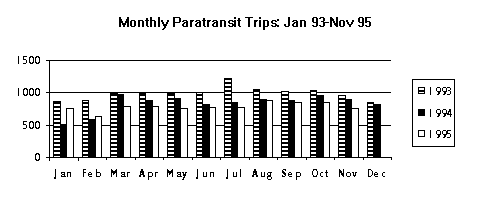
With STEP active in the community, more people with disabilities are choosing to ride the bus rather than the Complementary Paratransit service. These trends increase the passenger's mobility, independence and scheduling flexibility, while saving money for both the passengers and the transit authority.
Organizational Background
The concept of a transportation enhancement program within the County was derived from the Consumer Advisory Committee of the regional Office of Vocational Rehabilitation (OVR). OVR then offered a Request for Proposal, conditional that the program be housed within a transportation provider. Blair Senior Services, Inc., a private non-profit Area Agency on Aging (AAA), responded to the proposal with the STEP design. The program was extended with a grant secured through Project ACTION.
Blair Senior Services' transportation department has provided over 1.4 million shared-ride (paratransit) passenger trips during the past nine years. Over 15% of those trips required the use of a hydraulic lift to accommodate passengers with mobility limitations. Although data regarding other disabilities is not tracked, all service was provided on a door-to-door basis, requiring extensive driver/passenger/office interaction. This labor-intensive style of service delivery, coupled with the inherent drawbacks of paratransit, advanced notice, response time, etc., provided the agency with practical insight regarding the transition of passengers from paratransit to fixed-route. It should also be noted, that Blair Senior Services is under contract with the local transit authority to provide ADA Complementary Paratransit Service. Prior to STEP, Blair Senior Services was the primary referral source for many unresolved transportation issues.
The Blair Transportation Accessibility Coalition (BTAC) was a key ingredient to STEP's success. This organization, originally created through the fixed-route provider as a prerequisite for ADA compliance, restructured itself as an independent advocate of accessible transportation within the County. The Coalition became STEP's sounding board and later, a formal advisory council. BTAC became the public forum for STEP's activities. BTAC's strength was in its membership; a mix of persons with disabilities, transportation providers, human service agencies, municipal representatives and the general public. STEP and BTAC became extensions of one another, each relying on the other for direction and support.
Community Background
Altoona, Pennsylvania is centrally located within the County of Blair, in the heart of the Allegheny Mountains, about halfway between Pittsburgh and Harrisburg. According to the 1990 Census, the total population of Blair County was 130,542. Census statistics also site twenty-five percent of the County's population, those persons 16 and older, to have a self-care or mobility limitation. Additionally, eight percent of that population stated that a disability prevented them from working. These figures represent potential users of specialized transportation services.
Altoona Metro Transit (AMTRAN) is the public transit authority and fixed-route operator for Altoona, surrounding Logan Township and the Boroughs of Hollidaysburg and Duncansville. AMTRAN purchased it's first accessible buses (eleven) in June 1993 to operate it's nine fixed routes. For varying reasons, AMTRAN has witnessed declining ridership over the past several years. Other transportation providers in Blair County include two taxi cab companies, several private-for-profit operators, and over-the-road bus companies. AMTRAK provides rail service in Altoona and the County airport is located south of the Altoona area. Numerous human service agencies exist in the county, covering a broad range of support services for people with disabilities. Most of these agencies offer transportation for their clientele, exclusively for program-related activities.
SUMMARY
STEP was the vehicle which encouraged separate entities with common goals to work together for their mutual benefit. STEP filled the gap between human service agencies, transportation providers, advocacy groups, and persons with disabilities. STEP worked behind the scenes, prompting change from within. STEP established communication among these groups, built a working foundation, and highlighted the need for improved commitment and effort on all sides. With each enhancement, STEP made sure all parties involved received public acknowledgment and credit. STEP's existence was short-term, therefore it strove to educate, strengthen and empower the individuals and groups to understand their respective responsibilities and future direction.
Now that each group has a working relationship and appreciation of each other, future enhancements will be achieved and a communication system is in place for resolving conflicts. The following pages detail initiatives developed by the STEP program over an eighteen month period. Some of these initiatives may already be in place in your community, some may not. Modification of the following initiatives may be required to meet your community's specific needs.
Needs Assessment

Identifying and Reducing Transportation Barriers
In order to build a foundation and further define the program's goals, STEP needed to identify and fully understand the key transportation issues facing persons with disabilities. This was accomplished by designing assessment tools to interpret the accessibility of transportation in the area. Although these tools identified several shortcomings from varying perspectives, they also documented current services which were available, thus providing a starting point for positive reinforcement within the community.
It was imperative to establish the reputation of STEP from the beginning as an accurate, reliable and impartial source of information on specialized transportation. Need Assessment documentation was always done or coordinated through STEP staff. Complaints and comments through hearsay or third party sources were never relayed without verification. STEP undertook the following initiatives in an effort to stimulate commitment and communication between transportation providers, human service agencies, persons with disabilities, and the community as a whole.
INITIATIVE: Establish a Transportation Hotline
STEP established the Transportation Hotline to serve as the focal point for accessible transportation within the community. STEP received calls from county residents, agencies, transportation providers, advocacy groups, businesses and municipalities with comments, questions and/or complaints. Hotline staff documented, researched, referred and followed-up on all issues brought to STEP's attention. STEP encouraged written comments to applicable sources, often aiding in not only the composition of the comment, but the provider's response as well. Accurate and constructive comments in writing, addressed in a non-confrontational form, yielded honest and often helpful responses. The Hotline became a clearinghouse for transportation services and provided a much-needed Information and Referral network. STEP gained the confidence of providers and agencies which allowed STEP to screen, then forward, applications for existing programs and services directly to potential consumers (See Appendix, page 33). These applications and STEP's familiarity with transportation services, aided the individual in resolving their transportation need in a shorter time period with one single point of contact. Through this interaction and thorough research, STEP established itself as an impartial source of information and resolution, rather than a program with a single-purpose agenda.
INITIATIVE: Develop Problem Log
STEP developed the Problem Log to document and categorize comments, questions and/or complaints received via phone, in person, or in writing. The Problem Log served as an organizational tool which documented specific barriers encountered, as well as assisting the program to track a problem/solution from beginning to end (See Appendix pages 34-36). STEP found that many of the problems listed in the Logs were solved through existing services in the area. They were quickly resolved given STEP's clearinghouse ability. Others required considerable research. In all, STEP compiled a data base of encountered barriers and solutions for future reference and action.
INITIATIVE: Research and Document Key Components of Accessible Transportation on a Local, State and National Level
STEP became familiar with all types of transportation providers, service schedules, fares, subsidy programs, and the general climate of accessibility of transportation within the community. Additional exposure was required at the state and federal levels to ensure STEP's understanding of funding availability and stability. Pennsylvania lottery programs for shared-ride and fixed routes, sources of federal operating and capital assistance, are all important factors when local service and systems are evaluated. Research would not be complete without reviewing and understanding the intent and impact of ADA, or resources to interpret the law. The more STEP searched, the more resources were uncovered whose primary focus was transportation. Anytime STEP received information relevant to a local entity, it passed that information on as a source for future reference. All information was shared by STEP, often reducing local feelings of isolation or personal responsibility to resolve ADA compliance issues. Further, it allowed persons with disabilities, many for the first time, to view the ADA in written form and understand their basic rights and responsibilities.
STEP incorporated all sides of the transportation equation, from user to provider, in its problem solving. If an entity was found to be responsible for restricting mobility, the work was only half done. How would that entity, given it's resources, change or adjust to remove the identified mobility barrier? STEP communicated through peer-to-peer networking, advocacy groups, coalitions, state associations and nationally-based groups, gathering insight from relevant initiatives and experiences. Their successes and failures were needed to enhance accessible transportation locally as well solve particular problems.
INITIATIVE: Develop and Conduct Interviews with Human Service Agencies
STEP conducted Key Informant Interviews with ten human service agencies that work with persons with disabilities. STEP introduced the program's objectives, documented the services available for future reference, received the agencies' perceptive and past experiences in providing and accessing transportation services. STEP also requested and received a commitment from each agency to participate in future directions geared toward improving the mobility of persons with disabilities. STEP chose the agencies to be interviewed based upon two factors: consumer profiles and transportation involvement within the community. Staff administered the interviews to the directors of each agency. The interview's format consisted of four sections (See Appendix, pages 37-38):
Agency. The design of this section was to assess the agency's internal structure. It answered questions about the agency, including consumer profile, agency's purpose and geographic region served.
Transportation. This section asked questions on issues relating to the transportation needs of the agency's consumers and how these needs were being addressed. Areas covered included; allocation of funds exclusive to transportation, present level of commitment to use existing transportation services, and the agency perspective on the local impact of the Americans with Disabilities Act of 1990 (ADA) .
Training. This section focused upon the amount and type of sensitivity training provided to consumers and agency staff as well as the feasibility of training potential riders in the use of public transportation.
Specific Agency Issues. This section contained additional modified questions for each agency to identify their particular functions as regarding to transportation. The questions provided a more complete picture of the agency's role in local transportation.
From interviewing these agencies, STEP found that transportation was an integral part of all agency service plans. The interviews also showed that 70% of the agencies provided transportation services to their consumers, mostly to agency functions. Not one of the agencies interviewed had specific staff dedicated to addressing ADA compliance issues from a transportation perspective. Foremost, STEP found a lack of training and coordination. Training needs ranged from the user to sensitivity and awareness training for the general public and agency personnel. It was also learned that some agencies had exceptional in-house trainers and programs which could be beneficial to other agencies. Eighty percent of the agencies interviewed had never contacted, or been contacted by, the transit authority to discuss available transportation.
The interviews provided a valuable and much-needed assessment of the local transportation climate. These responses provided direction to STEP and served as a base for further evaluations, surveys, and training sessions.
INITIATIVE: Develop and Conduct Surveys.
The results of the Key Informant Interviews and the Problem Logs provided direction for development of two additional surveys; a Transportation User Survey and a Transportation Questionnaire for providers
STEP designed the Transportation Survey to evaluate the transportation needs of persons in the local area with disabilities (See Appendix, pages 39-41). To increase the response rate, STEP also distributed the surveys through appropriate human services agencies. The STEP Directions newsletter also publicized the availability of the survey. Nine agencies aided in distributing the survey to their consumers. STEP received a total of 397 complete and unduplicated responses. The survey itself consisted of eleven questions. Questions focused upon travel patterns, frequency of use, support services and existing program awareness. In addition, the survey asked questions on quality issues such as driver assistance and sensitivity, and if problems were encountered when arranging transportation.
The Transportation Questionnaire gathered information on accessible transportation providers in the area (See Appendix, pages 42-43). STEP distributed the questionnaire to local providers which surveyed their general levels of accommodation for arranging and transporting persons with disabilities.
It became evident that many individuals and support agencies within the community were not aware of existing accessible transportation options. It was also true that little effort was initiated by providers to promote or evaluate their delivery systems to accommodate persons with disabilities. Many did not realize their true levels of accessibility because they viewed accessible transportation from the narrow perspective of accommodating a person in a wheelchair.
STEP worked closely with the Blair Transportation Accessibility Coalition (BTAC) to develop a format for sharing this information. STEP and BTAC compiled the information in booklet and smaller quick reference formats. Days and times of service were included, as well as phone numbers and addresses, etc. The handbook was entitled Accessible Transportation Services in Blair County (See Appendix page 44). The handbook not only assists travelers with disabilities in making more informed choices, but also allowed for providers to advertise their service and accessibility. Before publication, STEP gave providers an opportunity to address limitations in accessibility and to make improvements. STEP distributed the handbooks through human service agencies, transportation providers, churches, grocery stores, restaurants, tourist centers and government offices.
INITIATIVE: Develop and Conduct Service Evaluations
STEP conducted two operational evaluations of the local transit authority; Fixed -Route Observational Review and, Accessibility of Bus Shelters.
Fixed-Route Observational Review
STEP observed first hand the strengths and weaknesses of the transit authority from the standpoint of a consumer who uses a wheelchair. STEP conducted the evaluations to assist the transit authority in better serving persons with disabilities. The observation review format was based on specific needs from a passenger's perspective (See Appendix, page 45).
A checklist was developed for each evaluation to enable STEP staff to monitor the bus routes and drivers with accuracy and fairness. When evaluating Driver Sensitivity, STEP reviewed driver interaction with the passenger, which included eye contact and handling procedures. The category of Safety and Mechanics concentrated on tie-down systems, the driver's ability to use the system and mechanical malfunctions. Also noted was the ease with which a wheelchair was positioned properly on the vehicle, and the passenger's feeling of security.
When reviewing operations, the type of vehicle and on-time schedules were noted. Passenger Sensitivity was assessed by documenting verbal and non-verbal cues directed toward persons with disabilities from other passengers. Recognizing passenger sensitivity could not directly be controlled by the provider, it was important to STEP to include this section, given the likelihood of new passengers being discouraged when encountering negative interaction. STEP evaluated all existing fixed-routes at least once, and approximately 50% of all drivers.
FINDINGS
100% of the drivers did not use a four point tie-down system
100% of the drivers had difficulty securing the straps, and straps were not secured properly and adequately
SAFETY & MECHANICS
80% of the drivers positioned the straps on the wheels, not on a stable structural part of the wheelchair
Slope of the ramps causes navigation difficulties for disabled passengers
100% of the straps loosened during transit, allowing excessive movement of the wheelchair
DRIVER
Procedures for assistance embarking and disembarking from the bus were not consistent
SENSITIVITY
One of the drivers displayed an inexcusable attitude and language
OPERATIONS
31% of the buses were off schedule by l0 minutes
PASSENGER
29% of the passengers displayed negative attitudes toward persons with disabilities.
Results from the evaluation determined a serious need for training among transit personnel, and more involvement by the transit authority in soliciting input from consumers with disabilities. These evaluations were instrumental in the development of the Driver and Bus User Training Session (See Training).
Accessibility of Shelters
The Bus Shelter evaluation focused upon the accessibility of each shelter stop of the transit authority. STEP used the Accessibility Review Form, as developed by the CGA Consulting Services, Inc., in association with G & G Dynatrends and Katherine McGuiness & Associates, Inc.
STEP evaluated twelve bus shelter stops. The evaluations consisted of eight sections: Accessible Route, Curb Cuts, Surface of Stop Location, Location of Stop, Shelter/Bench Evaluation, Signage, Other Obstacles/Barriers, and Overall Accessibility. Several issues were brought to light were; the lack of signage in accessible formats in all bus shelters, slope and condition of the sidewalks at shelter locales, and many bus pad areas of each stop did not meet the Americans with Disabilities Architectural Guideline (ADAAG ).
Accessible signage is mandated by the ADA, while the ADAAG bus pad size is only mandated on new construction. STEP realized that AMTRAN may not have the legal right-of-way in resolving specific accessibility issues for these bus shelters. The evaluations were done to encourage sensitivity and identify less-apparent barriers prohibiting the mobility of persons with disabilities. They provided an objective base to address the resolution of those barriers (See Appendix, pages 46-47).
Training
Develop Training Sessions for Transportation Providers and Users
All transportation providers, public and private, need to address formalized training on passenger assistance and sensitivity. In addition, it is also important to develop training for consumers and potential consumers with disabilities on the skills required to access transportation. STEP wanted to tailor these sessions to address specific local circumstances, while laying the groundwork for additional training. STEP included all applicable groups to in the development of training modules to enhance mobility.
INITIATIVE: Develop Training Sessions and Refresher Programs for Transportation Providers, Consumers and Potential Consumers
STEP easily recognized, through its monitoring, that the bus drivers lacked formalized training on lift operation, wheelchair securement systems and sensitivity issues. Also, passengers with disabilities lacked experience and exposure in accessing public transportation. This led to apprehension on both sides. Although the accessible buses had been in the system for nearly one year, persons with disabilities were not using the service which limited drivers ability to gain experience.
STEP worked closely with the local transit authority to develop Driver and Bus User Training Sessions. AMTRAN's commitment was key in the design and effectiveness of the driver training sessions. The initial work sessions consisted of a core sampling of drivers who assisted and secured volunteers with disabilities. STEP recruited volunteers who represented different disabilities, and used a variety of assistive devices. These encounters served to expose and sensitize drivers to persons with disabilities and their needs. Once the transit authority had this experience, they proceeded to develop a standard operating procedure when assisting and securing applicable passengers. AMTRAN then formalized its training session and shared it with the remainder of the driver staff.
Once drivers were more experienced, STEP established Bus User Training (See Appendix, pages 48-49). For maximum exposure, STEP targeted these sessions toward advocacy groups, agencies, housing complexes, personal care and long-term care facilities, and any other group which has a vested interest in mobility for people with disabilities. At each on-site session, AMTRAN would provide an accessible bus and experienced drivers. This allowed users to experience, first hand, the procedures for entering, securement, driver assistance and exiting the vehicle. Drivers provided specific answers to potential or current users. Drivers gained additional exposure to different devices and disabilities, and had an opportunity to develop the best techniques for assistance and securement. This information could then be shared with the applicable route drivers, based on the site location. Once training sessions were in place, refresher/update sessions were planned to practice and introduce new programs/techniques on specialized transportation.
At the Bus User Training Sessions, STEP administrated pre, post and refresher tests. This was done to assess the participants' level of knowledge on existing transportation services in the community, to evaluate the training session, and to determine if previous training participants ever started riding the bus. This was also an excellent opportunity to advertise advocacy groups and their focus, and to make individuals aware of existing programs and upcoming events such as public hearings (See Appendix, page 50 ).
The success of the training sessions were based on the commitment of the transportation providers and persons with disabilities. Each needed to participate in the development process to gain a keener insight into the problems and potential benefits that each faces in their day-to-day activities. This truly initiated productive dialog between all parties.
INITIATIVE: Develop a Travel Training System for New Riders
STEP researched and met with three local human service agencies that provide travel training for buses as part of their programs. The agencies provided travel training for persons with cognitive and mental disabilities, mobility and orientation training for persons who are visually impaired and skills training to consumers who want to learn to use transportation. Travel training referred to a type of assistance where a new transportation rider will partner with an experienced user and work together to learn the transportation system.
STEP found a lack of involvement among/between agencies and the transit provider in developing these programs. Each agency's travel trainer developed his/her own system of training individuals to access the bus system, independent of the transit authority. Taking into account that travel training is based on the individual's disabilities and transportation skill level, the bus drivers needed to be aware of how trainers are teaching persons to ride the bus.
STEP recommended increased communication and involvement between the transit authority and the agencies. Furthermore, the transit authority needed to define the responsibilities of their drivers and consumers to insure that travel trainers are not placing additional or unnecessary responsibilities on either the drivers or passenger.
INITIATIVE: Develop Reference Tools for New Users of the Fixed-Route System
To complement the Bus User Training Sessions, STEP developed reference guides on how to access the bus. These guides were a step-by-step processes on how to access fixed-route service. In cooperation with AMTRAN, STEP developed a handout entitled "Tips for First-Time Riders" and a training video, "Get Moving 2" (See Appendix, pages 51-52), that takes a potential user through a step-by-step process. STEP and AMTRAN used the video in the Bus User Training Sessions. It also showed, publicly, the transit authority's commitment to recognizing and serving the transportation needs of persons with disabilities. The video is readily available to the public, at no charge, through local libraries, video stores and support agencies. Human service agencies are also utilizing these guides for staff orientation on mobility and independence.
Public Relations
Develop Outreach and Marketing Strategies to Increase Education and Awareness
To increase community awareness of relevant issues and community use of resources offered by the program, STEP utilized an ongoing public relations campaign through several low cost, but highly effective, communication mediums.
INITIATIVE: Develop and Distribute a Newsletter Regarding Accessibility
STEP's newsletter, Directions, served as the primary source for publicizing the program. On average, STEP circulated six hundred and fifty newsletters per month throughout the community. STEP Directions' format was simple and consistent every month. A cover story was developed detailing an achieved local enhancement, an enhancement currently being addressed in a cooperative effort, state or national perspective and commentary, spotlighting a local agency and/or organization provided support services, and a calendar of upcoming events relevant to accessibility.
INITIATIVE: Develop Public Service Announcements and Publicity Materials to Make the Community Aware of Services and Other Noteworthy Events
STEP developed public service announcements (PSA's) which ran continuously throughout the program. Radio stations are required to advertise for free these announcements for nonprofit organizations in the community. Several radio stations, public access on television, and community bulletin boards, featured STEP's Transportation Hotline number and other noteworthy services and events at no cost to the program. STEP distributed flyers, posters and brochures highlighting program services to agencies and the public and private locales in an effort to heighten it's exposure.
Developing these marketing tools, such as posters, brochures and the newsletter, were done in-house on desktop publishing software (See Appendix, page 53). STEP incurred little expense, outside occasional bright colored paper in develop these marketing tools. Distribution of these items were to a broad range of bulletin boards throughout the County, listing a variety of STEP topics, from general program information to specific upcoming events. STEP also aided local advocacy groups in developing brochures which highlighted their mission and relevant topics of interest. STEP also had various media coverage, via radio talk shows, newspaper articles and television spots. Many of STEP's accomplishments received individual attention by the media.
It was important however, that the entity ultimately responsible for the operational change which enhanced mobility received the media's focus. It was vital, regardless of the achieved method, to have the responsible entity always speak on its own behalf. Not only did they receive the positive coverage, but they publicly committed their support toward accessibility and mobility for persons with disabilities. STEP also worked with BTAC and the local newspaper to publish the Accessibly Page. The page represented success stories of local consumers with disabilities achieving independence.
STEP teamed with BTAC in developing two programs produced and aired on the local Public Access Channel. These programs specifically addressed issues relevant to accessible transportation. Providers and riders were able to share their transportation services, concerns and experiences from their own perspectives in a live forum. Panel guests represented all major providers of transportation and persons with disabilities who have used these services. A moderator aided the format pace and allowed for audience questions and comments. Due to an overwhelming response, the shows were replayed on several occasions following the original taping.
Example of STEP PSA:
The Specialized Transportation Enhancement Program
(STEP)
is here to assist with resources and information on transportation for people with disabilities in the local area. Call us for Resources, Problems and Solutions.
Lines are open 8AM to 4PM, Monday through Friday. This service is completely confidential.
Call Us first-We are your "Help" Line!
INITIATIVE: Presentations to Local Agencies and Advocacy Groups
STEP provided numerous presentations to local groups and organizations to increase awareness of existing transportation services and program availability. These presentations were excellent opportunities to broaden the community's involvement and to solicit feedback.
INITIATIVE: Membership in Coalitions, Advocacy Groups, Advisory Committees.
STEP, as a member, addressed various organizations that advocate and assess services for persons with disabilities. Further, STEP volunteered it's support in many areas, including; clerical support, writing meeting minutes, designing and making copies of fliers, fund raising strategy and support activity, as well as marketing and recruitment to smaller group. STEP often needed to assist and strengthen the individual structure of the group in addressing relevant issues. STEP also impressed upon each organization, the need not to duplicate efforts in areas of transportation, but rather to become an active participant in existing efforts through the Blair Transportation Accessibility Coalition.
STEP was an integral member of the Blair Transportation Accessibility Coalition (BTAC). BTAC's mission is to assist in the general planning, advocacy, implementation, development and evaluation of programs and services related to transportation for persons with disabilities in Blair County. The Coalition membership includes: human service agencies, transportation providers, municipal representatives, persons with disabilities, and concerned citizens. The Coalition provided a forum in which concerned parties were able to address transportation issues in regard to persons with disabilities. STEP took direction from the issues addressed during Coalition meeting and it's various subcommittees' meetings. This partnership was key in STEP's success and the Coalitions productivity.
OTHER ENDEAVORS BY STEP
STEP did a complete review of the Complementary Paratransit certification process to determine the effectiveness of the procedure. There was minimal communication and interaction between the transit authority, their subcontractor for application processing, the provider of Complementary Paratransit and the applicant. The entire process was cumbersome and time consuming and did not secure the information necessary to adequately review the individual's eligibility or transport upon certification. These problems were overcome when all parties contributed ideas to the process. The revised procedure also reduced the entire review process in half.
STEP worked with the local chapter of an advocacy group to raise funds to reduce environmental barriers. Further STEP was able to secure funding and aid individuals to install ramps or curb cuts at their residence (See Appendix, page 54).
Local, state, and federal funds are limited to pay for such enhancements, which have such a major impact in mobility. Through RAMP Assistance Programs by STEP and local agencies several individuals received direct assistance in overcoming encountered structural barriers.
STEP and a local agency worked together to initiate an organized effort to address the City of Altoona's need for the position of an Americans with Disabilities Act Coordinator. The result was the development of a City ADA Task Force and appointment of an ADA Coordinator who has oversight responsibilities for accessible worksites, programs and activities, and for the development of a transition plan for the City (See Appendix, page 55).
A joint project between STEP, the transit authority and a local agency serving consumers with mental and cognitive disabilities, greatly improved the consumer's ability to access fixed-route service. A lack of driver interaction and transfer fees was frustrating individuals in their attempt to use the bus. Through the help of all parties, a simplified reduced fare for persons with disabilities was established. Discount punch cards were made available for reduced fare passengers eliminating the need for exact fares, additional transfer fares and the passenger's need to carry money.
Additional cooperation among these groups led to additional fixed-route utilization for volunteers at the local Veteran's Hospital. Prior to this, these participants with mental and cognitive disabilities, were transported by program vans to their work assignments.. In striving for community inclusion and independence, this was a excellent opportunity to involve and access public transportation. STEP, the transit authority and volunteer coordinators met with the individuals and their families to discuss any questions or potential problems with regard to riding the buses. Afterward, the volunteers toured one of the transit authority's buses to make everyone familiar with getting on and off the bus. After some in-depth classroom training, the volunteers began riding the bus accompanied by their coordinator. An average of eight volunteers now ride the bus unsupervised on a daily basis.
STEP obtained an extensive collection of literature and videos addressing accessible
transportation and disability awareness through it's sources at the local and national
levels. These publications were cataloged by topic and a library system was developed
for use by the general public. Materials were used for meeting presentations, staff
orientation and, sensitivity training. STEP developed a loan form to track and evaluate
topics and literature borrowed (See Appendix page 56).
APPENDICES
The STEP Program
INFORMATION & REFERRAL PACKET
 Checklist
____AMTRAN Paratransit Certification form
____MATP certification form
____Reduced Fare form (Disabilities)
____Reduced Fare form (Seniors)
____AMTRAN Schedules
____Blair Senior Services fares
____ STEP Program Fact Sheet
Local transportation services : ____ AMTRAN
(check all that apply) ____ Blair Senior Services
____ Huff's Transport
____ Nat'l Medi-Van
____ Yellow Cab
____ Altoona Cab
____ Greyhound
____ AMED
____ AMTRAK
List any other information sent to consumer here:____________________________________________________________________________________________________________________________________________________________________________________________________________________________
STEP Problem Log
1. Date:
FOLLOW UP
2. Time: _______________ DATE:_________
(See back for comments)
3. Received by (Staff Name):
_________________________________________________________
4. Received from (Consumer's Name):
_________________________________________________
5. Address:________________________________________________________________________
6. Phone#:_____________________________
7. How did you hear of the STEP Program?: RADIO T.V. NEWSPAPER BILLBOARD
AGENCY (name)_________________ OTHER _____________________
8. What is the problem?
_______________________________________________________________________________
_______________________________________________________________________________
_______________________________________________________________________________
_______________________________________________________________________________
_______________________________________________________________________________
_______________________________________________________________________________
_______________________________________________________________________________
_______________________________________________________________________________
CATEGORY: (Circle whichever categories apply to the problem statement)
A - Certification: User is not AMTRAN certified; MA Certified; does not meet eligibility requirements for transportation services available (e.g., not on MA)
B - Geographic: User lives outside geographical service area covered by transportation services available (i.e., outside Altoona city f or bus service, but could use BSS Van)
C - Schedules: User travel needs are outside scheduled hours of operation (i.e. evening)
D - Accessibility: User cannot access vehicle due to lack of ramp, lift or physical barrier
E - Costs: User cannot pay fare for services due to income restraints
F - Operations: Transportation service is not consistent in pick-up times or drop off; transportation service is late in delivery, customer service concerns
G - Mechanical: Vehicle will not operate (i.e., Lift breaks)
H - Age: User's age is limiting them in accessing transportation services that are affordable
I - OTHER: Any situation which does not fit into the above categories
9. How old are you?_______
10. Are you on Medical Assistance? YES NO
11. Are you AMTRAN Certified? YES NO
12. Do you ride the bus now? YES NO
13. Do you have a reduced fare card: YES Which One? Senior Disabled NO
14. What type of transportation do you use now? BUS BLAIR VAN TAXI CAR
FRIENDS/FAMILY
OTHER______________________
See back for Resolution/Referral documentation
RESOLUTION/REFERRAL:________________________________________________________
_________________________________________________________________________________
__________________________________________________________________________________
__________________________________________________________________________________
__________________________________________________________________________________
__________________________________________________________________________________
__________________________________________________________________________________
__________________________________________________________________________________
__________________________________________________________________________________
__________________________________________________________________________________
__________________________________________________________________________________
__________________________________________________________________________________
Checklist of Items sent to Consumer: (check all that apply)
___ Letter from STEP staff
___ STEP Program Fact sheet (always send)
___ AMTRAN Schedules
APPLICATION FORMS:
___ AMTRAN Paratransit Certification Form
___ MATP Certification Form
___ Reduced Fare Form: Disability Only
___ BLAIR SENIOR SERVICES Fare
FACT SHEETS ON LOCAL TRANSPORTATION:
___ BLAIR SENIOR SERVICES, INC.
___ AMTRAN
___ NAT'L MEDI VAN
___ GREYHOUND
___ YELLOW CAB
___ ALTOONA CAB
___ HUFF'S TRANSPORT
___ AMED
___ AMTRAK
OTHER:
____________________________________________________________________________________
____________________________________________________________________________________
Follow up Information: Any
comments: ___________________________________________________________________________
____________________________________________________________________________________
____________________________________________________________________________________
____________________________________________________________________________________
____________________________________________________________________________________
____________________________________________________________________________________
____________________________________________________________________________________
____________________________________________________________________________________
____________________________________________________________________________________
____________________________________________________________________________________
____________________________________________________________________________________
____________________________________________________________________________________
Problem Log Procedure List
1. Problem is received from the consumer via the phone, in
person, in writing, or through other method.
2. Problem Log form is filled out completely. Phone number
and contact name are very important.
3. Ask consumer how they heard of the STEP Program and
write that information on top of the form.
4. Get a as much information as possible from the consumer
i.e. age, disability, certification, insurance, etc.
5. After discussion with the consumer, determine the
category of the problem. Refer to the Category Criteria
List in the Problem Log File.
6. For Resolution/Referral, list all suggestions and solutions
that were offered the consumer. List any potential
solutions that require further investigation.
7. File the Problem Log into the In-Process file if further
investigation is needed. File in the completed Problem Log
file if resolution has been achieved.
8. If items need to be investigated, after investigation is
complete go back to original Problem Log and add the
determined solutions and steps required to achieve the
solution.
9. For all Problem Logs, follow up is necessary and should be
performed within two weeks of a resolution. Date of
follow up and comments must be completed at bottom of
form.
KEY INFORMANT INTERVIEW
AGENCY
1. What is the purpose of _________________________________________________?
2. What is the eligibility criteria for your services?
3. How would you describe your client profile? (Age, #, disability)
4. Do you have any statistical data available regarding profile?
5. What geographic area does your office serve?
6. Funding Sources:
TRANSPORTATION
7. Does your office provide any direct transportation services?
8. How many vehicles (lift equipped)?
9. Does your office provide any funding for special equipment or fare reimbursement? For what purposes?
10. Does your office have a staff person with lead responsibilities in transportation? In what areas?
11. Does your office provide any review of the local community for ADA compliance? What areas?
12. Would your office participate in a survey based on various aspects of transportation?
13. Does your office encourage clients to apply for local Complementary Paratransit Services?
14. What transportation barriers have your office or clients identified?
TRAINING
15. Does your office provide any user training for fixed route transportation?
16. Has your office ever approached or been approached by the local fixed route provider for user training?
17. Has your office developed any sensitivity training or awareness program for the general public or transportation providers?
18. Would your agency be willing to participate in a training forum concerning specific issues relevant to your clients' needs?
19. How do you perceive the current level of public awareness regarding accessible transportation?
20. What is your perception of the community's sensitivity toward persons with disabilities?
21. Other than the Blair Transportation Accessibility Coalition, are you aware of any other coordinated efforts to reduce barriers for the disabled community, improve public perception, or for ADA compliance?
22. Does your office have any resources (video, literature) addressing issues relating to
persons with disabilities?
Transportation User Survey
Question #1
How often do you use each type of "transportation" to get where you want to go? (Please check one column for each type.)
| |
About 3 or
more times a week |
About one time a week |
About 3 or more times a month |
About one time a month |
Every once in a while |
Never |
|
AMTRAN Buses |
|
|
|
|
|
|
|
Van Service |
|
|
|
|
|
|
|
Taxi |
|
|
|
|
|
|
|
Walk |
|
|
|
|
|
|
|
Friend/family vehicle |
|
|
|
|
|
|
|
Van from an agency program |
|
|
|
|
|
|
|
Your own private vehicle |
|
|
|
|
|
|
|
Private van companies (Huff, Medivan, Fullington) |
|
|
|
|
|
|
|
Other:______________ |
|
|
|
|
|
|
Question #2
How often do you make trips for each of these purposes? (Please check one column for each.)
| |
About 3 or more times a week |
About one time a week |
About 3 or more times a month |
About one time a month |
Every once in a while |
Never |
|
Work |
|
|
|
|
|
|
|
Doctor's Appointment |
|
|
|
|
|
|
|
Groceries |
|
|
|
|
|
|
|
Recreation (movies, etc.) |
|
|
|
|
|
|
|
General shopping (mall) |
|
|
|
|
|
|
|
Visit friends |
|
|
|
|
|
|
|
Volunteer |
|
|
|
|
|
|
|
Programs |
|
|
|
|
|
|
|
Other:_______________ |
|
|
|
|
|
|
Question #3
What time of day do you most frequently need transportation? (Check all that apply)
_____ a.m. (morning) 12:00 a.m. - 11:59 a.m. _____ before 6:30 a.m.
_____ p.m. (afternoon) 12:00 p.m. - 11:59 p.m. _____ after 6:00 p.m.
Do you need transportation: _____before 6:30 a.m. _____ after 6:00 p.m.
Question #4
What days of the week do you most frequently need transportation? (Check all that apply)
_____Monday _____Tuesday _____Wednesday _____Thursday
_____Friday _____Saturday _____Sunday
Question #5
Identify problems that you encounter when arranging transportation: (check all that apply)
_____ cost _____ geographically _____ you physically can't get to bus stop
unavailable
_____48/24 hour schedule limit _____ driver/operator
insensitivity _____ other:_________________________
_____ hours of operation
(i.e. no Sunday service)
(If you would like to expand upon these problems, please do so here:
__________________________________________________________________________________________
__________________________________________________________________________________________
__________________________________________________________________________________________
Question #6
Do you use home delivery services instead of getting items yourself because of a transportation problem?
Yes_____ No_____
If yes, what items do you use for home delivery?
_____groceries _____medicine delivery
_____medical service _____other
_____clothing
Question #7
How courteous and sensitive are drivers/schedulers of local transportation services? (check one)
____ Very courteous & sensitive ____ Usually courteous & sensitive ____ Often not courteous or sensitive
Question #8
Are you in favor of using public bus transportation?
_____yes _____no
Question #9
How much do you know about each of the following? (Please check one column for each item.)
| |
Know
Enough |
Know
Very Little |
Know
Nothing |
Like To
Know More |
|
Reduced Fare Certification |
|
|
|
|
|
Medical Assistance Transportation
Program (MATP) |
|
|
|
|
|
65+ Free Ride Hours |
|
|
|
|
|
Blair Senior Service Van Schedules |
|
|
|
|
|
Blair Senior Service Costs |
|
|
|
|
|
STEP Program (Specialized Transportation Enhancement Program |
|
|
|
|
|
AMTRAN Paratransit Van Service |
|
|
|
|
|
1990 Americans With Disabilities Act |
|
|
|
|
|
AMTRAN Bus Stops and Schedules |
|
|
|
|
|
AMTRAN Fare Costs |
|
|
|
|
|
Blair Senior Services van service is open to the general public and people under 65 |
|
|
|
|
*********************************************************************************************
If you would like more information on any of the above programs, please call the STEP Hotline at 696-6315.
Question #10
If you could change one thing about area transportation service, what would it be?
____________________________________________________________________
____________________________________________________________________
____________________________________________________________________
____________________________________________________________________
____________________________________________________________________
Question #11
Please make any additional comments about your transportation needs:
____________________________________________________________________
____________________________________________________________________
____________________________________________________________________
____________________________________________________________________
____________________________________________________________________
TRANSPORTATION QUESTIONNAIRE
Contact Name ______________________________ Phone ____________
Address ______________________________ TTY __________ FAX __________
Person completing the Questionnaire ____________________________
Phone Number __________________
TRANSPORTATION SYSTEM
_____ Air _____ Rail _____ Taxi _____ Bus
_____ Van _____ OTR _____ Other
INSTRUCTIONS:
Please complete the 16 questions below. Use the back of the questionnaire if necessary. Question's 12-16 are to be answered for Air, Rail, and OTR transportation services only.
1. Hours of transportation operation:
Sunday __________________ Friday _______________________
Monday _________________ Saturday _____________________
Tuesday _________________
Wednesday _______________ Holidays ______________________
Thursday _________________
Office Hours:
Contact name and phone number to call for accommodations:
2. What geographic area do you cover?
3. Is schedule and promotional information in an accessible format?
____ yes ____ no
If yes, what types (i.e., Braille, large print, tape).
4. Must traveler call ahead to schedule transportation?
_____ yes _____ no
If yes, what are the requirements?
5. Is transportation vehicle accessible to all disabilities?
Check all that apply:
____ blind/visually impaired _____ cognitive
____ deaf/hearing impaired _____ mobility
____ other
6. How are destinations identified by transportation staff (i.e. vocalized)?
7. How does traveler notify operators of their destination point?
8. Is there a capacity limit (number of seats available) for persons with disabilities?
_____ yes _____ no
If yes, what are the limits?
9. Is transportation staff available to assist traveler?
____ yes ____ no
10. Is there a different fare structure for people with disabilities?
____ yes ____ no If yes, what is the fare?
11. If the traveler has an escort/attendant, are they (escort/attendant) charged full fare?
____ yes ____ no
12. Is appropriate space available to store assistive devices?
(i.e. wheelchair)
____ yes ____ no
13. Are special accommodations available for meals?
____ yes ____ no
14. Are restrooms and dining facilities accessible?
____ yes ____ no
15. Is transportation facility accessible?
Check all that apply
____ blind/visually impaired ____ cognitive
____ deaf/hearing impaired ____ mobility
____ other
16. Is there accessible parking available?
____ yes ____ no
Additional comments or suggestions.
Example of Accessible Trans. Services Information Listed
General Information Other Information
AMTRAK
* Schedule information is available in accessible
formats. Call for a schedule.
* Travelers must call 24 hours in advance to
Schedule transportation.
* Stops are vocalized to passengers.
Telephone #: 946-1100 * Limit of one wheelchair per car.
National: 1-800-872-72-7245
* Transportation staff are available to assist
TTY: 1-800-523-6590 travelers.
AMTRAK's special teletype writer
service for info and reservations. * There is a 25% discount for travelers with
disabilities.
Location: 1231 11th Ave * Escorts/Attendants are charged full fare.
Altoona, PA Discount programs are offered. Check with the
reservation office for details.
Office Hours: 7 am - 9 pm
Sun. - Sat. * Space is available to store assistive devices.
* Special accommodations for meals are available.
Hours of Operation: Sun. - Sat.
10:20 am to 8 pm * Transportation facility is accessible.
Geographic Area Nationwide * accessible parking is available.
Covered:
Public Bus Evaluation
DRIVER SENSITIVITY
Y N
__ ___ Direct eye contact of driver
__ ___ Driver smiles at you
__ ___ Driver willing to offer assistance
__ ___ Rough handling by driver, characterized by abrupt, quick movements
__ ___ Driver talks with you
__ ___ Comments made by dispatcher
If Yes, explain____________________________________
SAFETY & MECHANICS
Y N
__ ___ Are straps secure?
__ ___ Did driver have trouble securing straps?
If Yes, explain____________________________________
__ ___ Was ramp/lift operating efficiently?
If NO, explain____________________________________
__ ___ Was it easy to access the wheelchair position?
If NO, explain:____________________________________
OPERATIONS
Y N
__ ___ Was the bus on time?
Check all that apply:__25'__30'__Ramp__Lift
How many passengers on the bus?_______
PASSENGER SENSITIVITY
Y N
__ ___ Scowls, frowns received from passengers
__ ___ Verbal comments received form passengers
If YES, explain:____________________________________
Bus Route:___________Time:_________Date:_________
Overall Comments:
Bus Shelter Evaluations
The Specialized Transportation Enhancement Program (STEP) has initiated a review of the AMTRAN bus shelters. We performed an evaluation on the accessibility of these shelters. We used an Accessibility Review Form (Refer to attached Appendix A) as was developed by the CGA Consulting Services, Inc. in association with G & G Dynatrends and Katherine McGuiness & Associates, Inc.
We realize that AMTRAN may not have the legal right-of-way in resolving specific accessibility issues of these bus stop shelters. It is with this report that we would encourage AMTRAN to identify the barriers prohibiting mobility of the disabled and to begin planning with the appropriate parties to form a resolution for these barriers. The following information can serve to increase AMTRAN's knowledge of the levels of accessibility with AMTRAN bus shelter stops.
The evaluations were completed on-site and twelve complete bus shelter stops were reviewed. The evaluation consisted of eight sections: Accessible Route, Curb Cuts, Surface of Stop Location, Location of the Stop, Shelter/Bench Evaluation, Signage, Other Obstacles and Barriers, and Overall Accessibility.
These evaluations brought several issues to the surface. The first is the lack of signage in an accessible format at any of the bus shelter stops. In addition, the bus pad area of each stop does not meet the ADAAG guidelines of 60" X 96". These two facts were common to all bus stop shelters that were evaluated. Accessible signage is mandated by the ADA, while the ADAAG bus pad size is only mandated on new construction. We are presenting our findings to you as informational in nature. You are not required to retrofit any of the existing bus shelter stops to comply with the 60" X 96" pad dimensions. Because this section was available for evaluation, we believed it important to provide you with feedback regarding this feature.
Please see the attached spreadsheet document which illustrates the accessibility level for each bus shelter stop as determined by our review. For a more detailed explanation of individual evaluations, please refer to the attached Appendix B. The following will offer a brief description of criteria used in each category evaluated.
Accessible Route
An accessible route refers to the pathway leading to the shelter stop. There are six sections to this category. The first is concerned with the existence of a path or trail to the bus stop. The second focuses upon the quality of the surface of the pathway. The third and fourth section deal with the width of the existing path. The fifth reviews any changes in the level of the existing pathway and the sixth is concerned with any additional obstacles impeding the pathway.
Curb Cuts
The section on curb cuts is concerned with the availability of an accessible entry to the pathway of bus shelter stop. There are six areas of evaluation. Specifically, the location of a curb cut, direction of the curb cut and gutter location. Also, the width of the curb cut and the existence of flared sides on the curb cut are noted. Additionally, the slope of the ramp of the curb cut is recorded.
Surface of Stop Location
Evaluations to the surface of the stops were concerned with the compactness of material chosen for the surface of the bus pad area.
Location of the Stop
This section evaluated the size of the bus pad and obstacles that could interfere with lift deployment. This section also notes if the bus pad is connected to an accessible pathway.
Shelter/Bench
The Shelter/Bench section evaluates the conditions of the shelter structure itself. There are seven categories. These categories review the availability of a shelter , bench, windscreen and clear floor space within the shelter of 30"X 48". Also, it is noted if the shelter is connected to a public path which is accessible and the width of the entrance to the shelter is noted.
Signage
Signage evaluates the availability of promotional material and the accessibility of the promotional material.
Other Obstacles or Barriers at Stop
This section dealt with any other barrier that had not already been noted in previous sections.
These evaluations have been done in an effort to provide AMTRAN with information on the accessibility levels of their shelter stops. ADA does not mandate that construction retrofitting take place on existing shelters. ADA does mandate that promotional materials be made available in accessible formats. It may be helpful to advertise these shelters and their accessibility status, allowing the public to make knowledgeable choices when choosing a bus stop. In this way, both AMTRAN and the community can benefit from the information.
USER TRAINING OUTLINE
Introduction: STEP Program: Ann, Howard
AMTRAN Staff: Bob, Flash, 3 drivers
I. Why User Training?
A. To encourage YOU to feel more comfortable using the public bus system.
B. To show YOU the services that are available for your use.
1. How to read a schedule: AMTRAN
- use attached sample to read through with Bob
2. Reduced Fare Certification
- (raise your hand if you would like a form):distribute forms(AMTRAN staff)
- discuss special hours: 9:30Am to 3:30 Pm
- Cost $.50
3. Certified Paratransit Forms
- (raise your hand if you would like a form) :distribute forms(AMTRAN staff)
- ADA mandated
- Mirrors regular AMTRAN operation hours
II. Discussion of bus boarding/disembarking procedures
A. New to some, review for others
1. Board the bus
2. Deposit $$
**OPTIONAL 3. Tell driver your destination
4. Take seat OR driver will install tie-down system
5. Pull rope OR push bar ONE BLOCK before you need to get off bus
B. Communication with the driver is the key
1. To tell your destination
2. To tell tie downs aren't secure or are becoming loose
III. Introduce the Buses: Large & Small
A. Optional to participate: raise your hand if you want to participate
*** Note: If you are already familiar with the bus, allow the others to ride these buses first
B. Split into two groups
1. Ambulatory (No lift)
- go to the LARGE bus in parking lot
2. Non-ambulatory(Lift needed)
- go to the SMALL bus in parking lot
C. Procedure
1. Break into groups of four at each bus (See Howard)
2. Enter single file at the front of the bus, get off at the back of the bus
3. Drivers will be on the buses to assist in the tie down system and to
demonstrate pull ropes and push bars (2 stations for the drivers
wheelchair positions & in the seats by pull rope)
****If we have time, you will be permitted to experience the other bus. If you want to experience the other bus, please wait in a small group in front of the buses until all others are completed with their first time experience. We will then repeat the above process.
IV. Conclusion
A. Back to the dining room
B. Please complete the evaluation forms
C. Thank you for all participating, we hope it was beneficial. If we can ever be of service, please call:
1. STEP Program 696-6315; 949-4856 (TDD)
2. AMTRAN : Eric Wolf, 944-4074
See you on the bus!!
Evaluation of Bus User Training Session (Pre-test)
In an effort to provide you with improved training session, we ask for your feedback through this evaluation form. All information is completely confidential and your name is optional. Thank you for participating in this session.
Sincerely,
The STEP Program of Blair Senior Services, Inc.
Name (Optional)__________________________________________________________
Date:___________________________________________________________________
Location of Training:______________________________________________________
1) Are you aware of (check all that apply):
____AMTRAN Reduced Fare ____AMTRAN Complimentary Paratransit
____Medical Assistance Transportation ____Americans with Disabilities Act
____65+ Free Ride Hours ____AMTRAN Fare Costs
____AMTRAN Schedules ____The STEP Program
Evaluation of Bus User Training Session (Post-test)
In an effort to provide you with improved training session, we ask for your feedback through this evaluation form. All information is completely confidential and your name is optional. Thank you for participating in this session.
Sincerely,
The STEP Program of Blair Senior Services, Inc.
Name (Optional)__________________________________________________________
Date:___________________________________________________________________
Location of Training:______________________________________________________
1) Are you aware of (check all that apply):
____AMTRAN Reduced Fare ____AMTRAN Complimentary Paratransit
____Medical Assistance Transportation ____Americans with Disabilities Act
____65+ Free Ride Hours ____AMTRAN Fare Costs
____AMTRAN Schedules ____The STEP Program
2) Did you learn what you expected at this session?
3) Was the material presented to you in an organized manner?
4) What was your MOST favorite part of the training?
5) What was your LEAST favorite part of the training?
6) Do you feel more comfortable with the bus service after this training?
7) Will you use the bus service?
8) Would you participate in another Bus User Training?
9) What would you like to see changed in future training?
10) How did you hear about this training?
AMTRAN Tips For First-Time Riders
With Spring just around the corner, AMTRAN is encouraging first-time riders to try the bus. Here are some tips to make your first ride simple and easy.
1. Planning your trip - Call AMTRAN (944-4074) and tell the dispatcher where you want to start and finish your trip. They'll tell you the name and number of your route and when and where the nearest bus stop is located. They can also confirm if that route has an accessible bus that day.
2. Finding the bus stop - Most AMTRAN routes have a bus stop on each block. Stops are marked with green and white AMTRAN signs.
3. Stopping the bus - Make sure the driver can see you in time to make a safe stop. A friendly wave when the bus is coming down your block will let the driver know you want to get on the bus.
4. Boarding the bus - If you use a wheelchair, the bus driver will deploy the wheelchair lift (on the big buses) or the ramp (on the little buses). If it's your first time, tell the driver so, and he or she will assist you and explain boarding procedures. Your boarding, and the safety tie-down of your wheelchair, only takes a few minutes. Once you've done it a couple times, you and the driver will work together quickly and easily. With ridership increasing among people who use wheelchairs, AMTRAN drivers are becoming more and more relaxed and experienced at working with people with disabilities.
5. Paying the fare - Once you're on board, you can put your money in the farebox or ask the driver to assist you. The regular fare is $1.00. (There is a 50% off-peak discount card for people with disabilities. Call the AMTRAN office for an application.)
6. Signaling to get off - You can tell the driver where you want to get off while you're boarding, or you can press the yellow signal tape a block before your stop.
7. Getting off the bus - Unstrapping your wheelchair and getting off the bus is even easier than getting on. Again, the driver will assist you.
Anyone who feels shy or unsure about trying the bus should call AMTRAN (944-4074 - ask for Eric) or STEP (696-6315 - ask for Linda). More and more people with disabilities are discovering the increased independence of riding the bus. AMTRAN's motto is "AMTRAN is the smart choice. Take the bus!" You should give it a try.
STEP by STEP with AMTRAN
Video for First Time Riders
Press Release Contact Persons
FOR IMMEDIATE ATTENTION: STEP 696-6315
AMTRAN, 944-4074
The Specialized Transportation Enhancement Program (STEP) of Blair Senior Services, Inc., recently produced a training video, "Get Moving 2," to introduce Altoona area residents to AMTRAN's accessible buses. The video is available as a free rental at Altoona and Hollidaysburg Public Libraries, Captain Video, Blockbuster Video, and Silver Star Video.
The 10 minute instructional tape demonstrates how easy it is for a person who uses a wheelchair to ride AMTRAN's accessible buses. It takes you step-by-step through the entire process: calling AMTRAN to find out when and where to catch an accessible bus to get you where you want to go, getting on the bus, paying the fare, securing your wheelchair, and getting off the bus at your destination. It also includes interviews with AMTRAN drivers and frequent AMTRAN passengers who use wheelchairs.
According to Vanessa McCune, STEP Transportation Specialist, "Based on calls we've received on the STEP Hotline, we realized that people who have never ridden the bus before were naturally apprehensive about trying it for the first time. We developed "Get Moving 2" to address their concerns. They can watch the video in the privacy of their own home and see how easy it really is to access transportation. Hopefully, this will lower potential anxiety about riding the bus and encourage people to give it a try."
Eric Wolf, AMTRAN Planning and Marketing Specialist, is very pleased with the increased ridership among people who use a wheelchair. When the accessible buses first went into service in June 1993, less than 50 people who use a wheelchair rode the bus each month. Last month, the figure was almost 200.
The STEP is geared towards enhancing transportation services for people with disabilities in the local area. STEP bridges the gap between the consumer with a disability and the private/public transportation provider through increased communication between the consumer with a disability, private/public transportation providers, human services agencies, and the local community. The STEP Hotline is provided to solicit public input on the existence of mobility barriers, services gaps, and other needs. Step also publishes a free monthly newsletter called, STEP Directions, and offers Sensitivity and User/Provider Training Seminars for all segments of the population.
The video, "Get Moving 2," was developed in cooperation with STEP and AMTRAN, funded by the Office of Vocational Rehabilitation.
STEP Application for Ramp/Curb Cut Sponsorship
Request for (Circle one): RAMP CURB CUT
Name: Date:
Location of requested Ramp/Curb Cut:
Do you RENT OWN the above property? (Circle one)
How many days a week would you utilize ramp/curb cut requested?
How many times a day (average) would you utilize ramp/curb cut requested?
Do you work?
List community activities in which you participate:
List other resources you have solicited to install this ramp/curb cut:
Would the installation of the ramp/ curb cut increase your independence level?
When application is completed, please return to :
STEP of Blair Senior Services, Inc.
1320 12th Avenue
Altoona, PA 16601
A determination will be made and a response will be sent to you at the above address. If you would like the response sent to an alternative address, please list that here:
Thank you for applying to the STEP Ramp/Curb cut Sponsorship program.. All information is strictly confidential.
ADA TRANSITION PLAN TASK FORCE BEGINS
The City of Altoona began working towards compliance with the Americans with Disabilities Act of 1990 by assembling an ADA Transition Plan Task Force. On November 18, 1994, the task force convened for its initial meeting. There were eleven people in attendance for the meeting held at the Wolf office building in downtown Altoona.
Staff from the STEP Program of Blair Senior Services, Open Doors for the Handicapped, the Center for Independent Living of Southcentral PA along with City officials and members of the community are coordinating this effort. The transition plan will include a self evaluation of all city buildings, policies, and practices, appointing an ADA coordinator, adopting a grievance procedure, and developing a transition plan.
The major discussion centered around the appointment of an ADA coordinator. The coordinator can be at least one employee that is knowledgeable about the ADA. This person or persons will be responsible for planning and coordinating overall compliance efforts, ensuring the implementation of the ADA regulations, and receiving and investigating grievances on programs, services, practices, and employment. Also under consideration is appointing new members to the task force. There were a few names mentioned and those persons will be contacted. Each member will be getting a copy of the transition plan that was done in compliance with Section 504 of the Rehabilitation Act of 1973. This will be used as a starting point when beginning the ADA transition plan.
If you would like information or would like to get involved with this project please contact the STEP Program at 696-6315 (voice)/949-4856(TDD) or call the Center for Independent Living of Southcentral PA at 949-1905. Remember this task force was a direct result of advocacy done by and for people with disabilities. If you have something to contribute, speak up. It will benefit you , all people with disabilities, and the community to be more active.
Step Program
S
pecialized Transportation Enhancement Program
Resource and Information
Resource Library
Hours 8:00 to 4:00 Monday Thru Friday
All materials provided by the STEP Program are to be returned within 30 days unless other arrangements have been scheduled. Please return materials by the date due to:
STEP Program
1320 12th Avenue
Altoona, PA. 16601
814-696-6315
Attached is a simple evaluation form which we are asking you to complete. By completing this form you will provide valuable information to help us tailor the resource directory better to your needs. Your help is greatly appreciated.
Items Sent: 1).
2).
3).
4).
5).
Date Mailed:
Name of Borrower:___________________Phone #: ___________
Agency:
Address:
DUE DATE:________________________