
ITS Regional Architecture for the Albuquerque Metropolitan Planning Area (AMPA) Evaluation Report
August 11, 2009
 PDF Version 591 KB
Prepared by:
The Federal Highway Administration
New Mexico Division
Contact: Carlos Magno
Phone: 505-820-2038
E-mail address: carlos.magno@fhwa.dot.gov
The New Mexico Department of Transportation, ITS Bureau
Contact: Charles Remkes
Phone: 505-222-6554
E-mail address: Charles.Remkes@state.nm.us
Mid-Region Council of Governments (MRCOG)
Contact: Nathan Masek
Phone: 505-724-3620
E-mail address: nmasek@mrcog-nm.gov
Table of Contents
- Introduction
- Objective
- Requirements of the Final FHWA Rule and FTA Policy
- Geographic Scope
- Development Process
- Participating Agencies and Stakeholders
- Workshop Process
- Maintaining the Architecture
- Lessons Learned
Introduction
The Albuquerque Metropolitan Planning Area (AMPA) Regional ITS Architecture is the roadmap for transportation systems integration in the Albuquerque Metropolitan Area over the next 20 years. This architecture was developed through a supportive effort by the AMPA’s transportation agencies, which represents a common vision of how each agency’s systems, will work together in the future, sharing information and resources to provide a safer, more efficient, and more effective transportation system for travelers in the region.
The architecture is an important tool that is been used by:
- Operating Agencies to recognize and plan for transportation integration opportunities in the AMPA as well as the larger state.
- Planning Agencies to better reflect integration opportunities and operational needs into the transportation planning process.
- Other organizations and individuals that use the transportation system in the AMPA as well as the larger state.
The architecture provides an overarching framework that spans all of these organizations and individual transportation projects. Using the architecture, each transportation project can be viewed as an element of the overall transportation system, providing visibility into the relationship between individual transportation projects and ways to cost-effectively build an integrated transportation system over time. The architecture also is coordinated with the New Mexico Statewide ITS Architecture to ensure consistency at those jurisdictional and operational points where AMPA based operations coincides and/or integrates with statewide planning and operations.
The total cost for the development of the AMPA Regional ITS Architecture was $72,075.10. This total cost was comprised of $67,350.20 for labor and $4,724.90 for direct expenses according to the Mid-Region Council of Governments (MRCOG).
Objective
The objective of the earmarked funds was to define the Regional ITS Architecture through a series of workshops based on the National ITS Architecture, conducted by representation of the stakeholders, resulting in the agreement of the regional architecture by consensus of the stakeholders.
The AMPA Regional ITS Architecture represents a consensus blueprint for ITS Investments in the AMPA region. The AMPA Regional ITS Architecture starts by identifying the potential ITS agencies (stakeholders) within the region, or in the adjoining regions or the state in general. It goes on to define possible integration opportunities between agencies within the region and adjoining regions and identifies how cooperation between the agencies in the deployment of ITS systems can be used to satisfy transportation needs.
The architecture can be used to efficiently structure implementations of ITS technologies. By creating a long-range plan for the implementation of these systems and technologies, agencies can:
- Prepare for future expansion
- Leverage funding
- Identify standard interfaces
In addition to structuring implementations of ITS technologies, the AMPA Regional ITS Architecture allows the region to comply with the FHWA Rule/FTA Policy on Architecture and Standards. The FHWA Final Rule, 23 CFR 940, (and corresponding FTA policy) to implement Section 5206(e) of the Transportation Equity Act for the 21st Century (TEA-21) requires that ITS projects funded through the Highway Trust Fund conform to the National ITS Architecture and applicable standards. The Rule/Policy requires that the National ITS Architecture be used to develop a local implementation of the National ITS Architecture, which is defined as a regional ITS architecture. This update of the AMPA Regional ITS Architecture will bring the regional architecture into full compliance with this Rule/Policy, which will facilitate the approval of federal funds to support ITS projects in the region.
Requirements of the Final FHWA Rule and FTA Policy
The FHWA Final Rule (23CFR 940) and FTA Policy on Intelligent Transportation System Architecture and Standards, which took effect on April 8, 2001, defines a set of requirements that regional or statewide ITS architectures should meet. The following is a list of specific requirements from the FHWA Rule/FTA Policy:
- A description of the region (scope)
- Identification of participating agencies and their systems (inventory)
- Operations concepts
- Agreements required for implementation
- System functional requirements
- Interface requirements
- Identification of ITS Standards
- Sequence of projects required for implementation
- Develop a process for maintaining the regional ITS Architecture
Geographic Scope
The geographic scope of the architecture is the entire AMPA boundary, which is shown graphically in Figure 1. The AMPA region covers Bernalillo County, the City of Rio Rancho, and some additional parts of Sandoval County and the Village of Los Lunas in Valencia County.
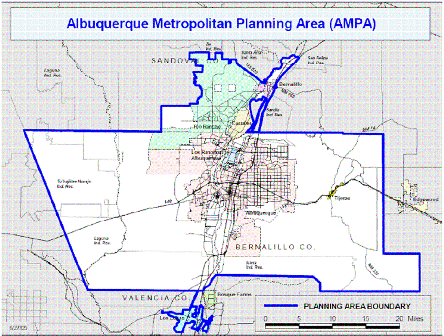
Figure 1: AMPA ITS Architecture Geographic Scope Source: Mid-Region Council of Governments
There is one other ITS architecture that borders on the AMPA Regional ITS Architecture: the New Mexico Statewide ITS Architecture. The regional ITS architecture provides a general expression of systems in the state, while the AMPA architecture provides specific examples of the systems within the AMPA region. For example, the Statewide ITS Architecture describes interfaces to the element Metropolitan Planning Organization/Regional Planning Organization (MPO/RPO) Traffic Database, while the AMPA architecture describes a specific example of this for the region, Mid-Region Council of Governments (MRCOG) Data Warehouse. The Statewide ITS Architecture was developed concurrently with the update of the AMPA architecture and there was significant cross review of the two architectures by stakeholders in both “regions”.
As mentioned in the introduction, the timeframe considered for the AMPA Regional ITS Architecture is a 20-year outlook for ITS activities in the region. This means that the architecture addresses existing ITS systems as well as those planned for development over the next 20 years. The regional ITS architecture represents a snapshot of the currently anticipated ITS and other projects based on information gathered from stakeholders, and research from agency websites or published agency documents. As such, the architecture will require regular updates to ensure that it maintains accurate representation for the region.
The architecture covers services across a broad range of ITS, including traffic management, maintenance and construction operations, incident management, emergency services, transit management, traveler information, archived data management, and electronic payment
Development Process
- The following process steps were used to develop the ITS architecture:
- Conduct a kickoff meeting to present the development process to stakeholders and gather initial information on architecture scope and needs.
- Create an initial architecture update focusing on ITS elements and a draft set of customized ITS Services to be provided.
- Conduct stakeholder outreach through a two-day workshop.
- Create of a complete updated architecture definition for review (Web-based).
- Allow stakeholder review of the draft regional ITS architecture and conduct additional stakeholder review through individual stakeholder interactions and through a one-day architecture review workshop.
- Finalize the ITS architecture based on review comments.
- Develop and deliver a draft Architecture document
- Following comments deliver the final architecture products.
Participating Agencies and Stakeholders
Stakeholder coordination and involvement was one of the key elements for the development of a regional ITS architecture. Because ITS often transcends traditional transportation infrastructure, it was important to consider a range of stakeholders beyond the traditional traffic, transit, and maintenance areas. In addition, it was important to consider stakeholders at a regional level in adjoining regions of the state.
The AMPA Regional ITS Architecture includes a wide range of stakeholders. Many of these stakeholders, along with various other agencies, were present at the stakeholder’s workshops. The following is a list of agencies/participants that were either present during the architecture development workshops and provided their input during those workshops:
- City of Albuquerque
- City of Albuquerque Public Works Department
- City of Albuquerque Transit (ABQRIDE)
- City of Rio Rancho
- Bernalillo County
- Bernalillo County Department of Public Works
- Federal Highway Administration
- Mid-Region Council of Governments (MRCOG)
- New Mexico State Highway and Transportation Department
- URS Greiner
Workshop Process
These workshops were conducted over a period of three days in which stakeholder reviewed relevant parts of the National ITS Architecture, and agencies and private entities were identified and mapped into the sub-systems and/or terminators of the National ITS Architecture. Furthermore these entities were classified as existing (entity already exist), or future (entity will 7 be built in the future). Then the Market Packages services of the National ITS Architecture were reviewed and classified as follow:
- Existing – market package already deployed by AMPA,
- Planned – funds have been program for this market package,
- Future – funds may be program for this market package, or
- Not Used – the service or services by this market package are not related to the needs of the AMPA to merit any consideration.
Once the Market Packages were reviewed, the ones rated as Planned were thoroughly reviewed and modified for the AMPA. These modified market packages were reviewed again in conjunction with the project-oriented flow diagrams by the stakeholders.
A one-day workshop was conducted in Albuquerque on June 6, 2000, with emergency services and incident management agencies to obtain their input for the update Regional ITS Architecture, previously developed in June 1999. Based on this input, the Regional ITS Architecture has been updated to include new information obtained relative to emergency services and incident management.
As before, the final product was developed in accordance with the USDOT Interim Guidance on Conformity with the National ITS Architecture and Standards, and a changes log has been maintained so that the users familiar with the June 1999 version 1 AMPA Regional ITS Architecture can easily identify the changes made for the new version.
Maintaining the Architecture
The AMPA Regional ITS Architecture is not a static set of outputs. It must change as plans change, ITS projects are implemented, and the ITS needs and services evolve in the region. The AMPA Regional ITS Architecture was created as a consensus view of what ITS systems the stakeholders in the state have currently implemented and what systems they plan to implement in the future. The AMPA Regional ITS Architecture will need to be updated to reflect changes resulting from project implementation or resulting from the planning process itself. Types of changes may include:
- Changes for Project Definition – When actually defined, a project may add, subtract or modify elements, interfaces, or information flows from the AMPA Regional ITS Architecture. Because the AMPA Regional ITS Architecture is meant to describe the current (as well as future) regional implementation of ITS, it must be updated to correctly reflect how the developed projects integrate into the state, or specific regions. Also, once projects are implemented, interfaces that were shown in the architecture as planned should now be changed to existing.
- Changes for Project Addition/Deletion – Occasionally a project will be added or deleted through the planning process and some aspects of the AMPA Regional ITS Architecture that are associated with the project may be expanded, changed or removed.
- Changes in Project Priority – Due to funding constraints or other considerations, the planned project sequencing may change. Delaying a project may have a rippleeffect on other projects that depend on it. Raising the priority for a project’s implementation may impact the priority of other projects that are dependent upon it.
- Changes in Regional Needs – Transportation planning is done to address regional needs. Over time these needs can change and the corresponding aspects of the AMPA Regional ITS Architecture that addresses these needs may need to be updated.
- Changes in other Regional/Statewide ITS Architectures – Changes made in New Mexico Statewide ITS Architecture can affect the AMPA Regional ITS Architecture, necessitating changes to maintain consistency between the architectures.
- New Stakeholder – When new stakeholders come to the table, the AMPA Regional ITS Architecture will need be updated to reflect their place in the regional view of ITS elements, interfaces, and information flows.
- Changes or Evolution in ITS Standards applicable to ITS Projects in AMPA – The architecture maps ITS standards to interfaces (and hence to projects). Over time, this mapping will need to be updated as standards release new versions, or as new standards are developed and matured.
Finally, the National ITS Architecture may be expanded and updated from time to time to include new user services or better define how existing elements satisfy the user services. These changes should also be considered as the AMPA Regional ITS Architecture is updated. The National ITS Architecture may have expanded to include a user service that has been discussed in a region, but not been included in the AMPA Regional ITS Architecture, or been included in only a very cursory manner.
Lessons Learned
The major lessons learned in the development of the Regional ITS Architecture for the Albuquerque Metropolitan Area (AMPA) follow:
- Early establishment of interagency relationships is important.
- Education about ITS and regional ITS architecture is needed within agencies to garner critical senior management involvement and support for ITS and regional efforts.
- Federal support, including education and the establishment of standards, has been and continues to be important.
- The National ITS Architecture is a useful tool for guiding the regional ITS architecture process.
- Institutional issues must be considered and respected.
- ITS created a new regionally focused paradigm for transportation planning and operations.
- The total cost for the development of the AMPA Regional ITS Architecture was $72,075.10.