
|
1998 FHWA
|
We aim to continually improve the public's access to activities, goods, and services through preservation, improvement, and expansion of the highway transportation system and enhancement of its operations, efficiency, and intermodal connections.
With more than 6.4 million kilometers of roadways in the United States, our challenge to improve mobility is often fulfilled in the optimizing of existing routes, intermodal connections, and structures. How well we manage congestion and how quickly we build new facilities are key elements involved in providing Americans with all the opportunities that become available when easy access to affordable mobility is a reality. In FY 1998, we made significant progress toward Transportation Secretary Rodney E. Slater's goal to deploy Intelligent Transportation Systems infrastructure across the United States within a decade.
Managing Our Assets |
Managing the Nation's Bridges | Reassessing the Highway
Performance Monitoring System
High-Performance Materials | Sharing Data | Advancing the Deployment
of Integrated ITS Technologies
Stabilizing Earth Walls and Slopes | Measuring the Benefits of ITS Strategies
In 1996, FHWA and AASHTO began an initiative to advance "Asset Management" into the 21st century through a public-private dialogue. By 1998, this initiative grew into a national program that included a series of executive seminars and reports and the formation of an AASHTO Task Force on Asset Management. In 1998, the AASHTO Task Force developed a "Strategic Plan" for Asset Management that was unanimously approved by the AASHTO Board of Directors at its 1998 Annual Meeting. The Strategic Plan comprehensively includes all the major elements that are needed to provide assistance, guidance, training, tools, and the research that States can use to advance Asset Management.

[top]
Bridge management involves bridge inspection, nondestructive evaluation, and the use of bridge management software such as Pontis, Version 3.4, which was released to users in September 1998. Bridge inspection activities are directed toward modernizing the national bridge inventory to make data more easily accessible. A major accomplishment over the last 2 years has been the decrease in the number of deficient bridges reported. Nearly 600 fewer bridges were identified as deficient in FY 1998. Better bridge management makes more effective use of funds in the maintenance, repair, and replacement of a State's bridges.

[top]
As the culmination of the past 2 years' work and with input from a wide-ranging outreach program that included a national workshop of customers, partners, and stakeholders, in FY 1998, FHWA moved ahead to develop a prototype replacement to the existing Highway Performance Monitoring System (HPMS), an important data system that provides measures of infrastructure condition and congestion. Migration of the improved HPMS from a mainframe environment to a PC environment continues; submittal software has been fully deployed and used in production this year by the States; and work continues on development and evaluation and on value-added, customer-access software. Many States have credited the new HPMS software with significant time savings.
This project is an ongoing partnership with States, metropolitan planning organizations (MPO's) and the Association of Metropolitan Planning Organizations, AASHTO, and other providers and customers.
[top]
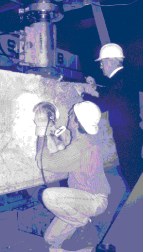
The condition of the Nation's highway bridges can be improved and upgraded through innovative materials research and development. New materials for 21st century applications are being identified, and FHWA, with the support of the States, industry, and academia, has undertaken the work of increasing the understanding and performance characteristics of high-performance materials. These materials, including high-performance steel, high-performance concrete, fiber-reinforced polymer composites, and aluminum, each have outstanding individual properties and surpass traditional materials. In partnership with State departments of transportation, FHWA is currently monitoring 3 high-performance steel projects, 19 high-performance concrete projects, 35 varied fiber-reinforced polymer bridge projects, and 2 aluminum bridge superstructures.

[top]
 Intelligent Transportation Systems (ITS) are providing
a wealth of data, and some ITS can augment or even replace other older data-gathering
systems. The National ITS Architecture is being revised to incorporate the Archived Data
User Service (ADUS), and projects are underway to determine the technical and
institutional issues involved. By archiving ITS data through ADUS, data already being
collected for ITS are made available and are proving useful for various
transportation-related applications, including policy, safety, planning, operations, and
research. Using ITS-generated data for different purposes is not only more efficient and
economical, but it often includes data that would be difficult to gather by other means.
ADUS has the potential to provide data needed for performance monitoring, progress
assessment, policy evaluation, and other transportation activities, including multimodal
and intermodal applications. The steering group for this ongoing project consists of FHWA,
the Federal Transit Administration, the National Highway Traffic Safety Administration
(NHTSA), the Bureau of Transportation Statistics, and the Intelligent Transportation
Society of America (ITS America).
Intelligent Transportation Systems (ITS) are providing
a wealth of data, and some ITS can augment or even replace other older data-gathering
systems. The National ITS Architecture is being revised to incorporate the Archived Data
User Service (ADUS), and projects are underway to determine the technical and
institutional issues involved. By archiving ITS data through ADUS, data already being
collected for ITS are made available and are proving useful for various
transportation-related applications, including policy, safety, planning, operations, and
research. Using ITS-generated data for different purposes is not only more efficient and
economical, but it often includes data that would be difficult to gather by other means.
ADUS has the potential to provide data needed for performance monitoring, progress
assessment, policy evaluation, and other transportation activities, including multimodal
and intermodal applications. The steering group for this ongoing project consists of FHWA,
the Federal Transit Administration, the National Highway Traffic Safety Administration
(NHTSA), the Bureau of Transportation Statistics, and the Intelligent Transportation
Society of America (ITS America).
[top]
Seattle, San Antonio, and Phoenix showcased the successful deployment of multimodal trans-portation and traveler information systems in FY 1998, and the fourth deployment was launched in the New York City metropolitan area on October 5, 1998. These four metropolitan areas were selected to participate in the ITS Model Deployment Initiative to deploy an intelligent transportation infrastructure with nine ITS components. Partnerships of public agencies and private companies deployed integrated, regional transportation management systems that provide improved operations, faster emergency response, better incident management, and up-to-the-minute traffic information for travelers. A rigorous evaluation is underway to document benefits, costs, and lessons.

[top]

Our Engineering Applications area aims to bring about innovations in bridge design and construction by applying R&T advances in design, seismology, corrosion, hydraulics, and geotechnology. A major accomplishment in 1998 was the AASHTO endorsement of the strategic roadmaps for hydraulics and geotechnology. One of the highlights of the geotechnology roadmap is the promotion of two demonstration projects that further ground-reinforcement technology through the use of mechanically stabilized earth and soil nails. Mechanically stabilized earth walls and slopes, which are extremely cost-effective and aesthetically pleasing, combine soil-reinforcing materials made of steel or polymers and an appropriate facing to produce a composite material with improved engineering properties. Soil nailing is a construction technique that strengthens the existing ground (in place) by driving or drilling steel reinforcements for earth-cut applications. Both of these methods are substantially faster and less expensive than other conventional types of earth-retaining systems for both temporary and permanent applications.
[top]
FHWA has developed modeling software to simulate individual vehicles within a real-world roadway environment that consists of freeways and arterial streets. Our CORSIM model provides detailed information that can assist transportation operators, designers, and planners in their evaluation of traffic operational performance measures along roadways. Measuring the benefits of ITS strategies such as ramp metering, high-occupancy-vehicle (HOV) lanes, and advanced controller logic is an important product of the CORSIM simulation.

[top]