
|
1998 FHWA
|
America's highways provide an economic life line for many businesses across the Nation. Road closures and congestion can mean delayed shipments and lost productivity. To eliminate lane closures for routine maintenance and testing, FHWA has fostered the development of a host of diagnostic equipment that can be used at highway speeds while vehicle mounted. These technological breakthroughs not only keep traffic moving, but they employ non-invasive techniques to determine the condition of pavements and highway structures such as bridges and overpasses. As important to transportation as the discovery of the x-ray was to medicine, these nondestructive, non-invasive technologies are truly revolutionary. They are safer, faster, and easier to use, and they provide more accurate and complete information.
Detecting Bridge Flaws at
90 km/h | Measuring the
Load-Carrying Capacity of a Pavement at 90 km/h
Measuring Road Roughness at 120 km/h |
Evaluating Pavement Performance | Simulating the Mechanics of Asphalt
Pavement
Using Computers to Build Better
Pavements | Helping
Lawmakers Assess Existing Truck Size and Weight Laws
Collecting Traffic Data Using
New Technologies | Making Sure You Get
to Work on Time
Using a Highway Decongestant | Keeping Tabs on Our Own Productivity | Maximizing Economic Efficiency
Guiding Program Revisions | Promoting Knowledge-Sharing
and Knowledge Management
HERMES (High-speed Electromagnetic Road-way Mapping and Evaluation System) produces images of the internal structure of reinforced concrete bridge decks and can be towed over a bridge deck at speeds of up to 90 km/h (. For the development of this new ground-penetrating radar technology for bridge deck inspection, FHWA won the coveted "R&D 100 Award," presented annually since 1963 by Research and Development magazine to recognize the 100 most technologically significant inventions worldwide. An earlier prototype, named PERES (Precision Electromagnetic Roadway Evaluation System), produced images at a rate of only 2 meters per hour; therefore, a second system with practical inspection speed was developed.
[top]
FHWA has designed and built a rolling-wheel deflectometer that is capable of deflecting, or bending, a pavement in order to measure the amount of deflection that occurs when the pavement is strained by a heavy load. If there is too much strain, a pavement will crack or show other signs of abuse. Deflection serves as the primary measure of the pavement's structural capacity by helping to determine how much weight a particular pavement can handle at a specific point in its life span. In the past, measurements of this sort necessitated lane closures and meant risking the safety of highway workers performing pavement measurements on one lane of an operating highway carrying traffic. Today's rolling-wheel deflectometer is mounted to a vehicle and travels a roadway at the speed of traffic. There is no risk to workers and no decrease in the traffic-carrying capacity of the highway while the measurements are taken. The rolling-wheel deflectometer is the first of its kind in the world and will soon be brought to a test track to validate its accuracy and precision.

[top]

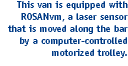
In October 1997, a Cooperative Research And Development Agreement (CRADA) was signed to support the conversion of the research prototype version of the Road Surface Analyzer (ROSAN) into a product available to the highway industry, including the State agencies, contractors, and researchers. ROSAN can measure macrotexture, faulting, grooving, rutting, slope, and road profile at speeds of up to 120 km/h and distances up to about 160 kilometers. After a year of effort, the first phase of product development has been completed, and a sales strategy has been developed. ROSAN is investigating pavement/tire noise associated with pavement texture. In addition, ROSAN has applications in other transportation modes, such as monitoring the surface condition of runways and surveying the track-pentograph-catenary system along the Northeast rail corridor.

[top]
In FY 1998, FHWA's Long Term Pavement Performance (LTPP) program kicked off its second decade with the introduction of DataPave. DataPave is a new software package that presents on an easy-to-use CD-ROM most of the data that LTPP, the largest and most comprehensive pavement study in the world, has collected on pavement performance over the past 11 years. Other LTPP accomplishments in 1998 include: (1) launching a Data Resolution initiative through which the States and Provinces reaffirmed their commitment to LTPP throughout its next decade and pledged to resolve a variety of issues related to missing or questionable data; (2) introducing LTPPBind, a Windows-based software program that provides State and Provincial highway engineers with the ability to apply regional temperature and traffic conditions to select more cost-effective and less restrictive Superpave asphalt binders; (3) developing software that automates AASHTO-approved design procedures for jointed concrete pavements to achieve the best balance between initial construction costs and long-term performance; and (4) disseminating findings to add to the body of knowledge on pavement design, construction, and rehabilitation.

[top]
In the year since the inception of the Simulation Imaging and Mechanics of Asphalt Pavement (SIMAP) program, we have demonstrated that it is possible to get high-resolution, three-dimensional images of asphalt pavements. This makes it possible to qualitatively distinguish between pavements with good and bad resistance to rutting. We are developing mechanistic and computer simulation models, and collaborating with researchers in other countries. These efforts will allow us to engineer and construct more durable asphalt pavements.
[top]
HIPERPAV, a user-friendly computer program, was developed to determine the best combination of pavement design, mix design, construction, and environmental considerations for preventing uncontrolled cracking in new concrete pavements for a given project. The final benefit is greater assurance that the pavement will be constructed without early-age uncontrolled cracking, thus ensuring longer pavement life.
[top]
In FY 1998, FHWA provided staff support for the Department of Transportation's Compre-hensive Truck Size and Weight Study, which will provide a fact-based framework for assessing the Nation's current body of truck size and weight laws. Our efforts included the development of state-of-the-art analytical tools--models and databases--that can be used to evaluate alternative truck size and weight policy proposals. We have applied these tools to five illustrative policy scenarios that were selected by an intermodal departmental oversight group. These scenarios--pavement preservation; bridge protection; geometric requirements; external factors, including safety of the system, environmental quality, energy consumption, and traffic flow; and economic considerations, such as rail competitiveness and shipper costs--were evaluated with respect to their impact on highway agency costs. This project is ongoing and has benefited from an unprecedented level of outreach involving private citizens, public interest groups, and State partners.
[top]
The goal of this technology transfer project is to evaluate the capabilities of a variety of automated non-intrusive vehicle detection technologies in real-world conditions. Non-intrusive data collection devices are defined as those that cause minimal disruption to normal traffic operations. In addition, non-intrusive devices must be able to be deployed more safely than conventional devices. Devices tested in this research fall into several broadly defined categories: passive and active infrared, passive and active magnetic, microwave, sonic and ultrasonic, and assorted approaches using video-capture technology. Phase one of the research emphasized the historical data collection needs of vehicle counts and speed. Based on feedback from the project outreach program, phase two will expand to include vehicle classification, traffic management, and ITS applications.
[top]
In addition to the traveler information systems that provide travel information via pagers, e-mail, handheld PC's, kiosks, the Internet, and cable TV in the four Model Deployment Initiative metropolitan areas, there are similar efforts in less populated areas. For example, the Arizona I-40 Traveler and Tourist Information System and the Branson (Missouri) Travel and Recreational Information Program (TRIP) also initiated service in FY 1998. Both systems provide information to tourists through Highway Advisory Radio, the Internet, kiosks, telephones, or changeable message signs.

[top]
Since keeping roadways free of traffic congestion helps increase national productivity, FHWA developed and implemented prototype traffic control algorithms that respond in real time to changes in traffic patterns, such as those caused by accidents, special events, or rush-hour traffic. Known as Adaptive Control Software, or ACS, this technology was field-tested on a roadway in Northern Virginia where before and after data were collected and analyzed. Our preliminary results have been presented, and three other sites throughout the Nation are scheduled for instrumentation and testing next year.

[top]
Interim guidance was issued implementing the TEA-21 requirement that all ITS projects funded from the Highway Trust Fund conform to the National ITS Architecture and standards. This guidance reflects input received from Federal, State, local, and private sector stakeholders in conjunction with national transportation association forums and 10 outreach sessions held across the Nation last spring. The intent of the interim guidance is to foster integration, encourage incorporation of ITS into the transportation planning process, and focus on near-term projects of regional significance. It is expected to be in effect for 1 year while a final policy is developed through formal rulemaking.

[top]
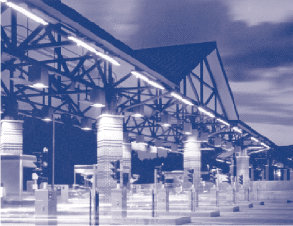

The Surface Transportation Efficiency Analysis Model, or STEAM, is a new software tool created by FHWA. This advanced tool assesses alternative transportation investments and policies to assist transportation decision-makers in selecting the most economic alternatives. Before the development of STEAM, planners could not easily compare economic benefits from alternative modal investments and demand-management strategies when developing their transportation plans, programs, and projects. This new software tool allows the development of monetary impact estimates for a wide range of transportation investments and policies, including major capital projects, pricing, and travel demand management. STEAM also performs risk analysis to clearly describe the level of uncertainty that may be present in STEAM projections.

[top]
FHWA is attempting to help the States achieve optimum productivity in real estate operations. Through our Quality Management Study, we are examining the successful practices applied by the realty services staffs of five States--Florida, Louisiana, Oregon, Pennsylvania, and Wisconsin. By tapping the spectrum of experience represented by these States, we will define how each State has implemented its quality initiatives while integrating organizational restructuring, staff downsizing, or funding priorities. The recommendations of this study will form a guide for other States to use when undertaking similar program revisions.

[top]
FHWA productivity often rests on our ability to deliver transportation technology and know-how so it can be put into immediate practice. To enhance our ability to present information according to the customer's point of view and to enable easy retrieval of information, we have initiated the development of a transportation knowledge network. This knowledge network is intended as a forum for the highway community to share knowledge, as a repository of valuable highway innovation information, as a means of accessing technical and industry developments, and as a resource for training and education. Knowledge-sharing has the potential to speed the delivery of transportation technology to FHWA's customers and partners, as well as to provide access to cumulative expertise on specific topics. Our partners in this ongoing project are the Bureau of Transportation Statistics, AASHTO, the Civil Engineering Research Foundation, and the Transportation Research Board.

[top]