
The Federal Highway Administration’s Office of Freight Management and Operations launched the Electronic National Freight Dialogue in early 2002. This Web-based activity provides a unique opportunity for the transportation community to share ideas, comment on current and emerging freight issues and trends, and identify future needs.
An efficient and effective freight transportation system is essential to U.S. economic growth, productivity, and international competitiveness. It also contributes to national security and our overall quality of life. As demand for freight service grows, increasing pressure will be placed on a transportation system that is already strained in some locations. By the year 2020, freight tonnage is expected to nearly double, with even higher growth rates anticipated in and around key ports of entry, major corridors, and intermodal connectors and hubs. Consequently, understanding and improving freight flows are becoming higher priorities among decisionmakers at all levels of government and in the private sector. Through the Electronic National Freight Dialogue, the Office of Freight Management and Operations will identify opportunities for federal programs to enhance the operations and management of the freight transportation network.
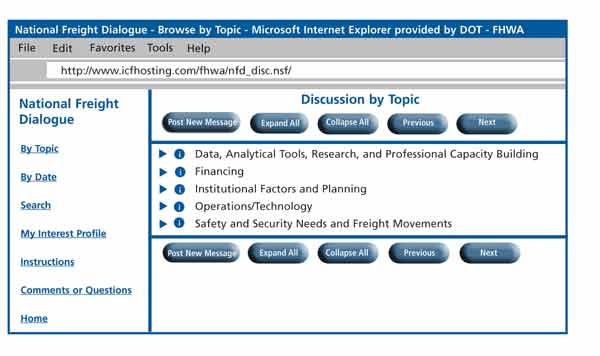
How Do I Find It?http://www.icfhosting.com/fhwa/nfd_disc.nsf/
It’s Simple To UsePosting comments on the Freight E-dialogue is easy—simply visit our Web site and review the questions you find interesting. Just click on any question to participate in the dialogue. Additional instructions are available on the Web site.
To encourage dialogue, the Office of Freight Management and Operations has developed questions on several topics: (1) data, analytical tools, research, and professional capacity building; (2) financing; (3) institutional factors and planning; (4) safety and national security; and (5) operations and technology. (A brief discussion of these topics is included in “Making Good Decisions.”)
You are encouraged to raise additional questions and share ideas that advance the discussion on freight-related issues. We look forward to hearing from you.
Making Good Decisions
Data, Analytical Tools, Research, and
Professional Capacity Building
Decisionmakers need accurate and timely data and analytical tools to better understand the nature of goods movement and to make more informed decisions about freight transportation investments. Data and analytical tools also play an important role in developing professional capacity in the transportation sector. The skill level and educational requirements of transportation jobs are changing dramatically in response to the introduction of advanced technologies, the globalization of trade, and changes in the organizational structure of the transportation industry and how it does business. State and metropolitan planning organizations often don’t have the freight skills and tools to effectively advance freight and intermodal plans and projects.
FinancingThe lack of dedicated funding, limited resources, low priority in the programming process, and eligibility issues regarding the use of public funding to support private sector interests are among the many reasons freight projects may be difficult to advance. Another problem with current financing is that it tends to focus on a single mode, rather than on the increasingly intermodal nature of many freight projects. Furthermore, public/private partnerships are often challenging to build.
Institutional Factors and PlanningThe degree to which freight is considered in the transportation planning and programming process ranges from being fully integrated, with substantial freight transportation projects prioritized and funded, to minimal consideration of freight, if at all. Typically, though, freight in the public arena is a minor constituency relative to passenger and other transportation interests. In addition, the relatively long public planning and project development time horizons make it difficult to formulate private/public partnerships to move freight projects forward, limit multijurisdictional solutions to freight-related problems, and hamper local responses to addressing immediate concerns.
Operations and TechnologyMore efficient operations are crucial to optimizing national freight performance; improving safety and security; expanding system capacity; and reducing collateral damage to natural resources, neighborhoods, and people. The need to improve operations comes not only from the growth in freight transportation but also from the demand for new logistical arrangements and for smaller, more frequent shipments where reliability and predictability are important. Technology can play a key role in improving the productivity and security of the freight transportation system.
Safety and Security Needs and Freight MovementsRecent terrorist attacks have heightened concerns about the vulnerability of the transportation system and the use of transportation assets to carry out attacks. The U.S. Department of Transportation places a high priority on transportation safety and security. Because of its accessibility and extent, the freight transportation system presents many security challenges. On the freight side, government responses to terrorism may include increased inspections of both international and domestic shipments, placing greater controls on shipments of certain commodities, and examining shipper business practices.
For More Information, Please Contact
Bruce Lambert
Transportation Specialist
Office of Freight Management and Operations
Federal Highway Administration
(202) 366-4241
bruce.lambert@fhwa.dot.gov