Case
Study Evaluation of the
Virginia
Department of Transportation’s
I-81
ITS Program
 |
Prepared
by Stephanie Baker
Virginia
Tech Transportation Institute
March 15, 2002
PDF
Version 355KB
Case
Study Evaluation of the
Virginia
Department of Transportation’s
I-81
ITS Program
|
Prepared
by Stephanie Baker
Virginia
Tech Transportation Institute
March 15, 2002
PDF
Version 355KB
This past September the people involved in
this Program lost a dear colleague, mentor, and friend, Dr. Richard Worrall, to
cancer. He was an intelligent, creative, and energetic man, always ready to help
and to challenge those around him to succeed. He is greatly missed by those who
knew him and came to appreciate how much he shared his life with
others.
The primary goal of this report is to provide information to the Sponsors, Policy Committee, and Management of the I-81 ITS Program that may improve the Program. In order to do this, the report focuses on the development of the Program and the lessons learned. Through lessons learned, recommendations are made about how the Program can be improved.
The evaluation covers the period from November 1999 through September 2001. The period of performance for the conduct and writing of the evaluation was September 2001 through March 2002.
A case study approach
was used for this evaluation. The major issues were explored through a
combination of document analysis and targeted interviews. The document analysis and interviews
focused on discovering information about several key issues of the Program
including:
·
Historical
development
·
Goals and
objectives
·
Organizational
structure
·
Program management
·
Critical
resources
·
Desired
outcomes
·
Program barriers and
successes
By covering all of these
issues in the document analysis and interviews, the intent was to come to an
understanding of how the Program is developing and make recommendations about
how to improve the Program.
Several sources were reviewed in the document analysis including:
The analysis looked at these and other documents for insight into the issue areas mentioned above. For example, the analysis of VTTI’s proposal provided information about the management structure established through the contracts VDOT set up with VTTI, and the Committee Contacts provided a list of the stakeholders who were invited to take part in the Program.
In order to understand the development of the Program and to make recommendations, it was critical to involve key stakeholders in the evaluation. These stakeholders included the Program Sponsor, the Program Manager, a Policy Committee Member, and Program Participants. In-depth interviews were conducted in order to capture the perspective of these participants. The interviews covered each of the issue areas underlined above. Interviews were divided into individual and group sessions based on who was being interviewed.
The interviews were a
success because participants were honest and open and had a genuine concern that
the information they provided be used to improve the Program. One participant
from Bristol specifically requested that his comments be used only to make the
Program a success, not used to tear it down. As the evaluator, I hope that this
report is a reflection of that request.
The report is broken
down into three major sections: Program Background, the Process for Establishing
the I-81 ITS Program, and the Barriers and Recommendations. Below is a brief
description of each section.
Section I: Program Background
The I-81 ITS Program was
officially started in June 2000 although discussions about the need for such a
program began in November 1999. This section of the report describes the origins
of the Program and other ITS efforts on the I-81 Corridor that influenced its
development.
Section II: Process Establishing the I-81 ITS
Program
The process establishing the I-81 ITS Program is documented in this report in basically chronological order from the time the Program was conceived in the autumn of 1999, through when this evaluation began in September 2001. Although steps overlap, the general order in which they occurred is described in Section II. Below is a list of the steps:
2. Strategic Planning
3. Asserting Leadership
4. Selecting a Management Team
5. Involving Stakeholders
6. Securing Funding
7. Evaluating Progress
Section III: Barriers and Recommendations
The final section of this
report covers the major barriers identified in this evaluation for which
recommendations are being made. Each barrier is described in detail in the
follow paragraphs.
Barrier 1: Unclear Organizational
Structure
The first barrier identified
was the unclear organizational structure of the Program. The barrier was a
problem in both the first and second year of the Program, but for different
reasons. The first year’s organizational struggles were due to a complex
structure that required too much time of participants to maintain.
Organizational struggles in the second year were due to a lack of communication
with participants about changes in the Program.
Barrier 2: Unclear Leadership &
Direction
The second barrier identified
was the perception that there was an absence of clear leadership and direction
for the Program. Participants in the second year of the Program were unsure
where the Program was heading and who was in charge. This barrier was linked to
a combination of delays in program funding, changes in management, and
organizational restructuring. Leadership and direction were not necessarily
lost; participants were just not informed about what was happening.
Barrier
3: Lack of
Communication
The organizational problems currently facing the Program can be addressed if the Functional Area organizational structure approved by the Policy Committee is implemented fully and communicated clearly to participants.
Recommendation 2: Hold Planning
Sessions
The current perception among program participants that leadership and direction are unclear can be addressed if a series of planning sessions are held with the Policy Committee and Functional Area Chairs to bring participants up to speed about what is happening and firmly establish the vision and organizational structure of the Program.
Recommendation 3: Hire a Full-Time I-81 ITS Program
Coordinator
All of the barriers
mentioned that are currently facing the Program can be alleviated if VDOT hires
a full-time I-81 ITS Program Coordinator who is responsible and accountable for
ensuring communication remains a priority.
The barriers and
recommendations are the heart of the evaluation because they indicate how the
I-81 ITS Program may move forward in a positive and productive manner.
The I-81 ITS Program has
been evolving for over three years. What is contained in this report is an
overview of what has occurred and recommendations for the future of the
Program. For this report to become
meaningful, next steps need to be developed from this document by the I-81 ITS
Policy Committee and the VDOT ITS Division.
Throughout this report
numerous organizations are discussed as well as technologies. Many of these
organizations and technologies have acronyms assigned to them. Below is a list
of all those that appear in this report.
Advanced Traveler
Information Service
ATIS
Commercial Vehicle
Operations
CVO
Concept of
Operations
COO
Intelligent
Transportation Systems
ITS
Parsons B Farradyne
PBF
Principle
Engineering
PE
Six-Year Improvement
Plan
SYIP
Now
called the Transportation Development Plan (TDP)
Traffic Engineering
TE
Transportation
Development Plan
TDP
University of
Virginia
UVA
Virginia Department of
Motor Vehicles
DMV
Virginia Department of
Transportation
VDOT
Virginia State
Police
VSP
Virginia Transportation
Research Council
VTRC
Virginia Tech
Transportation Institute
VTTI
Table of
Contents
Executive
Summary.......................................................................................................................................................................
i
Acronyms...........................................................................................................................................................................................
v
Section I: Program Background......................................................................................................................................
1
Origins..............................................................................................................................................................................................
1
ITS Environment.........................................................................................................................................................................
1
Section II: Process Establishing the I-81 ITS
Program.......................................................................................
3
Step 1: Responding to Environmental
Influences................................................................................................
4
Step 2: Strategic Planning..................................................................................................................................................
5
Step 3: Asserting Leadership..............................................................................................................................................
7
Step 4: Selecting a Management Team.......................................................................................................................
8
Step 5: Involving Stakeholders.....................................................................................................................................
11
Step 6: Securing Funding.....................................................................................................................................................
15
Step 7: Evaluating Progress............................................................................................................................................
17
Section III: Barriers
and Recommendations...........................................................................................................
21
Barrier 1: Unclear Organizational Structure.................................................................................................
21
Recommendation 1: Clearly Define and Implement Functional
Area Structure.......................
22
Barrier 2: Unclear Leadership & Direction............................................................................................................
25
Recommendation 2: Hold Planning Sessions........................................................................................................
26
Barrier 3: Lack of Communication.............................................................................................................................
27
Recommendation 3: Hire a Full-Time I-81 ITS Program
Coordinator.....................................................
27
Appendix A: Interview Instruments and Group Entrance
Survey............................................................
30
Appendix B: Interviewee List & Logistics..................................................................................................................
34
Appendix C: Policy and Technical Committee Invite
Lists............................................................................
35
Appendix D: Nine-Step Project Development
Process......................................................................................
38
Appendix E: I-81 ITS Program Work Plan....................................................................................................................
39
Appendix F: Standing Technical Working Group
Charges............................................................................
40
Appendix G: Status Report FY 2002 I-81 ITS Program
Funding........................................................................
42
References......................................................................................................................................................................................
44
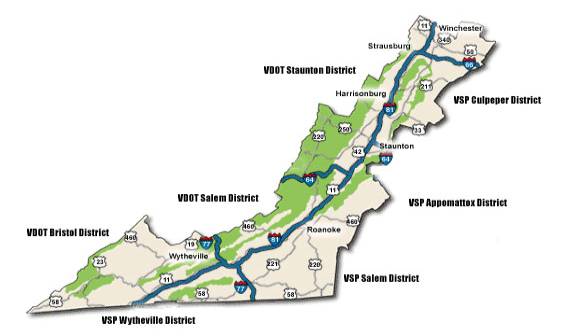
The I-81 ITS Program is a
framework for on-going coordination, planning, design, and implementation of ITS
investments along the 325-mile length of the I-81 Corridor in Virginia. Numerous
stakeholders are involved in the Program including the Virginia Department of
Transportation (VDOT), who sponsors the Program, the Virginia State Police
(VSP), the Department of Motor Vehicles (DMV), the Virginia Tech Transportation
Institute (VTTI), and ITS Consultants working on the Corridor. The Program
officially kicked off in June of 2000, although discussions about the need for
the Program began much earlier.
The Program traces its roots
to a meeting in Salem, Virginia on November 15, 1999. The meeting involved
senior representatives from the VDOT Staunton, Salem, and Bristol Districts,
along with staff from the VDOT Central Office. The meeting focused on the need for
efficient and effective planning and implementation of ITS investments in the
I-81 Corridor. Staff members from VTTI were present at this meeting to
facilitate the discussions.
Over the period from
November 1999 to March 2000, the objectives for the Program were refined and
recommendations were made by VDOT on how the Program should be carried out. One
recommendation was that VTTI should submit a proposal to manage the
Program. In June 2000, the proposal
was accepted and work began on the I-81 ITS Program.
The I-81 ITS Program is
unique in its focus on planning and implementing ITS in a rural corridor through
coordination and cooperation across districts, agencies, and sectors. Yet, the I-81 ITS Program is not the
first such cooperative and coordinated ITS effort along the I-81 Corridor. I-81, particularly along the Northern
Shenandoah Valley, has been a test bed for rural ITS development and investment.
Some examples of ITS planning and investments along I-81 include the VTTI’s
Travel Shenandoah Project, the University of Virginia Health Sciences Center’s
Pegasus Real Time Video Project, and the Staunton District’s Concept of
Operations.
 Travel Shenandoah
Travel Shenandoah is an
integrated traveler information service, providing comprehensive, timely, and
accurate information on traffic and travel conditions, traveler services,
tourist destinations, and emergency services to travelers. Data for the system
comes from two main sources: the Virginia State Police’s Computer Aided Dispatch
(CAD) system and VDOT’s Virginia Operational Information System (VOIS). The
delivery mechanisms for this information include the World Wide Web, cellular
phones, PCS/digital wireless phones, and cable TV. The Travel Shenandoah logo is shown on
the right.
Over three years in development, Travel Shenandoah has been structured as a public-private partnership including, among others, VDOT, VTTI, SHENTEL Service Company and its affiliates (providing telephone, cable, wireless, internet and pager services), VSP, the Virginia Tourism Corporation (VTC), the Northern Shenandoah Valley Regional Commission, the Shenandoah National Park, and the Shenandoah Valley Travel Association (SVTA). Travel Shenandoah went live in April of 2000, and was formally introduced to the public in late July 2000. The system is currently undergoing a name change to 511Virginia.org in order to capture the benefits of the system’s connection to Virginia’s new traveler information number, 511.
The Travel Shenandoah Service was significant to the development of the I-81 ITS Program because, as one participant from the I-81 ITS Program stated, “Travel Shenandoah has had an enormous impact on this corridor and planning for this corridor. Travel Shenandoah is a public-private partnership, and more so than just in name or in spirit. It is the basis for attempting to provide traveler information along this corridor, and to the extent that that model has been relatively successful to date, it is influencing the decisions being made about how to partner with the medical community and private providers of technology in this whole public safety arena.” In essence, Travel Shenandoah has helped lay the groundwork for the development of public-private partnerships and the use of advanced technologies to address issues such as traveler information along I-81.
An offshoot of Travel Shenandoah, funded through an FHWA earmark, was the Truck Fleet Alert and Support Service project. The service, under development since 1999, was created as a way to serve a specific segment of the traveling public with information from Travel Shenandoah. While much of the Travel Shenandoah information is useful for commercial vehicle operations, the Truck Fleet Support program has been designed specifically for commercial vehicle operators traveling on I-81. By taking the Truck Fleet project under the I-81 ITS Program umbrella, the Program gained the interest of a critical stakeholder group in the Corridor, commercial vehicle operators, and associations who support their work.
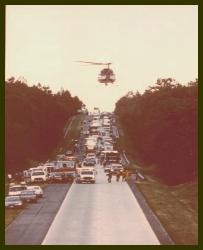
The Pegasus Real Time Video
Project (image to the right) is
investigating the feasibility of providing real-time video from local rescue
squads to the UVA Health Science Center’s Pegasus Medivac Helicopter. Local
rescue squads from the I-81 Corridor between Lexington and Harrisonburg are
being selected to participate in this project, which uses ITS to improve
emergency response on I-81 (Cross, 2001).
This project, started prior to the I-81 ITS Program, was placed under the
umbrella of the Program through the I-81 ITS Public Safety Working Group. This
was done so that it could receive the financial and stakeholder support the
I-81 ITS Program offers ITS innovators.
The Staunton Concept of Operations was a report developed in the autumn of 2000, which set forth a formal plan to fully realize the benefits of ITS in the Staunton District. The report, written by PB Farradyne, was undertaken to ensure that the District’s ITS Program had a clear direction and to support the procurement of devices and software that are of value to VDOT. The concept of operations identifies ‘who, what, when, and how’ of ITS operations in the District (PB Farradyne and Iteris, 2001).
This effort was important to the development of the I-81 ITS Program in that, through the Program, a Corridor Concept of Operations (COO) is being developed and is linked to the development of COOs in each District. Staunton was the first to develop a COO, but through the I-81 ITS Program each District is developing its own. The hope is that if these Concepts are created through the Program and linked to a Corridor COO, that ITS will serve not only the needs of each District but will be coordinated across the Corridor to provide a seamless service to the public. These COOs are an example of the type of cooperation and coordination that the I-81 ITS Program is trying to encourage and support.
The I-81 ITS Program also
falls under the umbrella of VDOT’s Smart Travel Program, which focuses on the
effective integration of ITS technologies into all aspects of its highway
construction, operation, and maintenance programs. VDOT’s ITS Division in Richmond has
played a key role in ITS development in the I-81 Corridor. VDOT has invested
time and funding into numerous projects including those mentioned above and the
I-81 ITS Program itself. This
provision of seed resources for the development and implementation of ITS on
I-81 has been critical to the projects successes and is likely to continue to be
important until ITS is an accepted and established part of VDOT’s Transportation
Planning Process.
The atmosphere of interest
and investment in ITS products and services, particularly those that improve
public safety and traveler information, has supported innovative technology
solutions to problems on I-81 and facilitated the development of the I-81 ITS
Program. The next section provides
a step-by-step analysis of how the Program was initiated, developed, and
evaluated.
The process establishing this I-81 ITS Program is documented below in basically chronological order from the time the Program was conceived in the autumn of 1999, through when this evaluation began in September 2001. Although steps overlap, this is the general order in which they occurred.
These steps were identified through the literature review, key document analysis, and the transcript analysis. After the steps are a short-list of barriers faced and recommendations for how to overcome them. Below is a list of the steps identified through the analysis.
Steps in the I-81 ITS Program Development Process:
2. Strategic Planning
3. Asserting Leadership
4. Selecting a Management Team
5. Involving Stakeholders
6. Securing Funding
7. Evaluating Progress
Throughout the discussion of the steps, applicable literature is cited as well as input from the individual and group interviews. Whenever a quote from an interview is noted, it will reference either the individual person interviewed or the site where the group interview took place. For example, (M) signifies a quote from the interview with the Program Manager and (SM) signifies a quote from the group interview in Salem. The codes listed below are used throughout the report.
Individual Interview:
Group Interview:
A complete list of who was at each of these interviews, both group and individual, is noted in Appendix B.
In the autumn of 1999, several circumstances came together that made the I-81 ITS Program ripe for creation. These circumstances were both internal to VDOT and within VDOT’s external environment. Some of these circumstances included:
These circumstances became triggers for possible changes in the way VDOT does business on the I-81 Corridor in general and in relation to ITS specifically. The I-81 ITS Program was, in many ways, a response to these internal and external triggers that demanded change.
The interviews support this idea that internal and external triggers were opening the door for such a Program on I-81. For example, public perception about I-81 being a hazard was a major reason for exploring ways to show the public that VDOT was making an effort to improve their travel.
“External influences, the
problems on the corridor (i.e. tractor trailer accidents, bad press) led people
to start thinking along the same lines, the problems led to concern and action.”
(R)
“All of the publicity about
unsafe I-81, there was a lot of negative publicity.”
(S)
“There was significant
sentiment in the communities along I-81 that the roadway was unsafe.”
(M)
Reconstruction was mentioned in the interviews as an issue in that ITS is often an afterthought instead of being integrated into the construction process. It was time for some effort, such as the I-81 ITS Program, to look at how technology could be integrated into the planning process before reconstruction is underway in earnest along the entire corridor. It was also a good time to consider how technology could improve public perception and the reconstruction process by providing such things as enhanced traveler information and coordinated incident response.
“81 reconstruction
legitimately gave us the opportunity to propose doing it (I-81 ITS Program).”
(S)
Organizational behavior literature shows that organizations do not change unless there are triggers, such as those mentioned above, indicating change is needed. However, not all trigger events lead to organizational change. In many cases, there is organizational and individual resistance to change in technical, political, and cultural systems (Tichy and Ulrich, 1984). Individual and organizational resistance to change in these three systems must be overcome if meaningful and lasting change is to occur.
Overcoming resistance to change requires
transformational leadership, not managers who are in search of a quick fix
solution. Transformational leaders need to avoid “the trap of simple, quick-fix
solutions to major organizational problems” (Tichy and Ulrich, 1984). Fortunately in this case, organizational leaders in
VDOT did respond to the triggers and initiated a lasting change at a strategic
planning session held in Salem, Virginia in November of 1999.
A strategic planning session
was held at the Salem Civic Center in November 1999 that focused on the need for
efficient and effective planning and implementation of ITS investments along the
I-81 Corridor. These discussions led to the creation of the I-81 ITS Program.
At the meeting in November,
a charge was crafted for the I-81 ITS Program along with an organizational
structure and a list of roles and responsibilities. The structure and charge
outlined by the Founders of the Program was critical to this Program getting off
the ground. Below is a summary of that meeting, highlighted in green, and the
resulting recommendations that were approved by the VDOT Executive Team.
Summary of
Strategic Planning Session
A one-day I-81 ITS Planning
Meeting was held at the Salem Civic Center on Tuesday, November 30, 1999
involving representatives of the VDOT Staunton, Salem, and Bristol Districts and
staff from the VDOT Central Office. The Virginia Tech Transportation Institute
(VTI) provided technical and facilitation support for the
meeting.
Gary Allen, representing the Assistant Commissioner for Planning, Research and Technology, Director of the ITS Division J. R. Robinson, and District Administrators Dennis Morrison, Fred Altizer, and Dan Marston met on December 14 to review the recommendations from that meeting. That review and discussion resulted in the consensus that the following recommendations should be presented to the VDOT Executive Team.
Gary Allen presented the
proposal to the Executive Team in February 2000, and the recommendation was
adopted with minor modifications.
Next
Steps
A two-tier organizational
structure will be established to oversee the ongoing and future ITS investment
in the I-81 Corridor. That investment program should be fully integrated with
all other VDOT activities in the Corridor. The two-tier organizational structure
will include:
·
A senior I-81 ITS Leadership
and Oversight Team to set overall policy and approve specific ITS investments,
and
·
An I-81 ITS Technical
Planning and Implementation Team, reporting to the senior team, to coordinate
detailed ITS planning, design, construction, operation, and maintenance within
the Corridor.
The I-81 ITS Leadership and
Oversight Team will be staffed by the ITS Division and
include:
·
Chair, Assistant
Commissioner for Technology and Research
·
Staunton, Salem and Bristol
VDOT District Administrators
·
VDOT Chief Engineer
·
VDOT Assistant Commissioner
for Operations
·
VDOT Assistant Commissioner
for Finance
·
VA State Police Director
Bureau of Field Operations
The Leadership and Oversight Team will meet as necessary to set overall policy, oversee the work of the Technical Planning and Implementation Team, review specific proposals, and approve funding priorities. The I-81 ITS Technical Planning and Implementation Team will include:
·
ITS
Division
·
Designated representation
from each District
·
Traffic Engineering Division
- TMS Design
·
Location and Design
Division
·
Maintenance Division -
Special Operations and TEOC
·
Transportation Planning
Division
·
Research
Council
·
Programming and Scheduling
Division
·
Financial Planning and Debt
Management Division
·
Lt. or 1st Sgt.
from each of the appropriate State Police Divisions
The Technical Planning and
Implementation Team will meet monthly. VTTI will serve as the facilitator and
staff for this group. Funding for this support will come initially from the
existing ITS PE SYIP projects and ITS Research Implementation Center
funds.
Additional working groups
will be assembled to undertake specific tasks. Each such group will include at least
one member of the Technical Planning and Implementation Team plus others as
appropriate.
Prior to the first Oversight
and Leadership Committee meeting in the Fall 2000, the Technical Planning and
Implementation Team is charged with:
·
Developing an overall vision
and strategy for ITS investment in the Corridor,
·
Preparing a recommended
short-term action plan and set of projects for inclusion in VDOT’s Year 2002
budget cycle,
·
Developing a “return on
investment” analysis for ITS investments
·
Developing a wireless
resource sharing plan for the corridor
· Identifying necessary implementation and policy actions (Robinson, 2000).
The Founders’ structure and
charge were detailed in the management proposal VTTI presented to VDOT in June
2000. Although the structure did
change over time the important thing to note is that VDOT’s leadership did
respond to the triggers for change in its environment in a meaningful way, not
with a quick-fix solution. While responding to the triggers for change in this
manner was a positive step, the Program may have ended there if not for the
transformational leadership of the VDOT ITS Division head, Mr. J.R. Robinson,
and the I-81 ITS Policy Committee members who made a commitment to support the
Program.
The response from VDOT’s
leadership to the call for change on I-81 through the planning strategic session
in Salem was critical to the I-81 ITS Program getting off the ground. Yet the
structure and charge would not have become a reality had it not been for the
leadership of Mr. Robinson and the I-81 ITS Policy Committee members, who
carried it forward and made sure it was implemented.
Transformational leaders are
distinguished by the ability to bring about change, innovation, and
entrepreneurship. Such leaders motivate followers to not just follow them
personally but to recognize the need for change, to sign on for the new vision,
and to help institutionalize a new organizational process (Daft,
1995).
Mr. Robinson and the Policy Committee members acted as leaders by having a vision, mobilizing commitment, and institutionalizing change. During the individual and group interviews, it became very apparent that Mr. Robinson and the Policy Committee were recognized as leaders of ITS in Virginia and this I-81 ITS Program. Below is a description of the steps associated with transformational leadership and the participants’ thoughts on how these steps were carried out.
A transformational leader provides the organization with a “vision of a desired future state. While this task may be shared with other members of the organization, the vision remains the core responsibility of the transformational leader. The long-term challenge to organizational revitalization is not ‘how’ the visions are created, but the extent to which the visions correctly respond to environmental pressures and transitions within the organization” (Tichy and Ulrich, 1984).
“I liked the Policy
Committee idea, that there was a group overall that led the direction.”
(V)
“JR has the big picture.”
(ST)
“JR thinks outside the box
and it is absolutely wonderful to have that ability. There needs to be more of
that in the department, more independent thought needs to be promoted.”
(SM)
The vision for ITS is based on the Founders’ charge and can be broken into two parts. The first is to integrate ITS vertically into VDOT’s planning process so that ITS is considered a part of the process instead of an added, or altogether separate, part. The second is to coordinate ITS planning and investment horizontally across agencies, departments, divisions, and districts so that travelers on a corridor such as I-81 experience seamless service, and divisions and agencies can utilize resources effectively. This vision is simple yet bold considering the inter-agency and intra-agency institutional issues confronting Mr. Robinson and the Policy Committee. This vision would have remained merely an idea if these leaders had not made the effort to mobilize commitment at the state and district levels.
A transformational leader is one who is able to win acceptance of a vision from at least a few key players and they begin to make it happen. The process of developing commitment and support requires a great deal of dialogue and exchange (Tichy and Ulrich, 1984). Mr. Robinson and the Policy Committee members championed the vision for the Program in their various realms of influence and thus mobilized support for the Program. The commitment the Program had from upper management (i.e. VDOT Executive Team and the Policy Committee) was critical because it opened the door for involvement from mid-level personnel in each represented organization (i.e. VDOT, VSP, DMV).
Mobilizing
Commitment
“We had tremendous
leadership from the Policy Committee.” (M)
“Through the Policy
Committee we had upper management support. I don’t think very much would have
come out of this without their support.
We have been trying to do this off and on in different parts of the state
before, and what we were missing was this recognition and participation by upper
management.” (S)
“You need to have someone
that is going to be champion in your district and within the department. If you
don’t have that than it is not going to happen. JR has been a champion. Without
JR we wouldn’t be where we are today.” (P)
“JR was integral. He got
people there and made the meeting credible.” (V)
“JR helped us get to where
we are with ITS” (SM)
“JR was
the champion within VDOT to get the third floor of VDOT interested.”
(R)
“JR did a lot of outreach on
what the program objectives would be and what was needed.”
(R)
After transformational
leaders create a vision and mobilize commitment, they must next determine how to
institutionalize the vision.
Organizations will not change
unless new patterns of behavior within the organization are adopted.
Transformational leaders must “transmit their vision into reality, their mission
into action, their philosophy into practice. Alterations in communication,
decision-making, and problem-solving systems are tools through which transitions
are shared so that visions become reality” (Tichy and Ulrich, 1984).
The I-81 ITS Program is bringing about changes by altering communication and decision-making processes. For example, change is being accomplished when people are brought together from different agencies, districts, and divisions to work on problems of joint concern through the creation of projects. The I-81 ITS Program is potentially a vehicle for making the Program vision a reality if support for the Program continues and these changes become institutionalized.
The Founders of the Program recommended that a Leadership and Oversight Team, later called the Policy Committee, be created as part of the original structure along with a Technical Planning and Implementation Team, later called the Technical Committee. VTTI was to serve as facilitator and staff for the Technical Committee; however, the role of facilitator and staff developed into Program Management when VTTI was given the contract to run the I-81 ITS Program.
VTTI’s role evolved into Program Management for several reasons beyond the obvious fact that they were awarded the contract to do so by VDOT. The first reason is that the late Dr. Richard Worrall, one of the individuals at the original meeting in November 1999, was working for VTTI and was prepared for VTTI to take on Program Management responsibility. Dr. Worrall had in-depth knowledge and experience in running this type of complex Program and readily stepped up to the management plate. As one participant said, “he was the glue that held the Program together.”
It is also likely that the management function was increased in preparation for the proposed monthly meetings of the Technical Committee and Working Groups. These Working Groups were created to deal with high priority issues such as safety, commercial vehicle operations, incident management, construction, and traveler information. Most of these critical areas were turned into Working Groups under the Technical Committee and were managed by VTTI.
Dr. Worrall’s interest and capabilities and the work necessary to manage multiple groups led to the creation of a strong management function. VTTI managed from June 2000 to June 2001 with Dr. Worrall as the Program Chair and Stephanie Baker as administrative support and facilitator. Wayne Spaulding of PB Farradyne was hired to sub-contract with VTTI, and served as Program Manager.
Management took responsibility for organizing participants, developing work plans, and managing project proposals. In the first year, the Program Manager and Assistant spent a good deal of time making sure these tasks were covered and participants recognized the importance of this support.
Administrative
Support
“I would recommend to others
having a Program management function with administrative support to have things
lined up. We had similar meetings on 81 that didn’t go anywhere because there
was not any way to follow up on what came out of the meetings and so you just
had a meeting and then a year later you’d have the same meeting and do the same
things. If there is nobody to do the work then nothing happens because everybody
is too busy.” (S)
“VTTI’s Administrative
Function coordinated management of the proposal process.”
(V)
“(Program Assistant)
informed us about what was going on.” (ST)
“Background work was very valuable
(prepared minutes, made ideas concise & simple).”
(SM)
One participant said it was useful for him to get out of his district office onto neutral territory at the VTTI facility and to have a facilitator who did not work for VDOT guiding the discussion. These two factors, the neutral territory and the use of a facilitator, created a more level playing field on which participants could discuss their project ideas.
Facilitation
“The facilitator was a
catalyst to all of the communication. That is what isn’t there now. The
facilitator made the process flow.” (V)
“The facilitator is a third
party capable of communicating with all of the stakeholders.”
(V)
“Having a facilitating party
is important. VTTI worked just fine. In other states, if they have a similar
institution near-by they should use it. The facilitator doesn’t need to be a
technical person, just someone who is able to draw ideas out of people.”
(SM)
“The facilitator helps a
meeting because it takes someone who is passionate about a subject out of
control of the meeting.” (B)
“Facilitators are beneficial
because they make a summary of the meeting, that is helpful especially when we
lack of manpower and resources. Having the facilitator serve also as staff is
very beneficial because they make sure everyone is fed back information and is
clear as to what went on.” (B)
In June 2001, Mr. Spaulding and PB Farradyne took control of overall management, and VTTI was no longer responsible for staffing functions. The decision to change the management team was made by the VDOT ITS Division when the Program Chair, Dr. Worrall, informed VDOT that he needed to reduce his time commitment to the Program. Mr. Spaulding had been the Program Manager for close to a year and was ready and willing to continue in his management role.
This change in management coincided with VDOT’s yearly submission of requests for funding which included the I-81 ITS Program and its projects. Typically funding requests are submitted in May and approved in July as part of the Transportation Development Plan (TDP). In this case, the funding was not approved until December 2001. This situation caused a six-month delay in the funding process for the Program’s projects and strained the resources available for managing the program.
Because the management change and funding delay occurred simultaneously, the Program Chair role and much of the administrative support and facilitation could not be replaced. As Mr. Spaulding commented, “the chaos in funding stole our momentum.” Participants noticed the change from a team management structure to only a Program Manager, although they may not have been aware that it was largely due to the funding delays. They believe the team approach is important to re-institute.
Management
Team
“The Overall Program
Management Team has to be full-time plus, my understanding is that it is
part-time at best and there are too many things not being addressed. Work Groups
can be part-time, not Program management.” (R)
Another issue that came to the forefront in the analysis of management was the absence of a full-time VDOT manager. Mr. Robinson had other responsibilities and could not devote a consistent and substantial portion of his time to the Program. As a result the management team was, over time, a combination of VTTI and PBF personnel working under contract. This was a fragile management situation because when funding problems arose, contract management tasks were limited. While it was appropriate for VDOT to contract certain tasks such as facilitation, it is not recommended that it contract out overall management in the future.
It is up to the Policy Committee and those who will decide
where the Program goes from here what type of function will be put in place to
manage and coordinate the Program. In the next section of this report on
barriers and recommendations, a suggestion is made concerning this issue.
Stakeholder involvement is key to the I-81 ITS Program. Participants were drawn from the districts, divisions, and agencies dealing with issues on I-81 including, among others: VDOT Bristol, Salem, and Staunton Districts, VDOT Central Office, VSP, the DMV, and various ITS consultants working on I-81. A list of these stakeholders can be found in Appendix C.
A great deal of preparation went into the Policy Committee, Technical Committee, and Working Group meetings to ensure that stakeholders were involved. All participants were contacted either by e-mail or via phone prior to meetings. If key players could not attend a meeting, management and sponsors decided whether the meeting should be rescheduled. Participants noted that involving key stakeholders was one of the strengths of the Program.
Stakeholder
Participation
“We had participation from
key people, but if your key people can’t come to the meetings don’t keep your
process going because you are not accomplishing anything. We changed meeting
dates and we worked around it to make sure that the key people were there. There
is a mistake people make, if the key people can’t participate they just keep
going. Well you don’t accomplish anything if you do that. We started with a
basic list and then we made sure they were available before we committed to
anything. Then once we had them we invited everyone else and they came it they
could.” (S)
“It is valuable to have
everyone in one place, the big meetings may not have been productive in terms of
getting a project statement written, but it gave us an opportunity to find out
what was going on.” (V)
“When we held regular
meetings with all of Work Groups it was good. We had the big group together and
broke off into Work Groups and you would come back together and share what you
had done and everyone would hear it. There used to be meetings where everyone
showed up.” (SM)
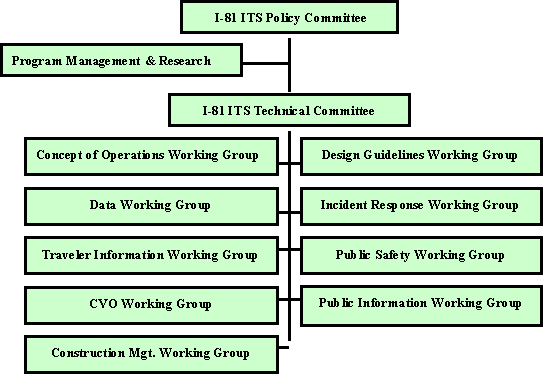
The organizational structure through which participants were involved has changed over time. During the first year, there were nine Working Groups, a Technical Committee, which was the sum of the Working Groups, and a Policy Committee. This structure served the Program well in its first year because it enabled the generation of project ideas for all of the critical areas identified by the Founders of the Program. The organizational chart used through the first year of the Program is shown on the next page.
First Year
Organizational Structure
 |
The kick-off meeting for the I-81 ITS Program took place in May 2000. During the first meeting, most of the Working Groups were formed, although several including Public Safety and Construction Management were added on later in the year. Furthermore, one group, Short Term Safety, was disbanded because it was a crosscutting issue that several groups needed to address.
Several meetings were held from May until the Policy Committees first met in December 2000. At these meetings, stakeholders spent mornings discussing issues in a large group session. The session would break at lunch into Working Groups to focus on particular issues of importance to the Corridor such as incident management. At the end of the day, groups came back together and shared what they had discussed in their sessions.
In between these larger meetings, Working Groups met to refine their project ideas and put them into the nine-step proposal format found in Appendix D. Project ideas were given to management to be placed into a project book that was presented to the Policy Committee for approval. The work plan that guided this process from kick-off meeting to policy committee approval is found in Appendix E.
The process created a level playing field with numerous avenues for involvement. Each person was a part of a Working Group that had its own mission or charge; these charges are found in Appendix F. People knew if they wanted their ideas in the project book seen by the Policy Committee, they had to get involved. If coordination across districts, divisions, and agencies was ever going to take place, it needed to begin with the people working together. The creation of projects brought all of these various stakeholders to the table.
Organizational
Structure
“At that
activities level, I think that original organizational structure was just what
we needed for where we were. And within that the stuff that you guys at Tech
came up with seemed to have provided a structure that the groups needed. I mean
it worked—you got reasonable projects out the other end that could be done.”
(M)
To encourage coordination, the first step was to get people to sit down and work together. Participants said that the Work Group structure was beneficial because they could focus on an issue in a smaller group setting. The larger group meetings, involving all of the Working Groups, seemed to be more useful for information sharing across groups and networking.
Work
Groups
“It is the right process to
have a group designating what is needed and taking it to higher management to
see how we would fund it, I liked the process.” (P)
“I think it (Work Groups)
gave the projects that came forward more credibility because they came from the
process rather than from individuals.” (S)
“I liked last year, how we all came up
with a program and everybody got a bit of funding and it all moved forward.”
(V)
“Work Groups were a good
structure, it took a large problem of how to improve things on I-81 and broke
things down into what people could tackle based on what people knew.”
(ST)
In September 2001, the organizational structure of the I-81 ITS Program shifted from one of Working Groups to Functional Areas. Materials put out by the management team at PB Farradyne stated that this change in structure was due to the success of the Working Group approach, which provided full-funding for the I-81 Short Term Action Program, and due to the re-orientation from Projects to Programs. The Working Groups, as mentioned above, were an excellent way to generate project ideas and bring stakeholders to the table to work together. Yet once the projects were submitted and funding was pending, the role of the Working Groups became unclear.
Mr. Robinson made a decision in September 2001 to cluster the nine Working Groups and the projects they produced into four Functional Areas. The evolution to Functional Areas had been taking place for quite some time because there were so many interdependencies between Working Group projects. These interdependencies were potential problems if they led to duplication or conflicting efforts.
Due to these interdependencies, Mr. Robinson proposed to the Policy Committee that a new Functional Area structure be created that clustered Working Group projects together. In this way the focus would shift off of individual projects to programmatic areas where project interdependencies could be considered and addressed. Working Groups may be organized again in the future to deal with specific tasks, but they will be formed under the Functional Areas. The new structure is illustrated in the figure on the following page.
I-81 Functional Organization
 |
 |
 |
Each of the projects created through the former Working Groups and funded are clustered under the new Functional Areas.
· Corridor Concept of Operations
· District Concept of Operations
· Design and Implementation of Database Management System
· ITS Design Guidelines
· ITS Assets and Wireless (GIS) Inventory for I-81 Corridor
· Travel Shenandoah
· I-81 Virginia Rural 511 Traveler Information Service
· Truck Fleet Alert and Support Service
· Interim Operations Center (VTTI)
This new structure is a departure from the original structure crafted by the Founders, but it is a natural way to transition from a project focus to a program orientation and ensures that whatever comes out of the I-81 ITS Program is coordinated. The purpose and composition of each Functional Area has yet to be defined. Involving key stakeholders in the definition of these Functional Areas will be critical to participant buy-in.
The Policy Committee has remained a constant and has been critical to the success of this Program. Participants recognize the importance of the Policy Committee and the role it plays. Without their support in moving projects forward for possible funding, the Program would not have been nearly as successful. The presence of an Oversight Committee consisting of leadership across division and agencies also gave credibility to the process.
Policy
Committee
“The Policy Committee
rationalized the funding process. People came up with ideas, delivered them to
the Policy Committee who could give them the o.k., and then the money flowed.”
(V)
“The Policy Committee should
call the shots. They can make decisions about funding and timing.”
(SM)
“The oversight committee is the right
approach. Use us (Policy Committee) for consistency, to gain resources, and to
see that resources are used to meet our goals.” (P)
The Policy Committee has representation from VDOT, VSP, and DMV, agencies that all have responsibility for the efficient and effective operation of I-81. Keeping this group of stakeholders engaged and involved in the I-81 ITS Program will be critical as the Program moves forward.
Stakeholder involvement at each level of the I-81 ITS Program organizational structure is important and has to be looked at critically to determine who needs to be involved, why they need to be involved, and what responsibilities they have. In the Recommendations Section there is a discussion of the roles and responsibilities of stakeholders. This is imperative so that stakeholders are used wisely and not left out of the process or asked to spend time on efforts that do not utilize them appropriately. Stakeholders have limited time and resources and must be tapped wisely.
One major lesson learned from this evaluation is that it is critical to have funding in order to gain interest from participants. Asking stakeholders to spend their limited time generating project ideas only to find no money is available can be deadly for moral and, in turn, involvement. It was important that Mr. Robinson and others were able to pull together various funding sources at the onset in order to get the Program rolling.
Seed
Funding
“When ITS got money and
could assign it to areas, it got more people interested.”
(SM)
“It is hard to keep momentum
if there is no money and people don’t see their efforts turning into concrete
results. There has to be some funding to put towards the recommendations to keep
the momentum going.” (R)
“Need money up front to get
people to the table.” (R)
“It goes back to the
question how is your program going to be successful? You have to commit
resources up front to get it started. It is a lessons learned at all levels, not
just the Central Office but along the Corridor.” (B)
“We had ITS Earmark funds to
do some things. If you started this with no funds whatsoever, I think it may
never get started. You need some funds lined up before hand even if it is not
very much, just do something and show progress. Otherwise you just have meetings
for the sake of meetings.” (S)
“Virginia has been very
effective in getting funding sources. It says something for JR’s leadership
obviously if we have been successful in getting those funding sources.”
(B)
Seed funding was critical to
the Program’s initial success and came from a mix of sources including ITS
Earmark, Transportation Development Plan (TDP), Maintenance, ITS Division State
Funds, and some private sector funds. As was noted earlier in step four, once
this seed funding ran out, the Program had to wait on the TDP for the majority
of its resources. Though delays in TDP were beyond the control of the VDOT ITS
Division, Policy Committee, and Management, lessons were learned about what
functions should not be dependent upon the yearly funding cycle.
Lessons have been learned throughout this funding process about the importance of seed funding for start-up and the importance of stable funding for key functions such as Program Management. To view the status of the FY02 budget, see Appendix G. The issue now is how to establish a stable funding source for on-going operation of such a cross-district and agency Program. Numerous ideas for future funding were suggested in the interviews.
“The three districts need to go together
and say this is our priority and we are going to go to the six-year plan with
this priority this year.” (S)
“We tapped a Federal grant,
so we could keep going with the Feds. Congressmen Wolf and Goodlatte see the
need to enhance safety of I-81 and they see that high-tech is the way to go, so
I think we should continue to tap the feds for that.”
(P)
“When we start doing construction
projects we should include ITS in our construction projects so that when
improvements are made we can get ITS in there with that.”
(P)
It is labor intensive to
continue to piece together funding; thus, it is the hope of the management and
sponsors to make the funding more reliable in the future. The current Program Manager, Wayne
Spaulding, commented that, “chasing funds does not provide predictability. If
you have something that needs a one shot hit then it is exciting to go out and
find a different source. But if you are producing something that requires
long-term funding because it has an operations base or maintenance cost, funding
on a one shot deal puts the Program at risk because you add a new cost without
identifying any new revenue to offset it.” Setting aside funding for ITS is a
relatively new concept, and finding a way to do so successfully, consistently,
substantially and in a Corridor-fashion (as opposed to District by District) is
critical to this I-81 ITS Program and others like it.
As the final step, the evaluation was simple in some respects because stakeholders were so willing to participate, yet difficult in others because no clear outcomes for the Program were established against which achievement could be measured. Because no outcomes were established, this document is more of a history, lessons learned, and recommendations report than a true evaluation.
This lack of clear outcomes and achievement measures is understandable due to the fact that the project was in a pilot phase. Now however, clearer goals, objectives, and expected outcomes need to be set in place, and work plans need to be created to reach them. As one participant in Bristol said, now it is time to “plan the work and work the plan.”
In the future, it is recommended that a series of objectives be created from the Program’s goals that are outcome oriented and linked to a work plan. These objectives should specify what the Program is trying to achieve in measurable ways. Although this type of planning program may not address typical VDOT questions such as “what was the percentage decrease in side-swipe accidents as a result of this intervention,” other things can still be measured including whether “the intervention successful in securing involvement from each district and agency identified as critical to ITS implementation.” These stakeholder involvement and planning-type questions can be measured qualitatively and quantitatively through the use of tools such as periodic stakeholder questionnaires or interviews.
Even though management never clearly described how success would be measured, participants believe the objectives of the Program are being achieved on some level. As mentioned in the Approach Section of the Executive Summary, an entrance survey was given to participants during the group interviews in order to determine if Program objectives were, from the participant’s perspective, being achieved.
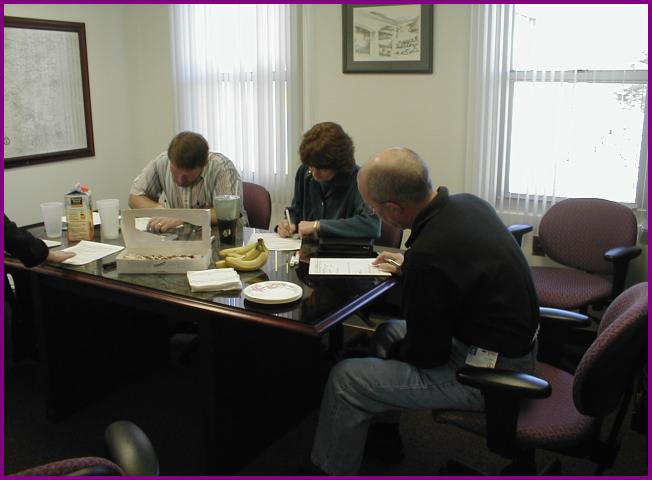
Participants were given a survey of roughly 20 questions. Ten of these were open-ended questions and 10 were designed in the form of a Likert scale so that some level of quantitative measure could be achieved. Four of the closed ended questions were focused on how well the Program had achieved its objectives. Each of the four objectives was listed as a statement, such as “the I-81 ITS Program has helped to identify areas where ITS can address needs on I-81.” Participants were asked to state their level of agreement with each statement and were not told these were objective statements. In this way it could be determined if participants perceived that Program objectives were or were not being achieved. Twenty-one Work Group participants filled out the survey. The picture on the following page shows participants from the Salem VDOT District filling out the entrance survey prior to their interview.
Salem VDOT
District Group Interview
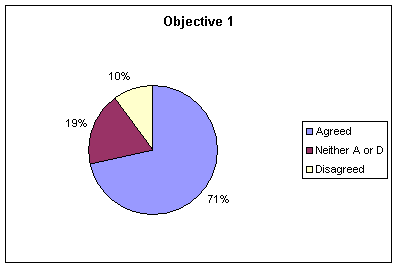
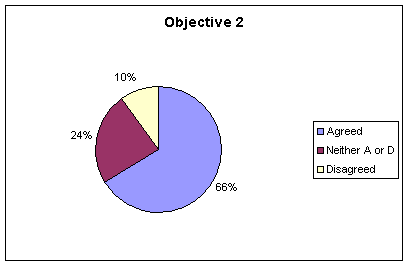
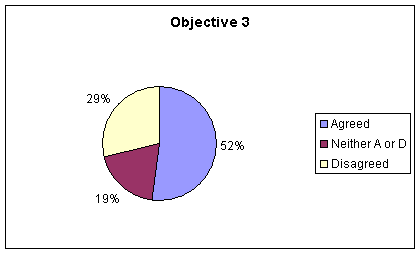
In the charts on the next page, each objective is stated and the level of agreement with the statement is shown in the corresponding pie chart. As the results show, participants tended to agree that objectives had been achieved. Results would have been even more useful if this exercise had taken place when the Program was initiated so that results could be compared over time.
Agreement was strongest on Objectives 1 and 2 likely because, in the first year of the Program, Work Groups met regularly to discuss areas where ITS could address specific issues on I-81 and to determine who would need to be involved in specific projects in order to do so. These discussions appear to have increased the participants’ levels of agreement with the following objective statements.
Objective 1: The I-81 ITS Program has helped to
identify areas where
ITS can address needs on I-81.
Objective 2: The I-81 ITS Program has helped to
identify where ITS can generate the greatest potential benefits, particularly
partnering opportunities.
Roughly half of the participants agreed that Objective 3 was being achieved. This is likely due to the fact that the structure of the Working Groups brought people together to coordinate and communicate ideas.
Objective 3: The I-81 ITS Program has improved the
coordination of ITS planning and operations over the length of the
corridor.
The final objective secured the least agreement. This could have been due to the fact that, as mentioned in the section on Transformational Leadership, Mr. Robinson and others in leadership positions are still trying to institutionalize the changes that have been envisioned for the way VDOT does business when it comes to ITS planning and implementation.
Objective 4: The I-81 ITS Program has helped
integrate ITS investment into
VDOT’s Construction
Program.
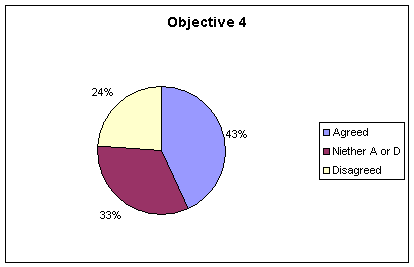
The integration of ITS investment into VDOT’s Construction Program is now being discussed, which is a first step towards turning this final objective statement into a reality. The Program will be able to improve on all four of these objectives in the future if action plans are put into place. Crafting action plans to achieve each of these objectives, and having a mechanism for measuring progress, is strongly recommended. These action plans should have timelines and leadership roles attached so that accountability is written into the process. This is just one recommendation; the next section of the report is dedicated entirely to recommendations for the future of the I-81 ITS Program.
This section of the report
covers the three major barriers identified in this evaluation for which
recommendations are being made. The barriers include:
·
Barrier 1: Unclear Organizational
Structure
·
Barrier 2: Unclear Leadership &
Direction
·
Barrier 3: Lack of
Communication
The first barrier identified through this evaluation was the unclear organizational structure of the Program. Although this issue has become more apparent in the second year of the Program, the first year also experienced organizational challenges. It is worth discussing the issues faced in each year of the Program for the benefit of those who may implement similar programs.
In the first year, participants struggled with the size of the Program. At one time, nine Working Groups were in place and participants were often asked to participate on multiple groups. Several participants noted that this was a problem because they did not have time on top of their normal jobs to attend all the meetings.
First Year Structural
Problems
“There were too many groups
with unstable numbers.” (V)
“Inadequate staffing, Work
Group members had multiple duties.” (ST)
“We have other
responsibilities so I didn’t have the time to spend that I would’ve liked. If we
had an ITS person we could make it clear that this is their job and they are the
one to go after grants, attend meetings, read through information and status
reports, and sit on committees. The person would have the full view of ITS, now
we are only getting partial views.” (B)
In the second year of the Program, the problems that were identified were a lack of structure and communication. At the start of the second year, management shifted from VTTI to PBF and the organizational structure was changed from nine Working Groups to four Functional Areas.
These changes took place in a short period of time with little communication with participants from management or the ITS Division. Participants wondered who decided that the changes would take place, why they were not alerted for months, how it would affect the projects they had proposed for funding, and if it would alter their role in the Program. To the defense of management, it was difficult to transition from VTTI to PB smoothly amidst funding delays; previous functions carried out by the joint VTTI and PB team were difficult to maintain. The new structure and unclear roles and responsibilities left participants wondering where they fit in and what was expected of them.
Second Year Structural
Problems
“We used to have I-81
meetings that included all Working Groups and status was provided. We have not
had one in a long time.” (R)
“Lack of direction after
project initiation, not sure of group role.” (V)
“Lack of organization,
started off well, but no follow-up or direction.” (ST)
“Confused organization
chart, unclear responsibilities.” (B)
“Lack of structure, it has
to be more than an organization chart there has to be structure for who is going
to be responsible for carrying things through.” (R)
It was very clear from the interviews that the I-81 ITS Program needs to consider the confusion and concerns among its participants, who are the heart of the Program, and address them promptly. It is time to clarify not only the organizational structure of the Program but also the roles and responsibilities of the participants within each level of the organization.
The VDOT ITS Division, through the creation of the new Functional Area structure, is dealing with the barriers mentioned above. The new structure will decrease the number of meetings participants need to attend and the time required, which was a problem in the first year of the Program under the original structure.
The organizational structure proposed by management and sponsors is simple, straightforward, and has been approved by the Policy Committee. Though it has been approved, the new organizational structure has yet to be executed. Below is a general recommendation for how the new organizational structure for the I-81 ITS Program may be executed as well as roles and responsibilities at each of its levels.
The organizational structure should give the most power and responsibility to the Policy Committee. As originally conceived, the Policy Committee was to provide leadership over the Program as a Board of Directors would for a non-profit or business. The Policy Committee should set overall policy and direction for the Program, identify Functional Area Chairs, oversee the work of the Functional Areas, review proposals, and approve funding priorities. This recommendation for a strong Policy Committee is in line with what participants say they want.
A barrier identified in the interviews and mentioned earlier was ongoing funding. The Policy Committee should tackle the funding problems and create a strategy for handing them as one of their first orders of business. The Program Coordinator, mentioned below, will be responsible for making sure the funds for the Program are spent responsibly to the achievement of Program goals and objectives; however, it is the role of the Policy Committee to advocate for and locate on-going funding. The Policy Committee has up to this point played a strong advocacy role for the Program; this role should continue and be strengthened.
The main role of the Functional Areas, which have yet to be composed and implemented, should be for developing strategies and plans to achieve the overall policies set forth by the Policy Committee for their particular area, and then implementing those plans. Each Functional Area should, among other things:
· Identify Functional Area members.
· Establish a mission or charge for the Area.
· Oversee projects currently underway that fall within the Area’s scope.
· Set up regular meetings to address issues particular to their focus on the corridor.
· Coordinate with other Functional Areas when issues overlap.
· Form and lead Working Groups to address particular issues and develop projects.
· Submit requests for funding each fiscal year to the Policy Committee for new initiatives.
The Functional Areas Chairs should work closely with the I-81 ITS Program Coordinator mentioned below to ensure that their efforts mesh with those of the other Functional Areas and to ensure that they are meeting the necessary deadlines for submitting projects to the Policy Committee.
It is recommended that the composition of each Functional Area roughly match that of the Policy Committee, including representatives from the VDOT Districts, the VSP Divisions, the DMV and possibly other agencies that operate on I-81 such as Emergency Services. It is not recommended that consultants sit on the Functional Areas; rather they should be called upon to serve on Working Groups for specific tasks or projects. Program participants are hopeful that the new Functional Areas will provide the structure the Program needs while demanding less of time of participants.
Functional
Areas
“Before there were too many
committees, hopefully the new structure will be easier to handle if it fleshed
out and described and we all buy into it.” (SM)
The role of the Working Groups is not clearly defined in the Founders’ original charge because the groups were not considered permanent fixtures. The Working Groups were to be created around specific issues and then disbanded when the issues had been addressed. During the first year of the I-81 ITS Program, nine Working Groups were created to tackle specific areas and to create projects for submission to the Policy Committee for funding. The structure was clear, though often demanding of the participants’ time. Working groups met regularly, worked through the nine-step proposal development process, and then were disbanded without any word of what happened with their projects or what their future role might be in the Program.
Under the new Functional Area structure, Working Groups should be organized at appropriate times in the funding cycle to assist in the development of projects. After the project development cycle is completed, groups should be disbanded. What should change is that participants should be told their group is to be disbanded and they should not have to find out after the fact that their group no longer exists. This is something that has left many participants feeling a loss of ownership in the process and in their particular projects. Participants should also receive regular updates via an I-81 ITS Program newsletter or website about their projects and the Program in general.
The membership of the Working Groups thus far has been drawn from state agency personnel, universities, hospitals, and private and non-profit sectors. The Functional Areas should continue to draw on these stakeholders for the Working Groups. Yet, it is important for the government agencies serving on the Functional Areas to understand their goals, objectives, and desired outcomes clearly before soliciting the support of outside entities so that the mission of the Functional Area is not transformed to meet other agendas.
It is essential to have a strong Program Coordination function. As is mentioned throughout this report, it is recommended that the Program Coordinator be a member of the VDOT Central Office ITS Division so that he or she has the authority to make decisions for the Program and is not as vulnerable to funding delays and reductions. The Coordinator will serve the entire I-81 Corridor, work with each of the Functional Areas, and report to the Policy Committee. Among other things, the Program Coordinator will be responsible for:
The Program Coordinator should be the glue that keeps everyone together from top to bottom. The Coordinator will have the challenge of utilizing staff and budgets appropriately and holding together a complex organizational structure with multiple stakeholders. Working closely with the Functional Area Chairs and staff on the Corridor will be important. The Coordinator should have a staff to assist in setting agendas, organizing meetings, moderating meetings, recording minutes, communicating between meetings, producing newsletters or other reports on progress. More on the role of the Coordinator is found in Recommendation 3.
The Program needs a framework through which participants understand how to operate; this organizational structure is ideal when considering the current circumstances and evolution of the Program. Working groups have served their purpose, and will be created again in the future by Functional Area Chairs for project development and other tasks. Now, the structure needs to be simplified into Functional Areas that serve as forums through which planning related to priorities on the I-81 Corridor can occur (i.e., Traveler Information, Public Safety, CVO, System Operations).
Recommended I-81 ITS Program Organizational
Structure
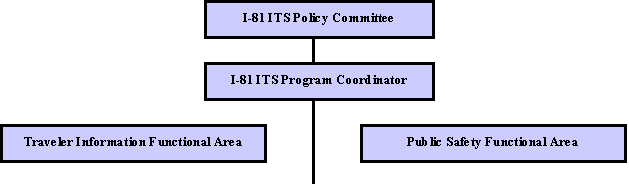

The next barrier identified through the document analysis and interviews was the absence of clear leadership and direction for the Program. Participants said they wanted to know who was in charge and who was deciding where the Program was heading.
Lack of
Leadership
“There is no vision in the
leadership now. Maybe when it was originally set up there was ownership because
they helped develop the vision for the Program and had this image in their head
of what needed to be done and how and where it needed to go. That started in
1999 and probably ended in 2000. In the entire 2001 there hasn’t been any new
breath coming in and saying ‘hey I know what is going on’ and taking charge and
telling everyone what they need to do. There is no direction.”
(R)
“There is a lack of Program
leadership, vision, and initiative to make things happen.”
(R)
“Uncertain decision-making
authority and leadership (is a barrier). Who is in charge.”
(SM)
Closely related to the issue of unclear leadership (i.e., who is directing the Program) is the lack of direction or vision (i.e., where the Program is going) for the I-81 ITS Program to which goals, objectives, and desired outcomes can be attached. Participants want to know where the Program is going and what the leadership is trying to achieve through the Program.
Lack of
Direction
“No vision.”
(SM)
“Lack of marching orders.”
(ST)
“Vague goals and objectives,
we didn’t have anything specific or outcome oriented.”
(B)
“I know my Work Group has
been disbanded but I don’t know where the money is going to come from for the
recommendations we made that were accepted. So where are we now? And where we
are going?” (R)
This perception about a lack
of leadership and direction should be addressed so that participants understand
the direction of the Program and know whom they need to hold accountable when
that direction becomes unclear.
As has been mentioned throughout the document, in the summer of 2001 three events simultaneously took place that affected the momentum of the Program (change in management from VTTI to PB, delays in funding, and a new organizational structure). These changes took place in the absence of communication with participants leading, in large part, to the perception that Program leadership and vision were fading. In fact, the leadership of the VDOT ITS Division and the Policy Committee was never lost, it was just not communicated to participants. It was the responsibility of the VDOT ITS Division to relay these changes and their implications for the Program to participants. In the future, it is recommended that they do so through a Program Coordinator, discussed in Recommendations 1 and 3.
To address this barrier, it is important now to execute the new Functional Area structure, inform participants about all of the changes taking place, and secure buy-in at every level. One suggestion for accomplishing these three objectives is to hold a short planning session like the one that took place in November 1999. The work Mr. Robinson and the Policy Committee have done to bring the Founders’ vision to the forefront has been important to the initial successes of the I-81 ITS Program, but now the Policy Committee and ITS Division need to consider how to take the new structure and vision for the Program forward.
At the first planning session, the Policy Committee should take a hard look at their priorities for the Program and what they want to achieve. The Policy Committee should revisit the vision, revise the vision if necessary, and provide overall Policy Direction for both the Program and the Functional Areas. The Policy Committee should also clarify the roles, responsibilities, and interrelations of the Policy Committee, the Functional Areas, and the Program Coordinator.
Once the Policy Committee shares the vision, policy direction, and general roles and responsibilities, the Functional Areas should hold their own planning sessions. These sessions should focus on creating charges and action plans. Functional Area roles and responsibilities can be further developed during these sessions. The I-81 Program Coordinator should run the sessions with the support of his or her staff.
Currently, participants do not know where the Program is going and what changes have taken place. Taking this planning step is essential for maintaining participant commitment. Participants want to know all their hard work and time is a part of a larger picture and directed towards some desired end.
The final barrier addressed is the lack of communication, mentioned throughout the report. Communication problems were noted across Working Groups, between groups and management, and between the Program and other efforts such as the I-81 Steering Committee.
From the beginning, maintaining these lines of communication was a challenge. During the joint meetings, where all the Working Groups met together, communication appeared to be strong because everyone was in the same location and results were communicated in a set of minutes. Yet when groups met on their own, communication across groups broke down. While these individual group sessions were essential for getting work done, one element missing was that minutes were not shared across groups and so little if any communication occurred. Because the groups’ charges overlapped so much in scope, what one group decided was often of great relevance to other groups.
It was also a challenge to keep communications sustained between the I-81 ITS Program and other efforts such as the I-81 Steering Committee. Success in gaining cooperation between the two efforts is important because the Steering Committee deals with reconstruction on I-81 and addresses Design, Environmental, and Construction issues. Working closely with this Committee may be one way to place ITS at the planning table along with the other divisions in VDOT.
After the first year of the Program, communication was an even greater challenge because, due to delays in funding, the Management Team went from a Program Chair, Manager, and Assistant down to a part-time Program Manager and Assistant. Maintaining the level of communication necessary for a complex Program is difficult with a part-time management team, and this was apparent throughout the interviews as communication was high on participants’ lists of concerns.
Lack of
Communication
“Lack of communication about
changing structure and resources.” (ST)
“Misunderstanding of what
resources are available and who the players are and their function.”
(SM)
“We need to know what our
progress is. We have spent a lot of money meeting over the past few years, so
what do we get? Let us know.” (R)
“Unclear communication of work plan and goals.” (B)
The final recommendation is to hire a full-time I-81 ITS Program Coordinator from VDOT’s ITS Division who has at least one staff person located on the Corridor for support. This Coordinator role was mentioned in Recommendations 1 and 2 because the establishment of such a person would support the accomplishment of all of the suggestions made in this report. The role of the Program Coordinator is noted in particular here, as maintaining the communication demands of this Program internally and externally will be among his or her major responsibilities.
The Program Coordinator should be a member of VDOT’s ITS Division assigned to the I-81 ITS Program. While VTTI and PBF played an important role in managing the I-81 ITS Program up to this point, a VDOT staff person is more appropriate for the Program Coordinator role. A VDOT staff person, unlike university personnel or a consultant, will have the authority and accountability necessary to make decisions for the Program and will not be as vulnerable to delays in funding as someone under contract. Other Program functions, such as facilitation and evaluation, are more appropriate for university personnel or consultants to handle because they require a neutral third party who can moderate and critique the process.
The Program Coordinator must try to create a neutral playing field for discussion among all participants. This is important so that stakeholder opinions and ideas are shared at the table, and the stakeholders leave knowing their voices were heard. Participants are much more likely to return to the table if they believe they will be heard. The Coordinator can do this by having a facilitator moderate and manage the meetings to ensure discussions are open. One participant stated that having a facilitator was important because the facilitator “takes someone who is passionate about a subject out of control of the meeting.” The facilitator can ensure communication is free around the table and no one person controls the discussion.
The Coordinator must make sure meeting agendas, records, and progress reports are communicated. Currently, participants are concerned that they do not know what is going on that may affect their work, and have no record of what their own group accomplished to share with others or to remind them of progress made. One participant stated “having the facilitator serve also as staff is very beneficial because they make sure everyone is fed back information and is clear as to what went on.” It is not critical who serves in this feedback role, it may be the facilitator or someone on the Coordinator’s staff, what is critical is that feedback is timely, accurate, and consistent.
Putting in place a strong Coordinator to work with the Policy Committee and Functional Areas is a way to address this communication barrier. The Coordinator can ensure that solid agendas are formed for each meeting, key issues are addressed, appropriate stakeholders are invited to the table, the meetings run smoothly, and minutes are shared across groups. This will become even more important as the Public Relations arm of the Program begins to build information they wish to share with the public. The Coordinator should liaison with public relations staff to ensure projects that have implications for the public are shared in a timely fashion.
The I-81 ITS Program Coordinator role will be demanding but it is essential for the development and survival of this Program. Someone needs to take it upon him or herself to make sure things happen and to hold others accountable. This person will need their own staff and the commitment and support of the Functional Area Chairs, the Policy Committee, and the VDOT ITS Division to make this work.
In closing, all three barriers focus on addressing institutional issues through the clarification and institutionalization of the organizational structure, roles and responsibilities, policy and functional area directions, and communication. The barriers can be dealt with if the organizational structure is simplified, if leadership roles and responsibilities are defined and accepted at each level, if a policy direction is provided, if the Functional Areas are constituted, and if a Program Coordinator is hired. These are not the only ways forward, but they are ones that can best address the institutional issues currently holding the Program back and keeping it from accomplishing all that it can for ITS implementation and planning on I-81.
The I-81 ITS Program has had many successes in its first two years and many lessons have been learned. The barriers that have been mentioned are not major problems; rather, they are institutional issues that can be overcome through the suggestions made above. If the leadership that has been shown by the Policy Committee, Mr. Robinson, and the ITS Division continues, this program has the support and guidance it needs to achieve its goals and objectives. And if the interest and commitment participants have shown through their involvement and shared during the interviews continues, the I-81 ITS Program will continue to succeed.
Below is the interview instrument used for the Policy Committee interview and is basically the same format that was used for the Management and Policy Interviews. The instrument varied slightly by who was being interviewed. The entrance survey and instrument used for the group interviews follows.
Interview Instrument
(Individual)
Introduction
1.
Why do you think the I-81 ITS Program is important?
2.
Are any stakeholders missing that should be brought into the Program?
ITS
Environment
3. How do you think other ITS efforts, such as Travel Shenandoah and the Staunton COO, have affected the development of the I-81 ITS Program?
Goals &
Objectives
4. What are the goals and objectives of the I-81 ITS Program?
5. Do you feel these goals are being met?
6. What types of people/staff will be needed to reach these goals?
7. What are your goals for the Program in the future?
Organization
8. What
role does the Policy Committee play in this Program? What are your main
responsibilities?
9. Do
you think that any group or person is missing from the Policy Committee?
Program
Management
10. What role do you feel Program Management has played in this Program?
11. Do you have any suggestions for Management going forward?
Resources
12.
What role do you play in the funding process after projects are
approved?
13.
What other sources of funding should be tapped for ITS Projects on
I-81?
14.
What other resources, other than funding, have helped to support this Program?
Outcomes
15.
What are some of the short-term outcomes of the Program?
16.
What do you think the long-term results of this Program are going to be?
Program Successes
& Barriers
17.
What factors such as people or activities have contributed to the Program’s
success?
18.
What factors have been barriers to the Program’s success?
19.
What lessons have you learned through the course of your involvement in this
Program?
20.
What recommendations can you offer to others who might want to start such a
Program?
Work Group Entrance Survey
Background
Information
1.
What organization do you work for? (Specify District, Central Office,
etc)

 2.
What is your role in the Program? Work Group Leader
Work Group Member
2.
What is your role in the Program? Work Group Leader
Work Group Member
Goals
3. What are the goals of the I-81 ITS Program?
4. Are these goals being met? If so, how? If not, why do you think they are not being met?
Organization
5. Describe your role in the Program?
6. What role does VDOT Central Office ITS Division play in this Program?
7. What role does Program Management play in this Program?
Program
Outcomes
8.
What are the short-term outcomes of the Program?
9. What do you think will be the long-term effects of the Program?
Program Barriers
& Successes
10.
What factors (such as people, activities, etc) have contributed to the Program’s
success?
11.
What factors have been barriers to the Program’s success?
12.
What lessons have you learned throughout your involvement in this Program?
13.
What recommendations can you offer Program Management & Sponsors to improve
the Program?
14.
What recommendations can you offer to others who might want to initiate such a
Program?
Rating
Beside the statements presented below, please indicate with a check mark whether you Agree Strongly, Agree, Neither Agree or Disagree, Disagree, or Disagree Strongly with the statement.
15. I have a clear
understanding of the goals and objectives of the I-81 ITS Program.
Agree Strongly
____
Agree
____
Neither Agree or Disagree
____
Disagree____
Disagree
Strongly____
16. I have a clear
understanding of how the I-81 ITS Program is organized.
Agree Strongly
____
Agree
____
Neither Agree or Disagree
____
Disagree____
Disagree
Strongly____
17. I have a clear
understanding of how projects are funded through the I-81 ITS Program.
Agree Strongly
____
Agree ____
Neither Agree or Disagree
____
Disagree____
Disagree
Strongly____
18. The I-81 ITS Program has
helped to identify areas where ITS can address needs on I-81.
Agree Strongly
____
Agree
____
Neither Agree or Disagree
____
Disagree____
Disagree
Strongly____
19. The I-81 ITS
Program has helped to identify where ITS can generate the greatest potential
benefits, particularly partnering opportunities.
Agree Strongly
____
Agree
____
Neither Agree or Disagree
____
Disagree____
Disagree Strongly____
20. The I-81 ITS Program has
improved the coordination of ITS planning and operations over the length of the
corridor?
Agree Strongly
____
Agree
____
Neither Agree or Disagree
____
Disagree____
Disagree
Strongly____
21. The I-81 ITS Program has
helped integrate ITS investment into VDOT’s Construction Program.
Agree Strongly
____
Agree
____
Neither Agree or Disagree
____
Disagree____
Disagree
Strongly____
Interview Guide
(Group)
10:15
Introductions
Ø
Thank everyone for taking
the survey, as it will provide useful data across groups.
Ø
Ask each person to say their
name and Work Group they were leading or a member of.
Ø
Ask
each person to write on a sheet of paper the major stakeholders involved in the
Program.
Ø
In
a Round Robin fashion collect the names and list them on flip
charts.
Ø
Keep going around the circle
until everyone’s lists are exhausted.
Ø
Ask if any stakeholder group
is missing that should be involved moving forward? –why?
10:25 Goal
Exercise
Ø
Ask each person to write a
Program goal.
Ø
Go around circle and ask for
goals and write on flip charts.
Ø
Ask participants if we are
reaching these goals?
Ø
If so, how—for each goal
list activities?
Ø
If not, why not—what
activities might be beneficial towards reaching goals?
10:35
Organization Exercise
Ø Ask participants to sketch the organization chart for the Program (general)
Ø Go around and ask each person to describe their chart
Ø Discuss differences
Ø Show the old chart and the new chart.
Ø Discuss strengths and weaknesses of each.
10:45: 5
Minute Break
10:50 Program Management
Exercise
Ø Ask participants if they have any recommendations for Program Management going forward
11:00 Program Barriers
& Successes Exercise
Ø
Ask participants to take
sheets of paper and write down three to five barriers to the Program’s success
and three factors that contributed to Program success (people,
activities).
Ø
Collect them and put them on
the wall in sections—Facilitators to Success & Barriers to
Success
Ø
Clarify/Discuss
them
Ø
Group & Label them into
general categories.
Ø
Ask if there was any person
in particular that was critical to Program success.
Open discussion about what
lessons have been learning. What has/is really working and what is not?
Open discussion on
recommendations. What would you recommend to others starting such a Program?
11:30 Closing . . . any other comments?
Below is a matrix listing the participants invited to take part in interviews as well as the interview logistics.
|
Stakeholder
Type |
Name |
Organization |
Date |
Location |
Confirm |
|
Sponsor |
JR
Robinson |
VDOT-C |
10/24/01 |
Richmond |
Y |
|
Management |
W.
Spaulding |
PBF |
10/30/01 |
Staunton |
Y |
|
Policy
Member |
D.
Morrison |
VDOT-D |
10/30/01 |
Staunton |
Y |
Location:
VTTI (Pilot Interview) Date: October 26 Time: 9-10:30
|
Stakeholder
Type |
Name |
Organization |
Location |
Confirm |
|
W.G.
Leader |
A.
Schroeder |
VTTI |
B’burg |
Y |
|
W.G.
Member |
K.
Laskowski |
VTTI |
B’burg |
Y |
|
W.G.
Member |
N.
Swan |
VTTI |
B’burg |
Y |
Location:
Staunton VDOT District
Date: November 6
Time: 10:30-12:00
|
Stakeholder
Type |
Name |
Organization |
Location |
Confirm |
|
W.G.
Leader |
S.
Myers |
VDOT-D |
Staunton |
Y |
|
W.G.
Member |
J.
Diamond |
VDOT-D |
Staunton |
Y |
|
W.G.
Member |
B.
Guill |
VDOT-D |
Staunton |
Y |
|
W.G.
Member |
R.
Slocum |
VDOT-D |
Staunton |
Y |
|
W.G.
Member |
C.
McGhee |
VTRC |
Charlottesville |
Y |
|
W.G.
Member |
Lt.
O’Neil |
VSP |
Appomattox |
Y |
|
W.G.
Member |
Sgt.
Rader |
VSP |
Augusta |
Y |
Location:
Salem VDOT District
Date: November 9
Time: 10-11:30
|
Stakeholder
Type |
Name |
Organization |
Location |
Confirm |
|
W.G.
Leader |
C.
McDonald |
VDOT-D |
Salem |
Y |
|
W.G.
Member |
B.
Yates |
VDOT-D |
Salem |
Y |
|
W.G.
Member |
M.
Azar |
VDOT-D |
Salem |
Y |
|
W.G.
Member |
D.
Lee |
VDOT-D/C |
Salem/Rich |
Y |
|
W.G.
Member |
L.
Bullock |
VDOT-D |
Salem |
Y |
Location:
Richmond
Date:
November 14 Time:
10-12:00
|
Stakeholder
Type |
Name |
Organization |
Location |
Confirm |
|
W.G.
Leader |
K.
Rusak |
VDOT-C |
Richmond |
Y |
|
W.G.
Member |
J.
DuFresne |
VDOT-C |
Richmond |
Y |
|
W.G.
Member |
K.
Earnest |
VDOT-C |
Richmond |
Y |
|
W.G.
Member |
S.
VanCleef |
VDOT-C |
Richmond |
Y |
|
W.G.
Leader |
S.
Shergold |
VTRC |
Richmond |
Y |
|
W.G.
Leader |
K.
Jennings |
DMV |
Richmond |
N |
|
W.G.
Member |
M.
Morecock |
Iteris |
Richmond |
Y |
|
W.G.
Member |
N.
Magorka |
Arinc |
Richmond |
N |
Location:
Bristol VDOT District
Date: November 27
Time: 10-12:00
|
Stakeholder
Type |
Name |
Organization |
Location |
Confirm |
|
W.G.
Member |
R.
Hubble |
VDOT-D |
Bristol |
Y |
|
W.G.
Leader |
D.
Necessary |
VDOT-D |
Bristol |
Y |
|
W.G.
Member |
B.
Waters |
VDOT-D |
Bristol |
Y |
D=District
C=Central Office
Below are the Policy Committee and Technical Committee Invite Lists. These lists have changed over time as the Program has evolved.
I-81 ITS Program Policy Committee
Members
|
Name |
Organization |
Title |
|
Andy Bailey,
Chair |
VDOT |
Assistant Commissioner
for Operations |
|
Gary
Allen |
Acting Assistant
Commissioner for Research & Technology | |
|
Tom
Boyd |
VDOT |
Assistant Commissioner
for Finance |
|
Col. John
Scott |
VSP |
Director Bureau of
Field Operations |
|
Daniel
Marston |
VDOT |
Bristol District
Administrator |
|
Fred
Altizer |
VDOT |
Salem District
Administrator |
|
Dennis
Morrison |
VDOT |
Staunton District
Administrator |
|
Lynwood
Butner |
DMV |
Assistant Commissioner
Motor Carrier Services |
I-81 ITS Technical Working Group Contact
List (June 2001)
Below
is the list of members involved in the Working Groups.
Work
Group Leaders & Numbers (WG#)
1.
COO
(Robinson & Spaulding)
2.
Incident
Response (DuFresne & Tyler)
3.
ITS
Guidelines (Rusak & Shergold)
4.
Data
Req. & Mgt. (Schroeder &
Caldwell)
5.
Public
Info & Marketing (Myers & Baker)
6.
Traffic
& Travel Info (Worrall & Kell)
7.
Public
Safety (Spaulding)
8.
CV
Safety & Ops (Jennings & Bergoffen)
9.
Construction
10. Safety
(Necessary & McDonald)
|
Name |
Organization |
Location |
Title |
WG# |
|
JR
Robinson |
VDOT |
Richmond |
Director,
ITS |
1 |
|
Wayne
Spaulding |
PBF |
Delaware |
I-81 ITS Program
Manager |
1 |
|
Ronnie
Hubble |
VDOT |
Bristol |
DTE |
1 |
|
Bob
Yates |
VDOT |
Salem |
DTE |
1 |
|
Rob
Slocum |
VDOT |
Staunton |
TE
(ITS) |
1 |
|
Lt. John
O’Neil |
VSP |
Appomattox |
Lt. |
1 |
|
First Sgt. Joe
Rader |
VSP |
Augusta |
First
Sgt. |
1 |
|
Jeff
Cutright |
VDOT |
Richmond |
L&D |
1 |
|
Mshadoni
Smith |
FHWA |
Richmond |
ITS
Specialist |
1 |
|
Martha
Morecock |
Iteris |
Richmond |
ITS Program
Manager |
1 |
|
Suzette M.
Valentine |
SMA |
VA
Beach |
Dir. Deployment
Services |
1 |
|
Jon
DuFresne |
VDOT |
Richmond |
ITS
Division |
2 |
|
CD
Tyler |
PB |
Maryland |
ITS
Consultant |
2 |
|
Mike
Azar |
VDOT |
Salem |
TE |
2 |
|
Leon
Sheets |
VDOT |
Staunton |
TE |
2 |
|
Tammy
Thomas |
VDOT |
Richmond |
VOIS/EOC Ops
Mgr. |
2 |
|
Alejandra
Medina |
VTTI |
Blacksburg |
Senior Research
Associate |
2 |
|
Steve
VanCleef |
VDOT |
Richmond |
L&D |
2 |
|
Lt. J. W.
Snow |
VSP |
Salem |
|
2 |
|
Lt. Gary
Taylor |
VSP |
Wythville |
|
2 |
|
Karen
Rusak |
VDOT
|
Richmond |
TE,
Design |
3 |
|
Steve
Shergold |
VDOT |
Richmond |
ITS
Division |
3 |
|
Stephen
Brich |
VDOT |
Richmond |
Assistant State
TE |
3 |
|
Jim
Diamond |
VDOT
|
Staunton |
DTE |
3 |
|
Omar
Necko |
VDOT |
Richmond |
ITS
Division |
3 |
|
Kenneth
Earnest |
VDOT |
Richmond |
ITS
Division |
3 |
|
Cathy
McGhee |
VDOT |
C’ville |
SR Research Scientist
|
3
|
|
Larry
Caldwell |
VDOT |
Richmond |
Data
Mgthttp://ntl.bts.gov/lib/jpodocs/edldocs1/13659/TE |
4 |
Aaron
Schroeder |
VTTI |
Blacksburg |
Head Info Applications
|
4 |
|
Dan
Widner |
VDOT |
Richmond |
Data
Mgt. |
4
|
|
Gene
Martin |
VDOT |
Richmond |
ITS
Division |
4 |
|
Fred
Kiiffner |
VDOT |
Richmond |
L&D |
4 |
|
Don
Wells |
VDOT |
Richmond |
Transp. Planning
|
4 |
|
Walter
Pribble |
VDOT |
Richmond |
Transp. Planning
|
4 |
|
David T
Lee |
VDOT |
Rich/Salem |
Materials
|
4 |
|
Lt. Steve
Adams |
VSP |
Culpeper |
|
4 |
|
Nick
Magorka |
Arinc |
Richmond |
Sen. Prin.
Engineer |
4 |
|
Dan
Papiernik |
Transcore |
Vienna |
Area
Manager |
4 |
|
Michelle
Griffith |
Transcore |
Vienna |
Program
Manager |
4 |
|
Sandy
Myers |
VDOT |
Staunton
|
PA |
5 |
|
Stephanie
Baker |
VTTI |
Blacksburg |
Research
Associate |
5 |
|
Eric J.
Gorton |
VDOT |
Staunton |
PA
Specialist |
5 |
|
Brenda
Waters |
VDOT |
Bristol |
PA |
5 |
|
Laura
Bullock |
VDOT |
Salem |
PA |
5 |
|
Jason
Bond |
VDOT |
Salem |
PA |
5 |
|
Mike
Stater |
VSP |
Div.
VI |
PA.
VSP |
5 |
|
Pam
Goheen |
DMV |
Richmond |
P.A.
DMV |
5 |
|
Scott
Cowherd |
SHENTEL |
Edinburg |
Travel Shen. Project
Mgr |
5 |
|
Greg
Cross |
LFPDC |
Woodstock |
ITS
Consultant |
5 |
|
Kevin
Barron |
VDOT |
Richmond |
ITS
Division |
5 |
|
Todd
Kell |
VDOT
|
Richmond |
ITS
Division |
6 |
|
Dick Worrall
|
VTTI |
NOVA |
University Research
Fellow |
6 |
|
David
Ferguson |
SHENTEL |
Edinburg |
VP Customer
Service |
6 |
|
Nicole
Swan |
VTTI |
Blacksburg |
Travel Shen. Project
Mgr |
6 |
|
Scott
Cowherd |
SHENTEL |
Edinburg |
Travel Shen. Project
Mgr |
6 |
|
Greg
Cross |
VDOT |
Woodstock |
Consultant |
7 |
|
Marsha
Scherr |
Comcare |
DC |
Executive
Director |
7 |
|
Cheryl
Lynn |
VTRC |
C’ville |
Senior Research
Scientist |
7 |
|
Dr. Debra
Perina |
UVA
|
C’ville |
Pegasus Flight
Program |
7 |
|
Dr. Jack
Potter |
Physician |
Winchester |
Dir. Emergency Med.
Services |
7 |
|
Carol
Gilbert |
Carillion |
Roanoke |
Director of
Trauma |
7 |
|
Ken
Jennings |
DMV |
Richmond |
Director Motor
Carrier |
8 |
|
Gene
Bergoffen |
Mainway
Services |
DC |
Principal
|
8 |
|
Dale
Bennet |
VA Trucking
Assoc. |
Richmond |
Ex. Vice
President |
8 |
|
Roger
Cole |
Hwy Serv.
Venture |
Richmond |
President |
8 |
|
Cyndi
Ward |
VDOT |
Richmond |
Maint., Special
Ops |
8 |
|
Dewey
Clower |
NATSO |
|
|
8 |
|
Scot
Imus |
NATSO |
|
|
8 |
|
Herb
Bridges |
VSP |
Chesterfield |
|
8 |
|
Vince
Burgess |
DMV |
Richmond |
Motor Carrier
Division |
8 |
|
Donny
Necessary |
VDOT |
Bristol |
TE |
9 |
|
Chris
McDonald |
VDOT |
Salem |
TE |
9 |
|
David
Rush |
VDOT
|
Richmond |
TE |
9 |
|
Reggie
Moseley |
VDOT |
Richmond |
TE |
9 |
|
Ben
Cottrell |
VTRC |
C’ville |
Research
Scientist |
9 |
|
Leon
Sheets |
VDOT |
Staunton |
TE |
9 |
|
Donnie
Robertson |
VDOT |
Salem |
Safety
Officer |
9 |
|
Lt. Gary
Taylor |
VSP |
Wythville |
Lt.
|
9 |
|
1st Sgt. Ed
Johnson |
VSP |
Bristol |
First
Sgt. |
9 |
|
Mike
Frye |
VDOT |
Bristol |
Safety
Officer |
9 |
|
Steve
VanCleef |
VDOT |
Richmond |
L&D |
9 |
Below is the outline,
developed by Dr. Richard Worrall in the autumn of 2000, which was given to each
of the Working Groups to guide them in developing their ideas into project
proposals. Program staff developed the final proposals using the information
produced by the Working Groups. The nine-step format was a simple way to ensure
that each group knew what was needed from them in order to draft a proposal, and
this assisted the management team in preparing projects for submission to the
Policy Committee.
Nine-Step Project
Development Process
1. Develop a two to three paragraph project scope of work.
2. List the tasks that should be part of the project.
3. Identify the deliverables, who would use them, and how they would be used.
4. Estimate the duration of the project.
5. Estimate the budget for the project. Provide some breakdown of the budget details, including what will be required in terms of equipment, software, and personnel-hours.
6. Suggest what agency (and what part of the agency) should be the lead for contracting and managing the project. Suggest an individual who could serve as project manager.
7. Identify any comparable projects completed, presently underway, or being procured.
8. List the anticipated benefits of each project, and who will experience the benefits. This list should include the cost savings that might be generated, even in other areas of activity. This will be used to create a return on investment justification for the project.
9. Recommend what type of organization should do the work (agency, university, consultant, contractor, etc.), along with staffing and other necessary resources.
Below is an example of a
work plan that was used to take the Program from kick-off meeting to Policy
Committee approval. The process was broken into
three major steps, the dates listed below next to the steps are not what
actually occurred the first year, but what was determined after the first year
as the ideal cycle for the following year:
Step 1: Project
Development
(March through
August)
·
Organizing the Working
Groups,
·
Generating project
ideas,
·
Submitting project ideas to
the Management Team.
Step 2: Assembling the
Project Book (late August through
September)
·
Assembling the project ideas
from the Working Groups into a Project Book,
·
Distributing the Project
Book to Core Technical Team (CTT), the amalgam of the Working Groups, for review
and comment.
Step 3: Review and
Approval
(late September through
December)
·
Editing the Project Book
based on CTT review,
·
Submitting the ideas to the
Policy Committee for approval.
·
Revising the final Project
Book based on Policy Committee review.
Each step is shown below in
the work plan.
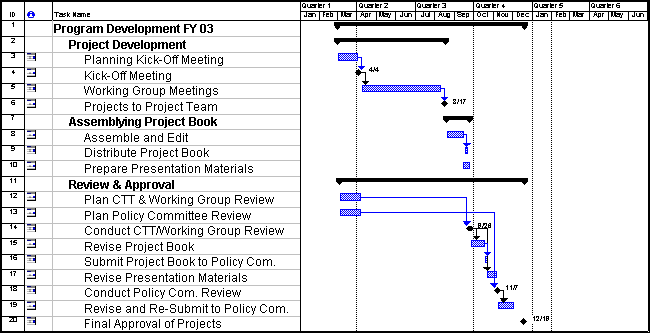
As is mentioned above, this
cycle is not what occurred the first year. The first year the Program did not
get started in earnest until August 2000, leaving little time to develop
projects in time for amble review. Lessons were learned about how much time is
required for each step and from these lessons a new timeline was created that
worked backwards from the date of Policy Committee approval. This work plan will
be likely altered in the future as the new Functional Area model is
implemented.
Below is a list of the
working groups in existence as of January 2001 and their charges.
I-81 Corridor ITS
Concept of Operations
The focus of the I-81 ITS Concept of Operations Standing Technical Working Group shall be on developing an overall, operational concept to guide the future, and coordinating deployment of ITS technologies over the entire length of the I-81 Corridor in Virginia, with particular emphasis on the most effective use of such technologies to improve operational efficiency and enhance safety.
I-81 Incident
Response and Clearance
The
focus of the I-81 Incident Response & Clearance Standing Technical Working
Group shall be on the development and implementation of procedures to improve
coordinated response to incidents within the I-81 Corridor, with particular
emphasis on the management of operations at the incident site and the timely and
effective clearance of the site to permit resumption of traffic
operations.
ITS Design
Guidelines
The focus of the ITS Design Guidelines Standing Technical
Working Group shall be on development of a set of ITS Design Guidelines for use
by VDOT in the planning, design, procurement, construction, operation, and
management of ITS facilities and infrastructure initially on the I-81 Corridor
and eventually across the state.
I-81 ITS Data Requirements, Communications &
Management Systems
The focus of the I-81 ITS Data Requirements, Communications, & Management Systems Standing Technical
Working Group shall be on the development and implementation of an integrated ITS database and set of
associated management systems and necessary communications infrastructure to support the on-going
planning, design, deployment, and effective operation of ITS technologies in the I-81 Corridor.
I-81 ITS Public Information &
Marketing
The focus of the I-81 ITS Public Information & Marketing Standing Technical Working Group shall be on the
provision of a continuing flow of easily accessible, useful information to the traveling public relating to their
understanding and use of evolving ITS technologies along the I-81 Corridor. (The Program shall be closely
coordinated with other, similar VDOT initiatives relating to the reconstruction of I-81, VSP Public
Information Programs, and other activities.)
I-81 Traveler & Traffic Information
Services
The focus of the I-81 Traveler & Traffic Information Standing Technical Working Group shall be on the
provision of a continuing flow of readily available, easily accessible, useful information to the traveling
public relating to current traffic and travel conditions,
and traveler services and tourism along the entire length of the I-81 Corridor,
based on the extension of the successful Travel Shenandoah Program south to
Bristol, Va.
I-81 ITS Public Safety
The focus of the I-81 ITS Public Safety Technical Working Group shall be on studying, tracking, and analyzing the electronic movement of patient data to help protect and save lives. This will include evaluating communication flows, privacy issues, and the impact on incident management sites.
I-81 ITS Commercial Vehicle Safety & Operations
The focus of the I-81 ITS Commercial Vehicle Safety and Operations Standing Technical Working Group shall be on assessing the safety and operational problems posed by the unusually large volume of truck traffic using I-81, recommending ITS initiatives to help address these problems, and implementing pilot projects based on these initiatives.
I-81 ITS Construction Safety & Congestion Management
The focus of the I-81 ITS Construction Safety & Congestion Management Standing Technical Working Group shall be on assessing the safety and congestion management issues associated with major construction activities within the I-81 corridor, identifying ways in which ITS technologies might be utilized to help address these issues, and on developing a recommended series of annual investment projects designed to achieve those ends. The group will also focus on providing on-going technical oversight of the conduct of any such projects and coordinate subsequent implementation of their results in the field.
|
Functional
Area |
Project |
FY 02
|
FY
03 |
FY-04 |
Funding
Source/Comments |
System
Operations |
Project
Management |
$137,000 |
$150,000 |
|
ITS
Division FY-03
TDP |
|
|
I-81 Corridor
COO |
$50,000 |
|
|
FY-02
TDP |
|
|
Salem & Bristol
COO |
$300,000 |
|
|
FY-02
TDP |
|
|
Inventory of ITS Field
Assets, Communication & Infrastructure |
$113,208 $25,000 |
|
|
FY-02
TDP ITS
Division |
|
|
System
Integrator |
$250,000 |
TBD by
Districts |
TBD by
Districts |
FY-02
TDP Future
TDP |
|
|
Interim Operations
Center |
$250,000 |
$250,000 |
|
State Maintenance
funds |
|
|
Develop ITS Design
Guidelines |
$124,005 $25,000 |
$25,000 |
|
FY-02
TDP
ITS
Division FY –03
TDP |
|
|
Incident
Management |
$471,000 |
|
|
FY-02
TDP |
|
|
Incident Response
& Clearance Program |
TBD |
TDB |
|
Will fund development
after 1/10 Mile Markers fully funded. |
|
|
1/10 Mile
Markers |
TBD |
|
|
Need final
estimate |
|
|
I-81 ITS
Communications Program |
unknown |
TBD |
|
I-81 PE |
|
|
Data Base Mgt.
System Design &
Implementation |
$180,000 $100,000 |
|
|
FFY 2001 ITS
Earmark Match by
VTTI |
Traveler
Information |
Travel Shenandoah Demo
Phase III |
$217,000 $150,000 |
$262,000 $573,000 |
$935,000 |
SPR FFY 2001
Earmark Maintenance or TDP
|
|
|
Travel Shenandoah Ext.
South to Bristol |
$300,000 $315,000 |
|
|
FFY 2001
Earmark SHENTEL
In-kind |
|
|
511 Signage
|
$55,000 |
|
|
FY-02
TDP |
|
|
511 Travel Shenandoah
Pilot |
$270,000 $220,000 |
|
|
FFY 2001
Earmark FY-02
TDP |
|
|
Truck/Fleet Alert
Pilot |
$100,000 |
|
|
FFY 2001
Earmark |
|
|
|
|
|
|
|
Public
Safety |
Pegasus Phase
II |
$150,000 |
|
|
FFY 2001
Earmark |
|
|
ITS-Public Safety
Initiative |
$1,000,000 $1,000,000+ |
|
|
FFY2001
Earmark TDP & Private
match |
|
Functional
Area |
Project |
FY 02
|
FY
03 |
FY-04 |
Funding
Source/Comments |
CVO |
Targeted
Countermeasures for Truck-Related Hazard
Locations |
0 |
$60,000 |
|
FY-03
TDP -
ITS counter measures targeted to the highest hazard locations for
commercial vehicles. |
|
|
Truck Parking
Availability Real-time Messaging |
0 |
$125,000 |
|
FY-03 TDP
-
Joint effort to make truck parking information available in
Real-Time. |
|
|
Intensified Safety
Outreach through Share the Road/No Zone |
0 |
$40,000 |
|
FY-03 TDP
-
Increasing driver awareness of commercial vehicle operating limits using
existing outreach programs. |
|
|
|
|
|
|
|
|
University
“support” |
|
$572,380 |
|
|
FFY 2001 Earmark |
Baker, S. (2001, January).
I-81 ITS program fact sheet.
Blacksburg, VA: Virginia Tech Transportation Institute.
Cross, G. (January, 2001).
I-81 ITS program congressional
briefing. Richmond, VA: Virginia Department of Transportation.
Daft, R. (1995). Organizational theory and design. St.
Paul: MN, West Publishing Company.
PB Farradyne and Iteris.
(2001, January). VDOT Staunton district
ITS concept of operations. Rockville, MD.
Robinson, J.R. (2000,
March). Summary of I-81 corridor ITS
planning meeting. Richmond, VA: Virginia Department of
Transportation.
Spaulding, W. (2001,
September). I-81 ITS program fact
sheet. Rockville, MD: PB Farradyne.
Tichy, N. and Ulrich, D.
(1984). The leadership challenge-a call for the transformational leader. Sloan Management Review, 26(1),
59-68.
Worrall, R. (2000, June). Proposal for I-81 ITS program management and
support. Blacksburg, VA: Virginia Tech Transportation
Institute.
Worrall, R. (2000,
September). VDOT I-81 ITS program working
group charges. Blacksburg, VA: Virginia Tech Transportation
Institute.
If you have any questions or
comments concerning this report please feel free to contact Stephanie Baker at
the Virginia Tech Transportation Institute.
Stephanie
Baker
Project
Analyst
Virginia Tech Transportation
Institute
3500 Transportation Research
Plaza
Blacksburg, VA
24061
540-231-1524