REPORT
Delaware Statewide ITMS Integration - ITS Evaluation Strategy
January 2002
|
|
Prepared by:
SAIC
151 Lafayette Drive
Oak Ridge, TN 37831
|
|
NOTICE
This document is
disseminated under the sponsorship of the Department of Transportation in the
interest of information exchange. The United States Government assumes no
liability for its contents or use thereof. This report does not constitute a
standard, specification, or regulation.
The United States
Government does not endorse products or manufacturers. Trade and
manufacturers’ names appear in this report only because they are considered
essential to the object of the document.
|
|
NOTICE
Comments on this
report should be provided to the Evaluation Team by February 22, 2002 in
written form via email, fax, or mail to:
Robert Haas
SAIC
151 Lafayette Drive
Oak Ridge, TN 37831
Phone: 865-481-2982
Fax: 865-481-2941
Email: Robert.p.haas@saic.com
|
REPORT
Delaware Statewide ITMS
Integration - ITS Evaluation Strategy
PDF
Version 1.42KB
Prepared for
U.S.
Department of Transportation
Dr. Joseph
Peters
Prepared by
Science Applications
International Corporation
151 Lafayette Drive
Oak Ridge, TN 37831
January 2002
In 2000, the U.S.
Congress earmarked funds for selected projects that were assessed as supporting
the improvements of transportation efficiency, promoting safety, increasing
traffic flow, reducing emissions, improving traveler information, enhancing
alternative transportation modes, building on existing intelligent
transportation systems (ITS), and promoting tourism. A small number of these
projects have been selected for national evaluation. The Delaware Statewide
Integrated Transportation Management System (ITMS) being developed by the
Delaware Department of Transportation (DelDOT) was among the selected projects.
A team led by
SAIC, under direction from the USDOT ITS Joint Programs Office (JPO), was
selected to develop and implement a case-study evaluation of ITMS. The
following excerpt from the Statement of Work (SOW) for this task defines the
objectives of this evaluation:
“Case Study/Lesson
Learned studies should provide qualitative information to others in the ITS
arena to help ensure success of their projects. In particular, the State of
Delaware integration evaluation should provide specific information regarding
the steps taken to merge Freeway, Arterial, Emergency, and Transit Management
systems together. Also, lessons learned
regarding how to tie legacy systems to new systems will be reported. Finally, the lessons learned through the use
of XML to manage and exchange data is highly desired. The case study should explain to developers how to utilize
existing technologies to build a seamless transportation management system. The
final report should document both technical and institutional steps regarding
how the system was implemented and integrated.”
What is XML?
XML, or Extensible Markup Language, is a
standard for storing structured data. It was originally designed as a method
for storing structured document content separately from document formatting,
but it is commonly used today as a general-purpose method for exchanging data
between applications. While XML frees system developers from defining how to
structure messages for transfer between sub-systems, developers must still
identify the messages and the content of those messages. The primary
advantages of using XML are that it is text-based and self-documenting so
that an XML message is easily interpreted by human readers and it is widely
supported. The primary disadvantages are that it is wordy and, if security is
a concern, is easily interpreted if intercepted.
|
In other words,
this evaluation will provide qualitative information about how the DelDOT ITMS
project developed a highly integrated system for managing and sharing
transportation data so that future developers of similar systems can benefit
from DelDOT’s experience. This evaluation will consider both the technical and
institutional steps required to implement ITMS, and will focus on the
integration of legacy systems and the use of extensible markup language (XML)
in ITMS.
The Evaluation
Strategy presented here was developed to serve as a planning and guidance document
as the first major step in a successful evaluation effort. This strategy, based
on the general objectives listed in the SOW, identifies specific goals for this
evaluation and identifies the methods that will be used to meet those goals. It
also provides a high-level schedule and identifies the key milestones for the
evaluation. The evaluation itself will begin, following the methodology and
schedule described in this evaluation strategy document, and evaluation
progress will be documented in periodic progress reports and interim briefings.
The evaluation will result in the production of a Case Study report.
In Delaware, as
in most States, the various systems and sub-systems that manage, maintain, analyze,
and respond to transportation data reside on many different hardware and
software platforms that are connected using a variety of communication systems.
One result of reliance on this disparate collection of systems is that
developing new systems that rely on information from multiple existing systems
is very difficult, requiring the utilization of different communication systems
and specialized software and/or hardware for integration.
This difficulty
is often a significant impediment to developing new systems that can provide
new capabilities by leveraging the wealth of transportation data that is
available across the State. When a system, such as a traffic management center
(TMC), absolutely requires access to data from several other systems, specialized
methods are developed to provide this data. However, these specialized methods
are often costly and do little to help make this data available to other
systems that could use it. These methods may also do little to help in
automating transportation processes because the data may be available to users
through separate applications installed at a single user location rather than
through a single application accessing separate data sources; in that case, the
user is required to review data from several applications in order to identify
an “integrated” response rather than having an application help integrate this
data and identify responses.
In 1997, DelDOT
published the Delaware Integrated Transportation Management Strategic Plan,
describing a different approach that “incorporates all modes of transportation
in Delaware (roadways, transit, rails, ferries, airports, ports, etc.) into a
seamless transportation system that enhances the movement of people and goods
throughout the State and meets the needs of DelDOT customers.” In other words, instead of developing new
transportation applications that, as part of the application, integrate data
and services as needed, DelDOT is developing an ITMS infrastructure that serves
as the common source of transportation data for all applications and provides
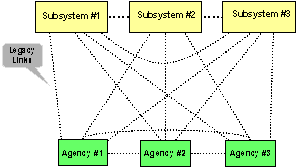
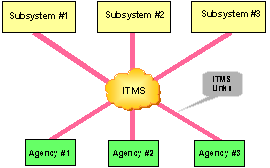
shared techniques for accessing that data. As depicted in Figure 1, this promises to simplify interactions between both
the systems and agencies that rely on transportation data, which should result
in long-term costs savings and in the development of novel, new systems that
utilize this integrated source for transportation data.
The broad level
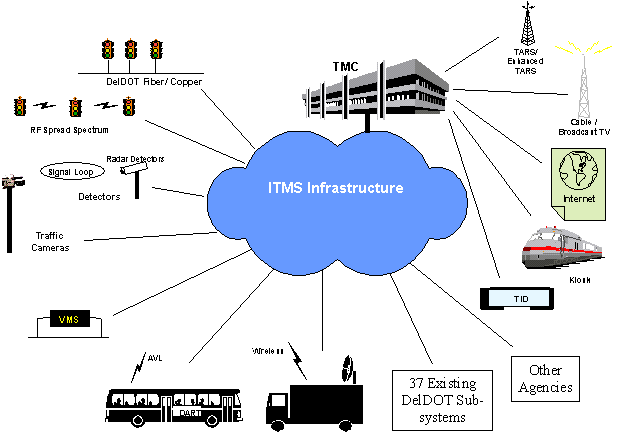
of integration called for in this strategic plan (see Figure 2), requires design and implementation of a core ITMS
infrastructure that provides the communications infrastructure and data
hardware and software necessary to collect, process, store, and distribute data
from a common data store using standardized access methods. It also calls for
an iterative approach for integrating systems into ITMS.
Delaware began by
identifying 675 miles of road that, by including them in ITMS, would generate
the greatest benefit to the public, and went on to identify the 250 critical
miles of roads among these 675 miles. It is for these sections of road that the
initial ITMS implementation is targeted. Delaware also evaluated the different
types of transportation data that are related to these sections of roads and
the different applications that might use this data, and identified a schedule
for integrating different data sources and transportation applications with
ITMS.
Delaware could
then follow a somewhat generic methodology for integrating a system with ITMS.
First, an ITMS communication network was established. To this end, DelDOT
extended its existing copper-based communications by installing approximately
61 miles of fiber cable along Delaware roads and providing additional loops to
connect State facilities that are located near to this roadway fiber network.
This network, which DelDOT continues to expand, connects fixed devices that lie
on or near major roads both to each other and to the central ITMS
infrastructure. To communicate with mobile devices and devices for which it is
not feasible to provide a fiber connection, DelDOT also supports an 821 MHz
wireless communication system.
Second, common
communication methods must be identified for communicating between devices.
DelDOT has selected IP-based protocols and XML as standards for transmitting
data between devices.
Third, the system
must be connected with the ITMS communication network. This could require both
hardware (e.g., to connect a system to the fiber network) and software (e.g.,
to generate XML-based messages rather than messages in a proprietary format)
changes to the existing system, as well as software changes to the ITMS
infrastructure so that data from the new system can be processed, stored, and
distributed.
Finally,
applications must be developed that utilize data from the new system. For
example, TMC applications that once relied on direct connections to field
devices for traffic data and to adjust signal controllers must be updated to
instead rely on the ITMS infrastructure to receive data and adjust controllers.
The Delaware
Statewide ITMS Integration project, which is the focus of this evaluation and
is the first project to integrate systems with the ITMS infrastructure, will
begin the process of integrating the highway system into ITMS by connecting the
electronic detection, video monitoring, and traffic signal control systems to
the ITMS communication network and the ITMS central control system and
operations software. Figure
2 depicts the scope of this project within the
framework of the overall ITMS effort.
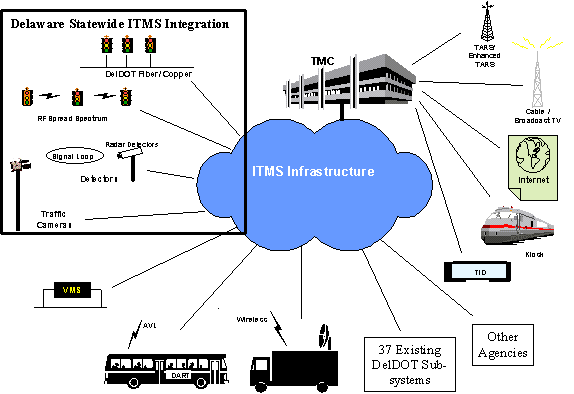
Figure 2.
The Delaware Statewide ITMS Integration Project
In this figure,
it is seen that the scope of the Delaware Statewide ITMS project is the
integration of the electronic detection, video monitoring, and traffic signal
systems with the ITMS infrastructure. The following paragraphs describe the
groundwork that has already been laid to integrate each of these systems and
the additional actions that will be taken as part of this project.
Electronic
Detection. Currently, data from electronic traffic detectors are connected
to different system-monitoring sites, and the existing TMC allows for separate
monitoring of each site. As part of the Delaware Statewide ITMS Integration
project, these sites will be connected to the statewide signal system, making
the detection data available for adaptive traffic control operations, for
storage in a central relational database, and for access by DelDOT’s Integraph
GIS for display and analysis. All departments within DelDOT will then have
access to accurate, up-to-date data regarding traffic volumes, speeds, and
occupancies.
Video
Monitoring. Currently, video monitoring cameras in urban areas operate over
a mixture of private and leased communication networks and are not integrated
in terms of control, operations, and monitoring. Separate systems at the TMC
are required to control and monitor different video cameras. This project will
connect more cameras to the DelDOT fiber network and will begin the process of
creating an integrated system to control, operate, and monitor those cameras.
Traffic
Signals. Currently, the traffic signal control hardware in urban areas has
been upgraded to be compliant with the statewide signal system specifications.
Also, the transportation management system at the TMC has migrated to ACTRA, an
NT-based tool that provides for adaptive traffic control. During this project,
these controllers will be tied to the statewide IP-based communications
network. In most cases, this will require installation of field communication
equipment to interface between the controllers and the state communications
network. In some cases, this will also require installation of additional fiber
and/or copper cable and communications equipment to connect the controllers to
the closest link on the existing network.
When this project
is completed, traffic data from electronic detection devices and video data
from video monitoring cameras will all be accessible through the use of
standardized access methods through the ITMS infrastructure, and standard ITMS
infrastructure methods can be used to monitor and adjust each traffic signal
controller. This functionality serves as a natural complement to the other
efforts at DelDOT that will begin to integrate transit and emergency response
operations with the ITMS infrastructure, will co-locate TMS, transit, and
emergency response activities, and will make data that is managed by the ITMS
infrastructure available via the Internet.
The excerpt from
the statement of work quoted in section 1.1 lists the following five general objectives of this
evaluation:
·
Document the technical and institutional steps required
to implement and integrate the system.
·
Explain how to utilize existing technologies to build a
seamless transportation management system.
·
Provide lessons learned in using XML to manage and
exchange data.
·
Provide specific information on the steps taken to
merge Freeway, Arterial, Emergency, and Transit Management systems together.
·
Provide lessons learned on how to integrate legacy
systems into a new system.
The following
five sections provide a more detailed description of each of these objectives,
lists the evaluation work product(s) that will be generated to meet these
objectives, and describes the evaluation approach that will be used to generate
these work products.
Integrating the
electronic detection, video monitoring, and traffic signals into the ITMS
infrastructure requires that DelDOT successfully complete a number of technical
and institutional steps, and documenting these steps can help other States
implement similar integration efforts. In fact, as described in section 1.2, each sub-system integration effort involves a similar set of
activities to establish a communication network, connect the sub-system to this
network, and develop applications to handle interactions between the sub-system
and the network. Thus, documenting the technical and institutional steps
required for this project can serve not only to help other States integrate
these specific types of devices, but can also serve as a template for
integrating other types of systems. This evaluation will generate several work
products intended to document the steps taken by DelDOT and the lessons learned
during this integration.
The primary work products
will be three annotated, logical timelines, one for each type of field device,
which describes the technical steps taken to integrate these devices with the
ITMS infrastructure. The timeline will list each of the key steps in the
integration process and the approximate date when that step was completed, and
will also highlight the occurrence of key events that resulted in lessons
learned during this integration project. In addition, the information in these
timelines will be synthesized to produce a flowchart indicating the general
steps required for this type of integration. Interviews with DelDOT project
management staff early in the evaluation will provide the basic timelines and
points of contact for follow-up interviews. Periodic follow-up interviews
during the course of the project will identify steps that were omitted from the
initial timelines, the completion dates of steps, and lessons learned as they
occur. We expect to use email and fax to facilitate the follow-up interviews by
letting the contacts mark-up the latest version of the timelines with any
changes that have occurred.
The other work
product associated with this objective will be a matrix of institutional
responsibilities that describes the various organizations within DelDOT that were
responsible for specific implementation steps and the role they played in the
integration. When special accommodations (e.g., cost sharing between
organizations) were required to help facilitate appropriate institutional
cooperation, these will be documented as lessons learned associated with this
matrix. Once again, interviews with project management staff and follow-up
interviews will serve as the primary methods for gathering this information.
One of the
questions that must be considered in any systems engineering project is whether
to re-use, buy, or build the various components that comprise the system.
Re-using or buying a component that provides the required functionality can
have many advantages: costs may be lower and experience using the component
already exists. Most importantly is the overall decrease in both project
schedule and cost uncertainty that comes with replacing a large
design-build-and-integrate project step with a purchase-and-integrate step.
In developing
software systems, however, there can be unexpected long-term costs to re-using
or buying a component. The high-level design information that is commonly
available when a buy-or-build decision is made may not reveal incompatibilities
or limitations of the purchased component that become apparent later in the
development cycle, or changing requirements force changes that a purchased
component simply does not support. Retrofitting an existing component to meet
requirements for which that component was not originally designed can be more
difficult than simply rebuilding the component. Information gained on the costs
and benefits of using existing technologies can be a valuable tool helping
other system designers better utilize existing technologies.
The primary work
products used to meet this objective will be architecture diagrams that
describe each of the system components (both hardware and software) that are
used to connect the field devices with the ITMS infrastructure. Each component
will be categorized as existing, purchased, modified, or built and the
rationale for this decision will be documented. These architecture diagrams
will also serve as the basis for documenting lessons learned in working with
the individual components, and information about reusable components developed
for the Delaware Statewide ITMS Integration project will be documented as
lessons learned. As with the technical and institutional steps, interviews with
the technical staff involved in the integration activities will be the primary
method used to gather this information.
One of the key
elements of the Delaware Statewide ITMS Integration project is the use of XML
as the common method for exchanging information between the various systems and
components that comprise ITMS. The use of XML has many potential advantages
over the hodge-podge collection of data exchange methods traditionally used - XML can contain complex data structures, tools already
exist for creating and reviewing XML data (which can help when developing and
debugging XML-based data exchanges), tools already exist for managing XML-based
data exchanges between components, XML data formats can be easily shared through
the use of templates (e.g., document type definitions [DTDs] or XML Schemas),
XML is compatible with Web-based development, and XML exchanges can pass
through most firewalls. However, there are some disadvantages (e.g., XML is
very “wordy” and, because it is plain-text and self-documenting, can be easily
deciphered if intercepted) and some uncertainties (e.g., most ITS data
exchange standards are not expressed in XML, XML specifies a data format but
not an exchange mechanism for transmitting data between components).
Documenting how XML was used in the ITMS project can help future designers
better understand the advantages of using XML and can remove some of the
uncertainties by providing an existing implementation that has already resolved
them.
The architecture
diagrams described in the previous section will serve as the first step in
describing the use of XML. Each connection between the components represented
in these diagrams indicates a set of messages that are transmitted between
these components, and the diagrams will indicate which of these transmission
paths handle XML messages. Moreover, each component will be characterized
according to whether it produces, consumes, translates, or transmits XML
messages that pass through it. These diagrams, derived from the DelDOT
technical documentation and confirmed by their technical staff, will provide a
high-level overview of how XML was used in the ITMS integration project.
This high-level
information will be complemented by more detailed information that lists the
messages that are produced and consumed by each component and the types of
translations each component performs. Most of this information is expected to
be available in the form of Unified Modeling Language diagrams developed by
DelDOT and its contractors during system development. Even more detailed
information will be presented in the form of either DTDs or XML Schemas that
will be provided for a few selected messages. Finally, documenting the trail
taken by a few specific messages as they pass between components and are
processed by components will complete the picture of XML usage in the DelDOT
project.
Although the
above work products will help describe how to use XML to manage and exchange
data, they do not address several issues that are key to using XML in ITS
applications. Each of the following issues will be addressed by interviewing
DelDOT to identify the steps taken to address each issue and documenting the
results of those interviews.
·
Compatibility with ITS standards. Many ITS standards have
already been developed to help standardize interactions between the
transportation devices that are being integrated in the Delaware Statewide ITMS
Integration project. However, most ITS message standards are not expressed in
XML. The evaluation will describe the steps DelDOT took to ensure that
inter-component messages implemented in this integration project are consistent
with applicable ITS standards.
·
Security. XML is a self-documenting, text-based
messaging system, which creates the opportunity for unintended recipients to
intercept or impersonate inter-component communications. Obviously, the
potential for traffic signal devices to receive adulterated messages that could
modify their signaling behavior is unacceptable, and DelDOT is implementing a security
system to deal with this threat. The evaluation will describe the steps DelDOT
is taking to ensure the security of inter-component messaging in this
integration project.
·
Tools. Many software tools are available for creating
and parsing XML text and for managing XML data. The evaluation will describe
the tools that DelDOT selected to help facilitate the use of XML in the
integration project.
The information
for these descriptions will come from the technical documents reviewed by the
evaluators and from interviews with DelDOT staff.
The overall ITMS
effort aims to integrate data across multiple systems at DelDOT, including
freeway, arterial, emergency, and transit management systems. However, the
Delaware Statewide ITMS Integration project has the more limited scope of
integrating electronic detection, video monitoring, and traffic signals with
the ITMS infrastructure. This integration does involve integration of devices
positioned along both freeway and arterial roadways, and the evaluation will
document the approach DelDOT used to address any institutional barriers that
may have been encountered during this integration project.
This integration
does not involve direct integration of emergency and transit management
systems; the integration of these systems is part of other projects currently
underway at DelDOT. However, the evaluators recognize the opportunity to gather
information about these additional integration activities at DelDOT
simultaneously with gathering information about the Delaware Statewide ITMS
Integration project and, to the extent that this information can be obtained
without affecting the primary objectives of this evaluation and without duplicating
the effort of other evaluations, the evaluators will document information about
these other integration activities. The work product used to document this
portion of the evaluation will be lessons learned that are identified during
interviews with DelDOT staff.
The Delaware
Statewide ITMS Integration Project is being implemented in an environment that
includes both a large number of existing systems and several new systems under
simultaneous development. Moreover, this project involves transportation data
that is critical to DelDOT’s ability to effectively manage traffic operations,
which requires that the transition to the new, integrated techniques occur in a
fail-safe manner that can rely on the older, legacy systems in case errors are
discovered in the newly developed systems. (Alternately, DelDOT may rely on a
phased migration to the new systems so that a failure will affect only an
acceptably small part of the overall system.) Also, additional legacy systems
exist at DelDOT that, even though they will not interact directly with the
field devices integrated during this project, will interact with the data
generated by these devices and stored in the ITMS infrastructure databases.
This evaluation will consider both types of interactions with legacy systems
and will document the steps DelDOT will take to ensure a smooth transition to
the new system and continued smooth interactions between the new system and
legacy systems that remain.
The evaluation
team will generate three evaluation products to document issues related to
integrating with legacy systems. First, the team will generate interaction
matrices that identify the legacy systems that rely on data from the affected
electronic detector, video monitor, and traffic signal devices. Then, the team
will select one of those legacy systems and will provide a more detailed
description of the steps taken by DelDOT to ensure continued operation of that
legacy system after these devices have been integrated with the ITMS
infrastructure. The team will also follow-up with DelDOT staff to identify
lessons learned regarding any of these interactions. Finally, the team will
generate a checklist of factors to consider when transitioning to a new system;
this checklist will document many of the types of failures that could occur
during this transition and the steps DelDOT took to mitigate against negative
consequences of a failure that might occur. Each of these products will be
derived from information gathered during interviews with DelDOT staff and
contractors.
The management
organization for the Delaware Statewide ITMS Integration evaluation effort is
presented in Table 1. Personnel of Science Applications International
Corporation (SAIC), supported by personnel of Daniel Consultants, Inc. (DCI)
are performing this evaluation. The project team reports directly to
Dr. Joseph Peters of the USDOT.
Table 1.
Management Organization
|
Role
|
|
Personnel
|
|
FHWA Evaluation Oversight
|
|
Joseph Peters - FHWA/JPO
Pierre Youssef - Mitretek Systems
|
|
Evaluation Team Management
|
|
Mark Carter - SAIC (National
Evaluation Manager)
Robert Haas - SAIC (Evaluation
Coordinator)
|
|
Analysis & Support
|
|
Kelly Pecheux - SAIC (Research
Engineer)
Tanya King - DCI (Transportation
Engineer)
Tom Tran - DCI (Transportation
Engineer)
|
The technical
reports to be developed from this evaluation will be as follows:
Evaluation Strategy Report. This document is the evaluation strategy
report for this evaluation, which addresses comments received on the draft
evaluation strategy report.
Evaluation Draft Report. This draft version of the
evaluation report will be delivered for review and comment. This draft of the
comprehensive final report will document both the methodology and the detailed
results of the evaluation, including the work products listed in this
evaluation strategy. An executive summary included in the report will summarize
the results of the evaluation. Comments received regarding this draft report
will be addressed in the final report.
Evaluation
Final Report. This final evaluation report will be the revised version of
the evaluation draft report described in the previous paragraph.
The evaluation
schedule is provided in Table
2. The major deliverables in this schedule are
described in the previous section, and the remaining items in the schedule are
project milestones with their anticipated completion dates.
Table 2.
Evaluation Schedule
|
Date
|
|
Milestone or Deliverable
|
|
Fall 2001
|
|
Kickoff Meeting / Initial Data Collection Activities
|
|
January 24, 2002
|
|
Draft Evaluation Strategy (deliverable)
|
|
March 1, 2002
|
|
Interim Briefing at PAWG
|
|
March 2002
|
|
Detailed Test Plan
|
|
March 28, 2003
|
|
Draft Final Report (deliverable)
|
|
May 23, 2003
|
|
Final Report
(deliverable)
|
US Department of
Transportation
400 7th Street, S.W. (HOIT)
Washington,
DC 20590
Toll-Free “Help Line”
866-367-7487
www.its.dot.gov
EDL Document No.: 13683