
Background on Deployment and Evaluation
The London, Kentucky, northbound weigh station on Interstate 75 is the site of an advanced, computer-aided, integrated system intended to help commercial vehicle inspectors with Kentucky Vehicle Enforcement (KVE) improve the effectiveness and efficiency of roadside safety, security, and registration enforcement operations. The system, which was commissioned in June 2005 and formally dedicated by the Governor on August 12, 2005, is now in daily operation (Figures 1 and 2).
Officials in Kentucky refer to the system as the Integrated Safety and Security Enforcement System (ISSES).1 The system is also known as part of “Kentucky’s Weigh Station of the 21st Century.” The station is located at mile marker 33 between Corbin and London in Laurel County. Funded in part by the Kentucky Transportation Cabinet through federal highway funds (Project VII.H.15.C), the system is the first of its kind in the country. Since 2005, two similar systems have been installed in
- Kenton County (I-75 southbound at mile marker 168, 20 miles south of Cincinnati/Covington, commissioned August 2006)
- Simpson County (I-65 northbound at mile marker 4, on the route from Nashville, Tennessee, commissioned October 2006).
The Kenton and Simpson county sites are shown in Figures 3 and 4, respectively. A fourth site, in Lyon County (I-24 eastbound in southwestern Kentucky), is also being considered for 2008.
Partners with the Kentucky Transportation Cabinet in this deployment include KVE, the University of Kentucky Transportation Center (KTC), and the Federal Motor Carrier Safety Administration (FMCSA, an agency of the US Department of Transportation, or USDOT). The KTC is working with Transportation Security Technologies LLC (TransTech, based in Oak Ridge, Tennessee)—which is the vendor leading a consortium of private-sector equipment developers and manufacturers—plus various other component vendors, suppliers, software developers, subcontractors, and system integrators to undertake the Kentucky deployment. A list of contact persons from each organization is presented in Appendix A.
The focus of the present evaluation is commercial vehicle safety and enforcement, in particular assessing the capability of the ISSES to provide inspectors with real-time inspection-decision aids. The system also, however, has homeland security applications in terms of detection and prevention of radiological incidents or attacks. These security functions are outside the scope of this FMCSA-sponsored evaluation.
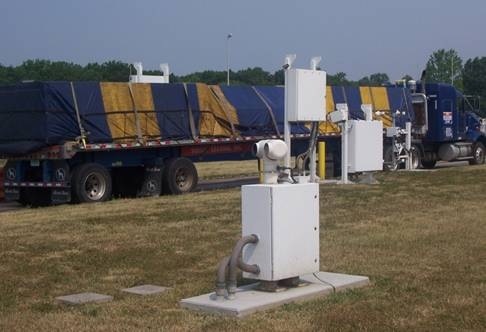
Figure 1. London, Kentucky, northbound I-75 weigh station (Laurel County). ISSES thermal inspection cameras in foreground and portal monitor/automated vehicle identification system in background.
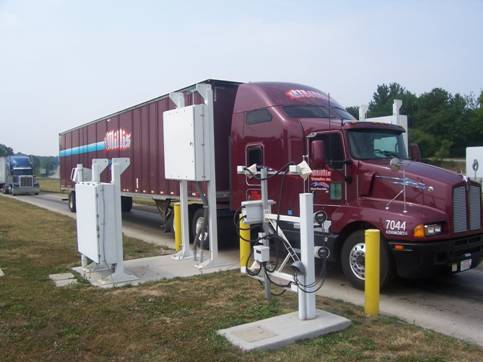
Figure 2. London, Kentucky, ISSES deployment. System control cabinet at left; elevated radiation detection panels close to truck lane on either side; visible lighting and identification camera apparatus in foreground.
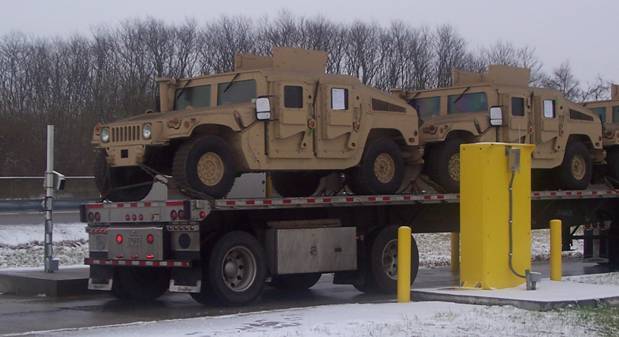
Figure 3. Kenton County ISSES site.
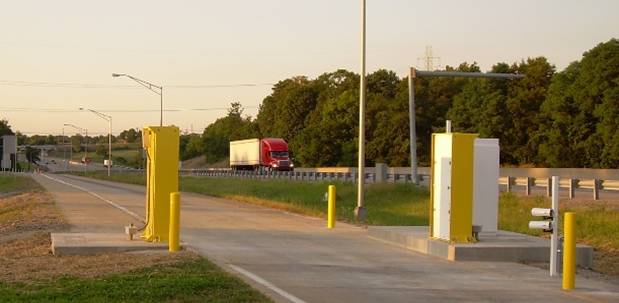
Figure 4. Simpson County ISSES site.
The USDOT sponsored an independent evaluation of the Kentucky deployment, to provide the government with important information on the accuracy, applicability, feasibility, and measurable benefits of selected technologies for use in other jurisdictions that may be considering similar Intelligent Transportation System (ITS) deployments. The independent evaluation, which is described in this report, is known as the Commercial Vehicle Safety Applications (CVSA) Evaluation. An Evaluation Strategy (USDOT 2005a), Evaluation Plan (USDOT 2006c), and Test Plan (USDOT 2007c) were prepared, detailing the research objectives, hypotheses, evaluation measures, and data collection and analysis methods. This evaluation is organized around three related studies:
- System performance
- Inspection efficiency, with a focus on safety improvements
- User acceptance and costs.
A Technical Report on the independent evaluation, providing further detail, analysis methods, and supporting data, was also prepared (USDOT 2008). The purpose of this Summary Report is to highlight the results, benefits, and lessons learned from the Kentucky CVSA Evaluation.
1 Three of the abbreviations used in this report happen to be similar and may be confusing. “ISSES” stands for the advanced-technology portal screening system deployed in 2005 and being evaluated at Laurel County. “ISS” is the USDOT computer-based Inspection Selection System, introduced in 1995, and available nationally to aid in the commercial vehicle inspection decision process. “IIS” is the corporate abbreviation for Intelligent Imaging Systems, a private company formerly known as Thermal Eye Technologies, which is active as a vendor in the development and deployment of the ISSES.