
High-Level Requirements for the US-75 Integrated Corridor in Dallas, Texas

April 30, 2008
Award# DTFH-61-06-H-00040
6. Requirements Process
6.1. User Needs and Functional Breakdown
The first step in the development of requirements for the ICM was to identify the needs and goals in the Concept of Operations. Once these were developed, User Needs and a definition of those User Needs were developed.
6.2. Use Cases
Use Cases are used in order to define how the system will be used by the users to ensure that all Needs identified are covered.
6.3. Map User Needs to Use Cases
The process that was used by the Dallas ICM Team is an iterative process starting with User Needs and mapping the identified High-Level Use Cases to each User Need. Then Requirements for each User Need/ Use Case were identified. The following table identifies the relationships established between the identified User Needs, and the Use Cases developed for the ICMS.
|
Use Cases | User Needs | |||||||||||||
|---|---|---|---|---|---|---|---|---|---|---|---|---|---|---|---|
|
|
1 | 2 | 3 | 4 | 5 | 6 | 7 | 8 | 9 | 10 | 11 | 12 | 13 | 14 |
| UC-1 | Use Case: Plan Trip | |
|
|
x | x | x | |
|
|
|
x | |
|
|
| UC-2 | Use Case: Change Trip – En route | |
|
|
x | x | x | |
|
|
|
x | |
|
|
| UC-3 | Use Case: Determine Response | x | |
x | x | |
|
|
|
x | x | |
|
x | |
| UC-4 | Use Case: Update Pre-planned Responses | x | |
|
|
|
|
x | |
x | x | |
|
|
x |
| UC-5 | Use Case: Monitor Network Conditions | x | x | x | |
|
|
x | x | |
|
|
x | x | |
| UC-6 | Use Case: Update Network Conditions | x | x | x | |
|
|
x | x | |
|
|
x | x | |
| UC-7 | Use Case: Implement Pre-approved response plan | x | |
|
|
|
|
x | |
|
x | |
|
x | x |
| UC-8 | Use Case: Collect Historical Information | |
|
x | |
|
|
|
x | x | |
|
x | |
|
6.4. Develop Requirements for Subsystems
Once user needs, use cases, and scenarios were completed, a conceptual design of the entire ICM system was developed. From this concept, subsystems for the corridor were identified. As discussed previously, four (4) subsystems were identified for development of the ICM system. These subsystems are the Database subsystem, the Evaluation Model subsystem, the Decision Support Subsystem, and the Web subsystem. The figure below shows a high-level concept of the physical architecture of the ICM System.
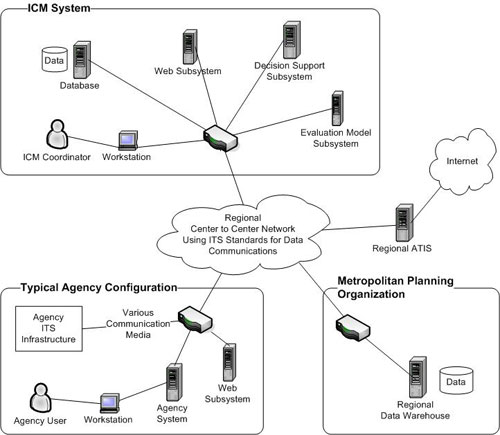
Figure 6.4-1 ICM System Physical Architecture
6.5. Map User Needs to Subsystems
In order to ensure that all functional requirements were identified from the user needs and use cases, a mapping of the user needs to the ICM system and subsystems was completed, as shown in Table 6.5-1. In several cases, the user needs are not directly attributable to the subsystems within the ICM concept, will be impacted by the ICM system and are external to the concept. For instance, User Need 7 - Need to have physical infrastructure coverage, and User Need 11 - Need to provide multi-modal alternatives for travelers are out of scope for the initiative, however, they both are required in order for the system to operate well. Each of the stakeholders within the corridor have identified new infrastructure for their individual networks, as discussed in section 3 above. In addition, one of the goals of the ICM is for modal shift, in order for that to occur alternatives must be available and known to the public.
|
User Needs | |||||||||||||
|---|---|---|---|---|---|---|---|---|---|---|---|---|---|---|
|
1 | 2 | 3 | 4 | 5 | 6 | 7 | 8 | 9 | 10 | 11 | 12 | 13 | 14 |
| ICM System | x | |
|
|
|
|
x | |
|
|
x | |
|
|
|
|
|
|
|
|
|
|
|
x | |
|
x | |
|
|
x | x | x | x | |
|
|
|
|
x | |
|
x | |
|
|
|
|
|
x | x | |
|
|
|
x | |
|
x |
|
|
|
|
|
|
|
x | x | |
|
|
|
|
|
6.6. ICMS Data Process
In order to further understand the process flow and data formats of the US-75 ICMS, the following diagram was created. The basic flow of information for the ICMS is:
- Agencies provide current network information
- Agencies store and process the information for their own systems,
- The Agency information is then sent to the ICMS via the Regional Center to Center. The format and content of this data is required to meet the Regional Center to Center ICD, which is based on the TMDD and MS/ETMC standards as defined within the Regional Center to Center documents.
- The ICMS Database is the first receiving component of the ICMS. The Database stores both historical information received from the Regional Data Warehouse and current network information it received from the ICM agencies and sends this information to the Decision Support subsystem.
- The Decision Support subsystem processes this data utilizing a macroscopic model to calculate both current conditions and predictive conditions of the network in 30 minutes. Based on these two time horizons, the model compares results against both a set of pre-planned scenarios and develops its own potential response plans. The Decision Support subsystem then sends a response plan request, if it calculates one is needed, to the database and to the agencies via the center to center system.
- In order to evaluate the performance of the ICMS, the Evaluation Model subsystem will be used on a regular basis to calculate the performance measures selected by the ICM steering committee. The Evaluation Model subsystem processes data utilizing models to calculate the performance measures. The data used in the model is received from the ICM database.
- The last component of the ICMS is the Web subsystem. The Web subsystem allows both agency users and external users to view the data within the ICMS. The Web subsystem allows authorized users to view, edit, query and update data within the ICM database. The Web subsystem will provide a data feed to regional ATIS systems to provide data on current conditions, planned special events, and construction events within the corridor.
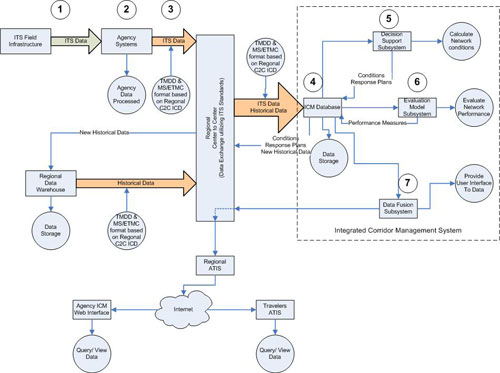
Figure 6.6-1 Data Flow Process