
2.0 Background
2.1 ITS Standards Testing Program
The U.S. Department of Transportation (USDOT) Federal Highway Administration (FHWA) has created the Intelligent Transportation Systems (ITS) Standards Test Program, whose objective is to assess a standard's performance and evaluate the ability of the standard to accomplish interoperability and interchangeability in ITS deployments. Battelle has been contracted by USDOT, in cooperation with the Standards Development Organizations (SDO) and USDOT, to evaluate the coverage and approach used by the site in deploying standards, and conduct both detailed static analysis and hands-on testing of the standard as used at the site.
2.2 ITS National Architecture
The DMS standard is derived from the architecture flows identified in the National ITS Architecture Version 5.0. The DMS standard concentrates primarily on the interface between the Traffic Management Center (such as VDOT) and the roadway (where DMS signs are installed). The data flows of the ITS physical architecture that are subject to DMS are shown in Figure 2.1.
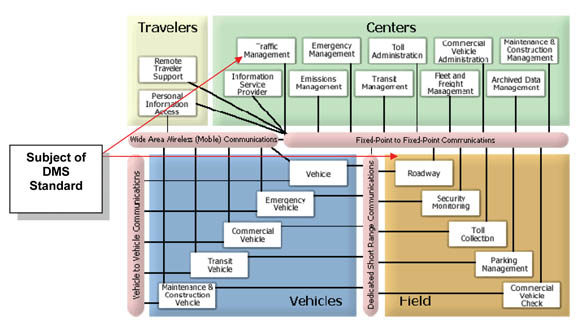
Figure 2.1. ITS Physical Architecture
The ITS national architecture defines one Advanced Traffic Management System (ATMS) market package, which represent slices of the physical architecture that address specific services. The VDOT/ Virginia Tech Transportation Institute (VTTI) deployment employs portions of the Traffic Information Dissemination market package (ATMS06) as shown in Figure 2.2.
This market package provides driver information using roadway equipment such as Dynamic Message Signs. A wide range of information can be disseminated including traffic and road conditions, closure and detour information, incident information, and emergency alerts and driver advisories. This package provides information to drivers at specific equipped locations on the road network. Careful placement of the roadway equipment provides the information at points in the network where the drivers have recourse and can tailor their routes to account for the new information. This package also covers the equipment and interfaces that provide traffic information from a traffic management center to the media (for instance via a direct tie-in between a traffic management center and radio or television station computer systems), Transit Management, Emergency Management, and Information Service Providers.
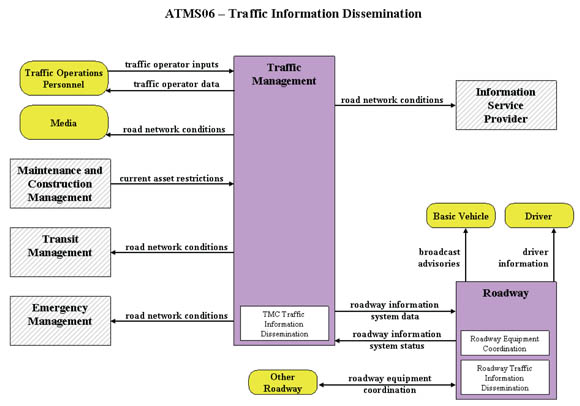
Figure 2.2. ATMS06 Market Package
The portions of this market package that are implemented as part of the VDOT/VTTI implementation include the data flows from Traffic Management and disseminating it to the roadway traffic information dissemination.
2.3 Standards Baseline
This report contains the results from the analysis of the testing conducted by VDOT/VTTI and the exception testing conducted by the ITS Standards Test Team (ISTT) of a specific subset of ITS standards applicable to the object definitions for Dynamic Message Signs. The primary standard of interest for ITS standards testing is the NTCIP 1203 v2.25, to the extent implemented by VDOT/VTTI. The standard of interest is shown in Table 2.1.
| Identification | Title | Date |
|---|---|---|
| 1203 v2.25 | Object Definitions for Dynamic Message Signs | Jan 15, 2004 |
The standard of interest listed in Table 2.1 references other standards and protocols. These standards were not directly evaluated but are included here for reference.
- 1101 NTCIP – Simple Transportation Management Framework
- 1201 NTCIP – Global Objects, Feb 2003
- 2001 NTCIP – Class B Profile
- 2301 NTCIP – STMF Application Profile
- 2101 NTCIP – Point-to-Multipoint Protocol/RS232 Subnetwork Profile
2.4 VDOT Deployment
The Virginia Department of Transportation (VDOT) and the Virginia Tech Transportation Institute (VTTI) conducted a Proof of Concept of Version 2 of the National Transportation Communications for ITS Protocol (NTCIP) Dynamic Message Signs (DMS) standard. Version 2 of this standard (NTCIP 1203) is being developed under the auspices of the American Association of State Highway and Transportation Officials (AASHTO), the Institute of Transportation Engineers (ITE), and the National Electrical Manufacturer's Association (NEMA).
The Version 2 DMS development has centered on making the standard more user-friendly. Specification development using Version 1 required a very detailed level of NTCIP in order to write a solid specification. Version 2 focuses more on user needs and requirements using a Protocol Requirements List (PRL) table as opposed to detailed understanding of the NTCIP standards. VTTI was acting in the place of a deploying agency.
The general concept of this testing was to determine if an agency with little to no prior NTCIP DMS experience could successfully specify, procure, and test DMS sign(s) and central systems software. The sign and software vendors developed their products in complete isolation from each other. VTTI then tested the sign and software to determine interoperability.
A Protocol Requirements List (PRL) was generated by VTTI using the Specification Guide and this PRL was provided to the sign vendor and the central software developer as part of the Request for Proposals (RFP) to develop a prototype deployment. The rest of the steps included advertising the RFP, procuring and awarding the contract, conducting a test workshop for VTTI to start generating test plans and test procedures, and then culminating in the testing of the sign and the central software system.
Throughout the duration of the task, VDOT and VTTI had assistance from the Indefinite Quantity Contract (IQC) team (Cambridge Systematics and Trevilon) and the Noblis (formerly Mitretek Systems) team to conduct the test workshop, assist in development of test plans and test procedures, and also assist in the conduct of the three-month field test of the sign and software at the VTTI Facility in Blacksburg, Virginia.
The ISTT has been involved in the VDOT/VTTI testing from its inception and has been participating and contributing to several tasks including:
- Review of test plans and procedures
- Participate in test workshop
- Monitor VDOT/VTTI conduct of sign testing
- Monitor VDOT/VTTI conduct of central systems software
Requirements
The NTCIP 1203 v2.25 has been revised from previous versions and has focused heavily on user needs, requirements, dialogs, and objects. The VDOT/VTTI implementation used the standard and developed a Protocol Requirements List (PRL) specific to the VDOT implementation. This PRL identified the requirements that VDOT requested in the Request for Proposals (RFP) to the vendor and the central systems software developer. This PRL is the one that was implemented by the VDOT/VTTI implementation and used for testing the sign and the central systems software.