
6. Security Benefits Assessment
The primary evaluation objective of the Security Benefits Assessment is to examine the ability of the test technology suites to improve HAZMAT shipment security. This objective is achieved by assessing the test technology suites' (and technologies with similar functionality available in the marketplace) in coordination with reasonable security processes and procedures to reduce the vulnerabilities in truck-based HAZMAT shipping, and thus, reduce the risk of successful HAZMAT-based terrorist attacks.
6.1 Security Benefits Assessment Overview
Assessing the potential security impacts (consequence reduction) related to the HAZMAT FOT presented a significant evaluation challenge for two key reasons:
- There is little or no event data on which to reliably baseline the level of HAZMAT-based terrorist attacks or to provide actuarial data in which to predict a statistically significant number of actual terrorist actions in the future.
- A method needed to be developed that would translate field test performance and user acceptance information into monetized risk reduction terms.
Consequently, the Evaluation Team developed a unique analytical framework to assess potential benefits. This framework built upon traditional vulnerability assessment techniques, combined observations from both real-world and simulated operations within the FOT framework, and made use of expert judgment and sensitivity analysis. The core of this framework is expressed in a classic vulnerability assessment equation:
Threat x Vulnerability x Consequence = Cost
where "Cost" is the financial impact of HAZMAT-based terrorist attacks.
By applying this formula both before and after the deployment of technologies, it was possible to determine the likely security impacts of the test technologies and to express these impacts in quantifiable, economic terms.
To begin the technology benefits assessment, typical HAZMAT motor carrier operational scenarios were identified and the most likely terrorist attack profiles for each of these scenarios were developed. For example, a typical operational scenario may be the delivery of a bulk fuel. A possible associated attack profile for this load and shipment scenario may be the use of false manifest to divert this fuel shipment and delivery to a populated area for intentional release. The four key operational scenarios or load types considered under the FOT were: Bulk Fuel, Less-than-Truckload High Hazard, Bulk Chemicals, and Truckload Explosives.
A series of these operational scenarios and associated attack profiles were developed by the Battelle Deployment Team and have been documented in earlier reports.[10] These scenarios and profiles also formed the basis for the FOT deployment of technologies.[11] An example of such a scenario would be the theft of a fuel truck while en-route, driven to a populated area, and detonated to maximize casualties.
Once the operational scenarios and attack profiles were established, determinations of the extent of the threat, or the probability that a given attack scenario may be attempted were made. This value is a function of terrorist aims and operating procedures. Through discussion amongst the Deployment Team, FMCSA, and the Evaluation Team, threats are not expected be impacted by the technologies deployed in this HAZMAT FOT. Deployment of a technology or set of technologies may make a given attack scenario less desirable relative to others, but the technology would not alter the terrorist overall desire to inflict harm. Therefore, threat is held constant throughout this assessment. Furthermore, as the war on terrorism continues, it is anticipated that the overall threat environment will not be held constant. Should this become the case, the analytical framework presented here can be easily adjusted to reflect such a revised threat environment.
Having established threat values, it was necessary to determine weight and rank of vulnerabilities. These vulnerabilities represent the probability that a given attack profile will be successful, given potential weaknesses in the various stages and processes involved in transporting HAZMAT from shipper to consignee. Vulnerabilities may include physical security gaps, information integrity lapses, operations failings, and environmental factors that are favorable to terrorist goals. These vulnerabilities were defined by the Deployment Team and consolidated into higher-level categories, described in Section 6.2. Once the "before" vulnerabilities were assessed, the Evaluation Team determined the impact of the FOT technologies to address the vulnerabilities.
Should vulnerabilities be exploited, it is critical to next determine the likely consequence of a success for a given attack profile and HAZMAT operational scenario. For this study, the consequence estimates represent aggregate numbers that include societal impacts – lost wages, damage to infrastructure, and loss of human life – as represented by economic values. Again, these values were determined in a previous effort performed by the Deployment Team for the FMCSA.
As with the threat element of the vulnerability assessment formula, the consequence of a successful attack was considered to not change as a result of the technology deployment.
The final activity in the benefits assessment framework was to establish the potential number and type of terrorist attacks expected over the time horizon of 3 future years. Using these incident occurrence estimates with per incident consequence dollar value and the vulnerability reduction estimates, overall reduction in potential impacts (benefits) were estimated for each considered technology countermeasure for each load type.
The Evaluation Team utilized two distinct groups of subject matter experts in developing the Security Assessment framework: an Expert Panel and a Delphi Panel. These two panels further provided input to derive the initial vulnerability values, the potential technology-enabled vulnerability reductions, and the likelihood of attacks using truck-based HAZMAT shipments. It should be emphasized that the estimates of vulnerability made by the Delphi Panel were based on the Panelists' personal domain knowledge and information provided to them on technical performance and user acceptance/issues. The information provided to the Panelists was derived through the FOT via Beta and interim technology tests, conducting staged security violation events, and through before and after interviews with test participants. These inputs are well documented in Volume III, Section 2: HAZMAT FOT Technical Performance, Efficiency and Safety Benefits Assessments.
The Expert Panel is a core advisory group consisting of 16 project-sponsored or volunteer experts in HAZMAT transportation, national security, risk and loss prevention, and public safety. Through the Expert Panel, the assessment benefited from the inputs and guidance provided by representatives of the American Trucking Associations (ATA); the National Tank Truck Carriers Association (NTTCA); the Commercial Vehicle Safety Alliance (CVSA); International Association of Chiefs of Police; International Association of Fire Chiefs; motor carriers; insurance companies; USDOT; the U.S. Transportation Security Administration (TSA); and the Deployment Team.
The Evaluation Team coordinated with the Expert Panel through dissemination of background and follow-up materials, Web-Ex-based conferences, and on-site meetings. These coordinated efforts resulted in developing and refining the initial risk assessment assumptions and ranges of impacts for inclusion into an iterative Delphi Method.[12] The assessment framework was approved by the Expert Panel, which also assisted in identifying and recruiting participants for the larger Delphi Panel of experts discussed below.
Using the Delphi Method has become a widely used practice regarding transportation vulnerability assessment due to the complexity of the interactions between factors and the wide range of estimates on the effectiveness of any assessed technology or strategy.[13] Through the use of a Delphi Method, experts were asked to provide estimates of vulnerability and of the beneficial effects of the FOT-considered technologies. These inputs were collected via surveys. Both numerical and linguistic responses were developed over a series of group interrogations. Outputs with linguistic values were then processed using Soft Computing Methods in order to provide input values that support conventional Multi-Attribute Decision Making Methods.[14]
The Delphi Panel supporting this assessment was comprised of 26 expert individuals, either familiar to the members of Expert Panel, and/or previously identified through their affiliation with associations, conferences, or working groups (notably the FMCSA HAZMAT Working Group), which was recruited to support this effort. The Delphi Panelists were highly knowledgeable experts in the subject of security, risk assessment, emergency response, and enforcement as pertaining to HAZMAT shipping. The panel was comprised of the following mix of representatives:
- HAZMAT Motor Carriers (10)
- Enforcement – State Police (3)
- Fire Fighters (4)
- HAZMAT Shippers/Manufacturers (5)
- Insurance/Risk Management (4)
Through three distinct surveys, these experts provided their opinions on pre-technology vulnerabilities, the impacts of technology to reduce the vulnerabilities, and the likelihood of truck-based HAZMAT attacks. These opinions were derived through an iterative process through which opinions were fed back to the Panelists anonymously, allowing individuals to reconsider their responses independently. This approach led to a movement of responses towards consensus, with the underlying reasons for minority positions documented.
Initially, the Evaluation Team briefed the Panelists with an overview regarding the FOT and the need for and overall purpose of the exercise and the Delphi process. This provided the Panelists with the base information to estimate the relative weighting of vulnerabilities and attack types for the four load types represented in the FOT.
Once the baseline vulnerability scores were established via the first survey, the Panelists were presented with detailed descriptions for the FOT technologies and deployment scenarios. The panel also received preliminary FOT results of technical and institutional performance for the test technologies. This aided the Panelists in developing their opinions (via the second survey) on the relative reductions in vulnerabilities through the use of the technologies.
The derivation of vulnerability weightings and the potential beneficial impacts of technology on risk, were based on the consensus of opinion of the 26 experts. However, residual variability in the Panelists' responses, following iterative interrogations, was accounted for in the final calculation of technology-enabled reductions in risk through the use of Monte Carlo simulation techniques. The Monte Carlo simulations consider the variability around input estimates (relative weighing of risk factors and the impacts of technologies on the risk factors) and provided solutions described by probability functions. These functions enabled potential security benefits to be presented in ranges across the probability functions.
Figure 6-1 presents an overview of the security assessment process.
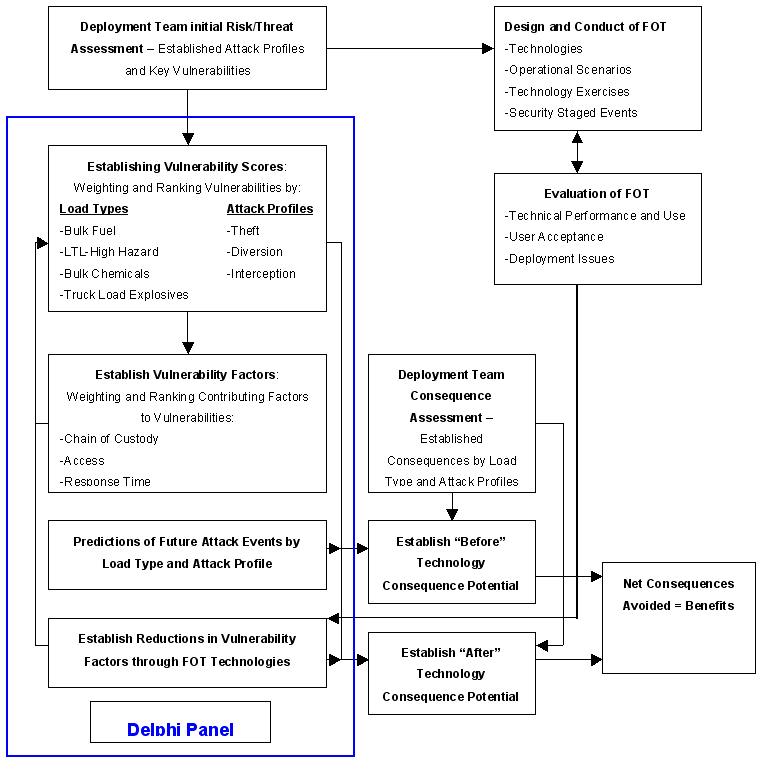
Figure 6-1. Security Assessment Process
6.2 Vulnerabilities and Technology-Enabled Vulnerability Reductions
As defined by deployment Task 1 of the FOT, the following three attack profiles were considered by the Delphi Panel for each load type:
- Theft is undertaken by means of stealth, deception, or force. Stealth and deception are deterred by detection, while force assumes detection and operates within parameters defined by the time to communicate and mount an interdiction. Stealth, deception, and force also define an escalation path for operational planning purposes.
- Diversion is a tactic that results in either theft or interception. The purpose is to create a path to a target opportunity or arrive at a location where control of the cargo by the terrorists can be achieved.
- Interception is the "instantaneous" version of theft in that the cargo is released and/or detonated, and ignited while still in control of the shipper/carrier/consignee. Particularly effective when the radius of damage is large, this is potentially the most violent of attack profiles in that it likely involves explosives as the mechanism for effecting material release.
Contributing to the potential success of an attack, three Vulnerability Factors (VF) were evaluated by the Delphi Panel:
- Chain of Custody – Protection of the Chain of Custody (CoC) is the ability to ensure that a shipment is in authenticated hands during the entire transportation process. CoC represents the first line of defense allowing positive tracking of the material form the point of origin to the point of delivery. Each shipment type infers a set of procedures that are followed at points where custody must affirmed or transferred.
- Access – If an attacker is unable to gain access by intercepting the CoC, this individual may elect to take forcible measures to gain control of the shipment and acquire access. Access is the ability to get inside of a critical effects perimeter (CEP) on the asset given that it has been identified and intercepted. The CEP is different depending on the threat. For detonation in-place, this perimeter can be thousands of feet; for theft, the perimeter may involve cab entry. Access is measured as the probability that the adversary will get inside the CEP for a given shipment type and given threat.
- Response Time – Response time is the timeframe that it takes for authorities to identify that a shipment has been seized, mobilize response forces, close on the asset, and to neutralize the consequence potential. Response time is a function of the level of monitoring, the location and alert posture of response forces, and the ability to track the asset once it has been commandeered.
In establishing the "before" or "no-technology" baseline, the Delphi Panel was surveyed to evaluate the vulnerability of each shipment type against each attack type in a structured format. The panelists assigned a Vulnerability Score(VS) to each of the shipments considered in the FOT for each attack type. The panelists were asked to assign a value in a range using a rating scale from 0.0 to 10.0 (in which 0.0 is extremely low and 10.0 is extremely high). This value, the VS, served three purposes to:
- Establish the vulnerability for a shipment to an attack type (theft, diversion, or interception).
- Establish the Panelists' estimate of the relative vulnerability among all shipment types to a particular attack type.
- Establish the Panelists' estimate of the relative severity among threats.
The Panelists then estimated the contribution of each VF to the VS for each shipment type. This is done by assigning a "weight" (in terms of percentage) to each VF (chain of custody, access, and response time), indicating the Panelists' judgments on the degree of influence each factor has on the overall vulnerability of a shipment type to a specific attack type. The Panelists' judgments are made based on evaluation of the baseline information, or pre-technology condition.
The before (no technology) and after (with technology) impacts of technology on these Delphi Panel-weighted vulnerability factors were incorporated into overall probability of attack success reductions. The weighted sum mean reductions in probability of success for each of the attack types, by load type, and by technology countermeasure, are presented in Tables 6-1 through 6-3, respectively. These were derived by averaging the technology-enabled reductions in vulnerability of the contributing VFs, weighted by the contribution of each VF to the attack types.
The relative likelihood of attack methods and the weighting of vulnerabilities/vulnerability subcomponents assigned to the load types by the Delphi Panel were used to develop overall vulnerability reduction for the technologies by load type. These are average vulnerability reductions weighted by the VSs for each load type. These are presented in Table 6-4 and Figure 6-2.[15] The significance of the overall vulnerability reduction is when multiplied by the potential consequences of attacks using HAZMAT, provides an estimate of potential security benefits afforded by the technologies. The potential security benefits are calculated in Section 6.3 of this synthesis document.
| Technology Countermeasure Scenarios | Bulk Fuel | LTL-High Hazard | Bulk Chemicals | Truckload Explosives |
|---|---|---|---|---|
| Wireless Communications (WC) | 23% | 17% | 19% | 17% |
| WC + GPS Position | 26% | 24% | 27% | 20% |
| Panic Alert + (WC + GPS Position) | 42% | 37% | 42% | 33% |
| Driver ID + (WC + GPS Position) | 40% | 38% | 39% | 29% |
| Vehicle Disabling (+WC + GPS) | 42% | 39% | 44% | 31% |
| Cargo Seals (+WC + GPS Position) | NA | 37% | NA | 29% |
| Cargo Door Locks (+WC + GPS Position) | NA | 36% | NA | 29% |
| PSRC (WC + GPS Position) | 37% | 36% | 39% | 31% |
| ESCM (WC + GPS Position) | 41% | 39% | 39% | 29% |
| Panic Alert + Vehicle Disabling (+WC + GPS) | 52% | 47% | 52% | 40% |
| Panic Alert + Driver ID + Vehicle Disabling (WC + GPS Position) | 58% | 54% | 57% | 43% |
| Panic Alert + Driver ID + ESCM (WC + GPS Position) | 57% | 53% | 55% | 42% |
| Panic Alert + Driver ID + Vehicle Disabling + Cargo Seals (WC + GPS Position) | NA | 53% | NA | 42% |
| Panic Alert + Driver ID + Vehicle Disabling + Cargo Door Locks (WC + GPS Position) | NA | 52% | NA | 42% |
Vulnerability reductions from 0–10 percent are considered nil; reductions from 11–25 percent are considered low; reductions from 26–50 percent are considered medium; and greater than 50 percent are considered a high reduction.
| Technology Countermeasure Scenarios | Bulk Fuel | LTL-High Hazard | Bulk Chemicals | Truckload Explosives |
|---|---|---|---|---|
| Wireless Communications (WC) | 14% | 13% | 11% | 11% |
| WC + GPS Position | 16% | 15% | 14% | 13% |
| Panic Alert (WC + GPS Position) | 26% | 23% | 23% | 23% |
| Driver ID + (WC + GPS Position) | 24% | 23% | 21% | 19% |
| Vehicle Disabling (+WC + GPS) | 25% | 26% | 24% | 21% |
| Cargo Seals + (WC + GPS Position) | NA | 23% | NA | 19% |
| Cargo Door Locks (+WC + GPS Position) | NA | 22% | NA | 19% |
| PSRC (WC + GPS Position) | 24% | 23% | 22% | 22% |
| ESCM (WC + GPS Position) | 24% | 24% | 21% | 19% |
| Panic Alert + Vehicle Disabling + (WC + GPS) | 31% | 31% | 29% | 27% |
| Panic Alert + Driver ID + Vehicle Disabling (WC + GPS Position) | 34% | 34% | 31% | 29% |
| Panic Alert + Driver ID + ESCM + (WC + GPS Position) | 34% | 33% | 30% | 29% |
| Panic Alert + Driver ID + Vehicle Disabling + Cargo Seals + (WC + GPS Position) | NA | 33% | NA | 28% |
| Panic Alert + Driver ID + Vehicle Disabling + Cargo Door Locks + (WC + GPS Position) | NA | 33% | NA | 29% |
Vulnerability reductions from 0–10 percent are considered nil; reductions from 11–25 percent are considered low; reduc tions from 26–50 percent are considered medium; and greater than 50 percent are considered a high reduction.
| Technology Countermeasure Scenarios | Bulk Fuel | LTL-High Hazard | Bulk Chemicals | Truckload Explosives |
|---|---|---|---|---|
| Wireless Communications (WC) | 7% | 5% | 5% | 6% |
| WC + GPS Position | 8% | 6% | 6% | 7% |
| Panic Alert (WC + GPS Position) | 12% | 8% | 9% | 12% |
| Driver ID + (WC + GPS Position) | 11% | 8% | 8% | 9% |
| Vehicle Disabling (+WC + GPS) | 11% | 9% | 10% | 10% |
| Cargo Seals (+WC + GPS Position) | NA | 8% | NA | 9% |
| Cargo Door Locks (+ WC + GPS Position) | NA | 8% | NA | 10% |
| PSRC (WC + GPS Position) | 12% | 9% | 10% | 11% |
| ESCM (WC + GPS Position) | 11% | 8% | 8% | 10% |
| Panic Alert + Vehicle Disabling + (WC + GPS) | 14% | 11% | 12% | 14% |
| Panic Alert + Driver ID + Vehicle Disabling (WC + GPS Position) | 15% | 12% | 13% | 14% |
| Panic Alert + Driver ID + ESCM + (WC + GPS Position) | 15% | 11% | 12% | 14% |
| Panic Alert + Driver ID + Vehicle Disabling + Cargo Seals (WC + GPS Position) | NA | 11% | NA | 14% |
| Panic Alert + Driver ID + Vehicle Disabling + Cargo Door Locks (WC + GPS Position) | NA | 11% | NA | 14% |
Vulnerability reductions from 0–10 percent are considered nil; reductions from 11–25 percent are considered low; reductions from 26–50 percent are considered medium; and greater than 50 percent are considered a high reduction.
| Technology | Bulk Fuel | LTL-High Hazard | Bulk Chemicals | Truckload Explosives |
|---|---|---|---|---|
| Wireless Communications (WC) | 15% | 13% | 12% | 11% |
| WC + GPS Position | 17% | 16% | 16% | 12% |
| Panic Alert + (WC + GPS Position) | 27% | 25% | 25% | 21% |
| Driver ID + (WC + GPS Position) | 25% | 25% | 23% | 18% |
| Vehicle Disabling + (WC + GPS) | 26% | 27% | 26% | 19% |
| Cargo Seals + (WC + GPS Position) | NA | 25% | NA | 18% |
| Cargo Door Locks + (WC + GPS Position) | NA | 24% | NA | 18% |
| PSRC (WC + GPS) | 24% | 25% | 24% | 20% |
| ESCM (WC + GPS) | 25% | 26% | 23% | 18% |
| Panic Alert + Vehicle Disabling + (WC + GPS) | 32% | 32% | 31% | 25% |
| Panic Alert + Driver ID + Vehicle Disabling (WC + GPS Position) | 36% | 37% | 34% | 27% |
| Panic Alert & Driver ID + ESCM (WC + GPS Position) | 35% | 36% | 33% | 26% |
| Panic Alert + Driver ID + Vehicle Disabling + Cargo Seals (WC + GPS Position) | NA | 36% | NA | 26% |
| Panic Alert + Driver ID + Vehicle Disabling + Cargo Door Locks (WC + GPS Position) | NA | 35% | NA | 26% |
Vulnerability reductions from 0–10 percent are considered nil; reductions from 11–25 percent are considered low; reductions from 26–50 percent are considered medium; and greater than 50 percent are considered a high reduction.
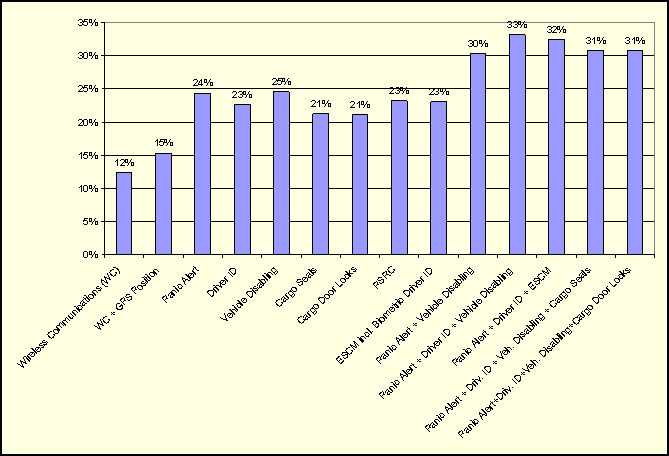
Figure 6-2. Average Percent Reduction in Overall Risk Across Load Types by Technology Combination
6.3 Security Benefits
For the Security Assessment, benefits were defined as potential reductions in the costs (consequences associated with HAZMAT-based terrorist attacks multiplied by the number of attacks) through full deployment of the technologies. These represent societal benefits. The "per event" potential consequences of HAZMAT-based attacks were obtained from a document developed by Battelle for FMCSA that explored the potential economic impacts of intentional and non-intentional releases of HAZMAT. The study examined the potential consequences as measured by:[16]
- Fatalities and injuries.
- Property Damage: Damage to the truck, to other involved vehicles, and to other public and private property.
- Product Loss: Quantity and value of the HAZMAT lost during a spill.
- Environmental damage.
- Evacuation: Predominantly short-term relocation of people and business operations.
- Cleanup: Stopping the spread of a release and removing spilled materials.
- Traffic Delay: Additional travel time experienced by the motoring public due to delays caused by the incident.
- Business Disruption: Businesses having to reduce or cease operations because the facility is inaccessible, supplies cannot be received, or other constraints imposed by the incident.
The estimates of the consequences of intentional releases of HAZMAT were derived through a framework that developed a series of multipliers to estimate the overall economic impacts of HAZMAT releases based on likely numbers of human casualties. The multipliers were based on a proxy measure for estimating effects. As the study states:
Fires were considered a reasonable proxy in that a large-scale hazardous materials incident often includes a fire and/or explosion, affecting multiple residences/businesses and resulting in traffic delays and community disruption.[17]
Using these multipliers with estimated casualties for intentional HAZMAT releases based on load type, quantity and attack scenarios, reasonable worst-case consequence estimates were developed.
The Battelle study presented reasonable worst-case consequence estimates for nine threat-based classes of HAZMAT, four of which are used in estimating potential impact reduction in this assessment. Derivation of the per event consequence values used in this assessment considered the composition of HAZMAT for each load type, potential quantities released (TL versus LTL) and the Delphi Panel predicted distribution of attacks with undirected versus directed (including detonation) releases. Table 6-5 presents the per-attack consequence estimates used for this assessment.[18]
| HAZMAT FOT Load Type | Reasonable Worst-Case HAZMAT Attack Consequences |
|---|---|
| Bulk Fuel | $3.7 Billion |
| LTL High-Hazard | $2.1 Billion |
| Bulk Chemicals | $16.3 Billion |
| Truckload Explosives | $13.3 Billion |
To put these consequence numbers into context, the following examples of the consequences of terrorist attacks in the United States are proffered.
Two tragedies provide examples of the harm that can occur from explosive material delivered in a van or light truck: the 1993 New York World Trade Center (WTC) and the 1995 Oklahoma City Federal Building:[19]
- The 1993 WTC bombing killed six people, injured over 1,000, and resulted in over $113 million in loss of life and bodily injury, and over $510 million in insured losses (based on figures from the Federal Emergency Management Agency). Total losses are estimated to be $623 million.
- The Oklahoma City bombing killed 168 people, injured 601, and resulted in $560 million in loss of life and bodily injury, and over $125 million in insured losses. Total losses are estimated to be $685 million.
Vehicles used in the transportation of hazardous materials typically have much larger capacities than the vehicles used in these two incidents. If these vehicles were used to carry out a terrorist act, the damage would have been far worse. If certain hazardous materials were involved and released in a directed attack, it could result in far greater numbers of casualties and damage to property over a larger area.
Another example of the impacts of directed attacks in the United States, albeit attack(s) using airplanes against buildings as opposed to trucks, is the September 11, 2001 attack(s) on the WTC.
- The Government Accounting Office (GAO) reviewed eight studies from seven organizations that examined the financial impacts of the 9-11 attack on the World Trade Center.[20] The GAO concluded that the study conducted by the New York City Partnership and Chamber of Commerce provided the most comprehensive estimates: $83 billion in 2001 dollars for direct and indirect costs.
Although threat may vary over time and is difficult to predict, in estimating the security benefit, threat was held constant at 100 percent, meaning that there is a 100 percent chance that an attempt will be made to use a HAZMAT shipment for a terrorist attack. By holding threat constant, the security benefits of the technologies were derived using, the overall vulnerability reductions (presented in Section 6.2 of this synthesis document) multiplied by the consequences of HAZMAT-based terrorist attacks. For example, the benefit calculated for Wireless Communications with GPS positioning for Bulk Chemicals is calculated as follows:
(Bulk Chemical Consequence) X (Technology Vulnerability Reduction) = Benefit
= $16.3 Billion Consequence X 16% Vulnerability Reduction from Wireless Communications with GPS Positioning
= $2.6 Billion Benefit
The estimated security benefits are presented in Table 6-6. These figures are not additive across load types.
| Technology | Bulk Fuel | LTL | Bulk Chemicals | Truckload Explosives |
|---|---|---|---|---|
| Wireless Communications (WC) – Cellular Phones, Pagers, Two-Way Radios | $548 | $268 | $1,917 | $1,409 |
| WC + GPS Position (Baseline) | $622 | $348 | $2,581 | $1,657 |
| Panic Alert + (WC + GPS Position) | $995 | $529 | $4,058 | $2,822 |
| Driver ID + (WC + GPS Position) | $933 | $537 | $3,730 | $2,345 |
| Vehicle Disabling (+WC + GPS) | $970 | $573 | $4,278 | $2,556 |
| Cargo Seals (+WC + GPS Position) | NA | $529 | NA | $2,345 |
| Cargo Door Locks (+WC + GPS Position) | NA | $513 | NA | $2,400 |
| PSRC (+WC + GPS) | $908 | $525 | $3,891 | $2,652 |
| ESCM (+WC + GPS) incl. Biometric Driver ID | $946 | $553 | $3,730 | $2,400 |
| Panic Alert + Vehicle Disabling + (WC + GPS) | $1,207 | $689 | $5,098 | $3,355 |
| Panic Alert + Driver ID + Vehicle Disabling (WC + GPS Position) | $1,331 | $776 | $5,539 | $3,547 |
| Panic Alert + Driver ID + ESCM (WC + GPS Position) | $1,318 | $755 | $5,319 | $3,510 |
| Panic Alert + Driver ID + Vehicle Disabling + Cargo Seals (WC + GPS Position) | NA | $755 | NA | $3,469 |
| Panic Alert + Driver ID + Vehicle Disabling + Cargo Door Locks (WC + GPS Position) | NA | $747 | NA | $3,510 |
6.4 Security Assessment Findings
The field data collection and the risk-consequence assessment showed that the primary enabling technology combination on which all other technologies operated was Wireless Communications with GPS positioning. This combination is key to the security architecture deployed in the FOT. To assess the most widely used fleet management technology deployed (Wireless Communications) as a stand-alone application, the Delphi Panel was also asked to provide opinions on the beneficial effects of this technology. In framing the Delphi Panelists' responses, care was given to instruct them to assess the value of each technology independently, therefore, enabling a mix and match approach to technology combinations that could be used to model real-world deployment of technology suites across different load types/operations.
While the technology combinations do show promise for reducing the vulnerabilities of truck-based HAZMAT shipments, and thus, risk as expressed in reduced consequences, the Delphi Panel and the test participants provided a clear message that not all solutions are foolproof. Their responses also indicated that not all solutions perform to form in a dynamic real-world environment in which human and technology failures can occur, and where the adversary is cunning and looking for new ways to subvert security efforts. These opinions provide important discussion points for development of security-related public policy. Following are the key findings derived from the Evaluation Team interaction with the Delphi Panel, which echoed the general comments provided by participating motor carriers:
- Frequency in Driver/Dispatch Communication. It was found that frequent communication with drivers and asset positioning are of significant security benefit. Inherent in the concept of asset positioning was the concept of Geofencing and Untethered Trailer Tracking. With user-configured polling frequency, these forms of communication types allowed dispatchers to know the whereabouts of their drivers and assets, and to be alerted in the event of crisis or exceptions to normal operational parameters.
- Wireless Communications and GPS Positioning. These items were considered vulnerable to possible electronic jamming and the ability of a driver to react and transmit a message while under attack.
- Average Polling Rates. The polling rates for GPS positioning were considered too infrequent to effectively track a vehicle, even at 20-minute average intervals.
- Panic Alerts. These items were considered valuable as reflected in the large incremental increase in vulnerability reduction, but may be limited in effectiveness for more local (within population areas) hauls where the damage could be done before intervention by enforcement. It was recommended that a driver-carried Panic Button be used in conjunction with in-vehicle Panic Buttons. Dissemination of panic notification should be via multiple modes (e-mail, fax, pager, cell phone, etc.).
- Remote Vehicle Disabling. This was also considered a strong vulnerability reduction technology, but it was recommended that it should be combined with driver-local disabling to be most effective, and not be solely reliant upon dispatcher trigger disablement. Additionally, concern was expressed over the reliability of the system to prevent a truck from being inadvertently stranded.
- Driver Identification/Unit Assignment. These were considered useful, but the human/ technology relationship needed improvement (unobtrusive for the driver and more reliable). It was recommended that this technology be coupled with vehicle disablement to prevent unauthorized use of a truck.
- Electronic Manifesting. Acceptance was mixed, with comments focused on the potential system costs, complexity, and lack of a significant base of users as hindering factors.
- Electronic Seals and Remote Door Locking. These were considered useful for detecting tampering or providing a hard lockout until dispatch approves a door opening. These devices were not considered appropriate to Bulk Fuel and Bulk Chemical operations. Additionally the E-seal concept was not considered as mature as some of the other technologies; therefore reliability and potential cost were issues.
- The Public Sector Reporting Center. In concept, this item was considered as a strong vulnerability reduction system. In terms of identifying crisis and reducing response time, concerns exist about the potential frequency of false alarms/alerts that would burden public safety agencies, integration with existing systems such as computer-aided dispatch (CAD), and the potential cost of deployment.
10. Battelle, HAZMAT Field Operational Test Task One: Conduct A Risk/Threat Assessment, Draft Report prepared for the U.S. Department of Transportation (USDOT), Federal Motor Carrier Safety Administration (FMCSA), October 2002. Also, from Battelle, Framework for Assessing Safety & Security Incident Consequences for Highway Shipments of Hazardous Materials, Final Report, prepared for the USDOT and FMCSA, December 2003.
11. On the basis of the Deployment Team's initial Threat/Risk Assessment, load/operational types were prioritized with four type chosen for the FOT: Bulk Fuel; Less-than-Truckload-High Hazard Materials; Bulk Chemicals; and Truckload Explosives.
12. The Delphi Method provides a technique to arrive at a group position regarding an issue under investigation. This method consists of a distributing a series of repeated interrogations, usually as questionnaires, to a group of individuals whose opinions or judgments are of interest. After the initial interrogation of each individual, each subsequent interrogation is accompanied by information regarding the preceding round of replies, usually presented anonymously. The participant is encouraged to reconsider, and if appropriate, to change a previous reply in light of the replies of other group members. After two or three rounds, the group position is determined by averaging the responses. The Delphi Method was originally developed at the RAND Corporation by Olaf Helmer and Norman Dalkey.
13. The Volpe Center, Surface Transportation Vulnerability Assessment, October 25, 1999.
14. Evangelos Triantaphylou and Chi-Tun Lin, Development and Evaluation of Five Multi-Attribute Decision Making Methods, International Journal of Approximate Reasoning, 1996, Volume 14, pp. 281–310.
15. In Tables 6-1 through 6-3, electronic cargo seals and remote door locks were considered to be impractical for Bulk Fuel and Bulk Chemical load types, therefore "NA" ("Not Applicable") is used.
16. Framework for Assessing Safety & Security Incident Consequences for Highway Shipments of Hazardous Materials, Final Report, Battelle, prepared for the USDOT and FMCSA, December 2003.
17. Framework for Assessing Safety & Security Incident Consequences for Highway Shipments of Hazardous Materials, Final Report, Battelle, prepared for the USDOT and FMCSA, December 2003.
18. Per event consequence estimates based on weighted averages of Delphi-predicted attacks by attack profile (directed release versus undirected release) and the following load types:
- Bulk Fuel – average of flammable liquids and flammable gases – Bulk quantity.
- LTL – heavier than air PIH in LTL quantity (LTL impacts estimated at 6 percent of TL or bulk impacts).
- Bulk Chemicals – heavier than air PIH in Bulk quantity.
- Truckload Explosives – sensitive explosives in Bulk quantity.
19. Federal Register / Vol. 68, No. 86 / Monday, May 5, 2003 / Rules and Regulations, p. 23867.
20. U.S. Government Accounting Office, GAO-02-700R, Impact of Terrorist Attacks on the World Trade Center, May 29, 2002 . The reports that were reviewed were prepared by: the New York City Office of the Comptroller; New York Governor and State Division of the Budget; New York City Partnership and Chamber of Commerce; Fiscal Policy Institute; New York State Senate Finance Committee; Milken Institute; and, New York State Assembly Ways and Means Committee.
