
8. Benefit-Cost Assessment and Deployment Potential
This section presents an overview of the processes of estimating the potential benefits and costs for the technologies and combinations of technologies tested during the FOT on a macro- and micro- (firm level) economic basis, and presents the finding regarding the market or full deployment potential for the industry.
8.1 Overview
8.1.1 Benefit-Cost Assessment
In Volume III, Sections 2 and 3 present the security, operational efficiency and safety benefits that could be realized through the use of the technologies tested in the FOT. The security benefits were derived using FOT results in terms of the technical efficacy of the technologies. The benefits were also derived from the test participants' perceptions of the technologies and levels of potential consequence associated with the deliberate release or use of the hazardous materials associated with terrorist attack scenarios. This information was provided to a panel of industry experts (a Delphi Panel). The Panelists provided their opinions regarding relative risks and vulnerabilities; effectiveness of technologies to address the risks and vulnerabilities; and expectations of terrorist attempts in the near future to commandeer HAZMAT shipments and use them as weapons.
The processing of information to and from the Delphi Panel was conducted within a rigorous analytical framework that allowed for the derivation of macro, or societal, benefits (defined as reductions in potential consequences associated with HAZMAT-based terrorist attacks). These were developed for the four key load or operational types that comprise the majority and most at risk truck-based HAZMAT shipments.
Efficiency benefits – those benefits that accrue directly to the motor carriers – were calculated based on potential changes in operations due to the use of the FOT technologies. As described in Volume III, Section 2, few if any benefits were directly associated with the FOT technologies beyond the base enabling technology combination of Wireless Communications with GPS asset tracking. The calculated benefits were ascribed to improved asset and personal utilization and reduced communications costs. Anecdotally, participating motor carriers did view the ESCM as having the potential to augment their current freight tracking capabilities and reduce administrative costs associated with processing shipping documentation.
8.1.2 Industry Deployment Potential
The calculated macro-economic benefits and costs are directly related to the level of technology deployment by motor carriers hauling HAZMAT and are expressed over a range of potential deployment levels. Supporting the estimation of these macro-economic benefits and costs is the definition of potential market. Market (or full deployment) potential is defined in terms of the number of power units in each of the four load types that could be equipped with one or more technology combinations. Estimates of potential technology adoption by motor carriers and minimum acceptable return on investment periods is defined through the Deployment Team's motor carrier industry survey effort[24] and qualitative input from the motor carrier test participants regarding the financial attractiveness of the test technologies.
Taken together, the aforementioned inputs provide a basis for defining the likely current level of technology deployment (with current levels of benefit versus an assumed baseline of no technologies), projected into the near future (3 years). The current and future levels of technology adoption, associated benefits, and costs are compared to the maximum or full deployment potential levels, with the gaps quantified.
8.2 Industry Demographics
The Security Assessment and Efficiency Assessment provide system and motor carrier or shipment-level assessment of technology and procedural countermeasure efficacy. These efficacies were expressed by reductions in potential consequence(s) of HAZMAT-based attacks and profitability to motor carriers. To demonstrate the potential costs and benefits of motor carrier industry-wide adoption of the technologies, this assessment reduces the estimates to a per-truck basis, then extrapolates the security and efficiency findings to the universe of truck-based HAZMAT shipping in the United States.
This is done using demographic data on HAZMAT carriers documented in the FMCSA-maintained Motor Carrier Management Information System (MCMIS) Census File. MCMIS is a computerized system containing comprehensive industry demographic records (fleet sizes, load types, etc.). These records also contain safety performance records for the motor carriers and HAZMAT shippers who are subject to the Federal Motor Carrier Safety Regulations (FMCSR) or Hazardous Materials Regulations (HMRs).
The MCMIS Census file HAZMAT carrier-specific records were extracted and used to define the typology of the industry. Records were segregated for each HAZMAT class and division type, and shipment type (Bulk, Non-Bulk, or Bulk and Non-Bulk shipments). The fleet-specific data was aggregated by HAZMAT class, division, and shipment types into representations of the HAZMAT mix for the four load types being considered in the FOT. (In actually, there were five load types – LTL represents high-hazard shipments [Bulk and Non-Bulk type services].) These aggregations are detailed in Volume III, Section 4.
8.2.1 Industry Topology by Size
The numbers of trucks by load type formed the basis for establishing the per-unit benefits and costs and the full deployment potential. Within load type, the fleets were stratified based on number of trucks. This stratification was done to enable the assigning technology costs and potential for technology adoption most appropriate to the fleets – in general, smaller fleets are more capital constrained and often require a different technology mix for managing fewer assets. The fleet stratification was indifferent to the double counting of trucks across load types, as the assumed constraining factor to technology adoption is overall fleet size, regardless of specific loads.
Based on MCMIS, there are approximately 709,000 trucks associated with 26,760 U.S. fleets hauling HAZMAT in the four main load types. The demographics for the four operational segments for this FOT are covered in Volume III, Section 4.
8.2.2 Distribution of Fleets by Size and Relationship to Technology Adoption
As previously discussed, fleet size is related to the level of fleet management support technologies required to maximize operational efficiencies. For example, a fleet with only a few trucks and drivers would not likely require integrated communications, tracking, and decision support systems as would a fleet of 50 trucks or a fleet of 500 or more trucks would. In the case of small fleets, cell phones may be all that is needed to maintain driver-dispatcher communications and establish current truck location. However, a larger fleet with greater demands on dispatchers may find the need for text messaging and vehicle tracking capabilities.
Across the four load types, approximately one-quarter to over one-third of the carriers is a one-truck operation. These one-truck operations require little, if any, technology above basic cellular or satellite phone services to support voice and Internet access for customer contact and load finding/bidding.
Fleets containing less than 10 trucks represent between two-thirds and over three-quarters of the HAZMAT haulers. As with the one-truck operations, methods of communications and fleet management are generally reliant upon low-cost solutions – mobile phone, two-way radio, and paging systems. Aside from the one-truck operations, there is potential for productivity improvements by adopting technologies (if priced at levels acceptable to small fleets) even in this universe of small operations.
Realizing the differing operational needs of fleets of different sizes and operational characteristics, the FOT fielded technologies in six different tiers of hardware, capabilities, and pricing per truck. Additionally, one FOT component was the development of a compendium of commercially available fleet management and security technologies of varying capabilities and pricing schemas that could provide affordable solutions for small fleets. These are discussed in detail in Section 5 of this synthesis document.
8.3 Motor Carrier Technology Adoption
The motor carrier industry is a diverse collection of industries, with each responding to the unique demands of customers. Within each of these sub-industries or industry segments, there also exists a large amount of differentiation in how individual trucking companies operate and what portfolio of fleet management solutions (technical and non-technical) are used to conduct business. To support this diverse industry, a wide range of technology solutions are available to motor carriers, but not all commercial offerings are applicable to individual companies' operational needs or ability to pay for them.
Based on fleet size (a prime factor regarding levels of technology adoption and one of the most readily measurable factors) estimates were developed for the current level and near-term future levels of technology use by the four load types included in the FOT.
8.3.1 Estimation of Current and Expected Annual Growth in Technology Usage
To assess the propensity of carriers to adopt particular technology solutions, the Deployment Team surveyed motor carriers transporting HAZMAT in the second and third quarter of 2003. When returned by 153 motor carriers, the survey questionnaire produced a broad diversity of responses regarding fleet sizes, range of operations, routing variability, and general operational characteristics. The surveyed motor carriers provided the levels of fleet management technologies currently used and those to be employed in the near-term (3 years future).
The Evaluation Team recognizes that the responses to the Deployment Team survey represent approximately 0.6 percent of HAZMAT carriers considered in this analysis, a relatively thin sample on which to base market projections.
To assess possible over/under estimation within fleet size and technology bins for the Deployment Team's HAZMAT Industry Technology Analysis, the results of two other industry technology surveys were reviewed.[25] Additionally, a study of technology use by over 900 motor carriers conducted for FMCSA also was consulted.[26] These sources, while suggestive in content, enabled the validation of initial approximations of current technology usage by carriers derived through the HAZMAT Industry Technology Analysis.
8.3.2 Estimated Current Use of Technology by HAZMAT Carriers
The estimated percentage of fleets using the FOT-technologies was applied to the fleet size demographics presented in Section 2.1of this synthesis document to provide estimates of the number of technology-equipped trucks in the fleets. It is assumed that if a fleet used a particular technology, it would be used in all of the trucks associated with a particular load type. As previously noted, the more localized hauls of Bulk Fuel and LTL express or Non-Bulk-type services are assumed to use the Terrestrial Communications system rather that the Satellite Communications system.
Weighted sum averages were developed for each of the load types and technologies to derive the estimated number of trucks using the technologies. These averages were calculated by multiplying the percent distribution of fleets by size by load type by the percent of technology adoption for the fleet size bin, and then summed across a particular technology. The resultant technology percent adoption rates by load type were then multiplied by the number of trucks for each load type to estimate the maximum percent of equipped trucks within each load type. Tables outlining this information are contained in Volume III, Section 4.
The estimated current levels of technology deployment developed through this effort indicate that with the exception of cell phones, paging systems and two-way radio (approximately 87 percent of trucks), Satellite Communications (59 to 63 percent of trucks) and asset tracking (45 to 48 percent of trucks) technology adoption is limited among the four load types. On-Board Computers are used in approximately 12 percent of trucks and 20 percent of trucks are from fleets using Web-based shipment tracking systems (a proxy for the ESCM test system). The percentages for the other technologies are estimated to be at most 13 percent of trucks, with most below 10 percent of trucks.
Also, based on the survey responses, it is estimated that over the next three years, modest annual growth is expected for the technologies: Satellite Communications (1.7 to 2.3 percent); Panic Buttons (1.3 to 1.4 percent); Vehicle Tracking (0.8 to 1.1 percent); On-Board Computers (2.4 to 2.9 percent); Automated Driver Identification (1.0 to 1.3 percent); and Remote Vehicle Disabling (1.2 to 1.4 percent). Less than 1 percent annual growth in technology adoption is expected for the remaining technologies, with especially small growth in cell phone/pager systems, as these have already approached near universal adoption.
In context, the current level of technology adoption, as expressed in technology-equipped trucks, represents costs already incurred and benefits already being realized compared to the baseline (no technology) efficiency and security costs and benefits.
8.4 Estimated Efficiency Benefits and Costs
For the efficiency assessment, the key finding was that the participating motor carriers ascribed little operational efficiency impacts to the test technologies, with the exception of Wireless Communications with GPS tracking capabilities. The motor carriers' primary viewpoints for operational efficiency were focused on the following: the ability to communicate efficiently with drivers, to know where the vehicles are and when to manage customer requests for status and arrival times; track driver and vehicle operational performance on the road; and to effect better load planning.
8.4.1 Benefits, Costs, and ROI Summary
Using detailed quantitative operational data and qualitative perception data from the participants and archived transaction records and pricing schemas from QUALCOMM, financial performance analyses were developed for the combination of Wireless Communications with GPS asset positioning. For the industry segments, LTL-High Hazard, Bulk Chemicals, and Truckload Explosives, benefits focused on the following elements:
- Reduced telecommunications costs.
- Increased driver to dispatcher ratios.
- Reduced on-the-road downtime translated into potential load increases or trips.
- Reduced fuel consumption and engine wear.
- Reduced maintenance costs and increased revenue through decreased repair down time.
- Reduced out-of-route miles.
For Bulk Fuel and LTL-Non-Bulk operations, which as a key performance metric use driver utilization versus a calculated target (in terms of on-time performance or pounds of product moved), benefits were derived in terms of saved driver time, while holding other variables constant.
To summarize, estimated monthly benefits per truck from Section 5 of this synthesis document are:
- Bulk Fuel – $486
- LTL (Non-Bulk) – $160
- LTL-High Hazard – $196 to $820
- Bulk Chemicals – $130 to $593
- Truckload Explosives – $152 to $917
8.4.2 Cost and ROI Summary
The benefits presented in Section 6 of this synthesis document were compared to the generally, more high-end costs of the satellite- and terrestrial-based product/service offerings to estimate benefit-cost ratios and expected payback periods. Table 8-1 presents the costs by industry segment (capital costs are amortized over 3 years). Using these costs from Table 8-1and benefits developed in Section 5 of this synthesis document, benefit-cost ratios and payback periods in months were calculated, with the results reported in Table 8-2. The annual costs per truck include the initial purchase of equipment and installation amortized over 3 years plus annual messaging and maintenance service fees. These are from the figures presented in Table 8-1. The type of equipment – Terrestrial- versus Satellite-based assumed for each load type is: Bulk Fuel and LTL Non-Bulk-terrestrial (T) and LTL High-Hazard, Bulk Chemicals, and Truckload Explosives – Satellite (S). The choice of Terrestrial- versus Satellite-based systems is based on using the lowest cost service appropriate to the operational characteristics associated with the test scenarios. For example terrestrial is more appropriate for the shorter hauls in more developed areas with good terrestrial coverage associated with the Bulk Fuel and LTL-Non-Bulk scenarios. The longer hauls in more remote areas characteristic of the Bulk Chemical, LTL-High Hazard and Truckload Explosives operations require the coverage afforded by satellite service.
| Item | Purchase Cost/Truck Terrestrial/Satellite | Annual Cost/Truck Terrestrial/Satellite |
|---|---|---|
| Mobile Communications with GPS Tracking Units (Hardware Costs) | $1,000/$2,000 | $336/$672 |
| Installation | $200 | $72 |
| Basic Monthly Service (per truck)[27] |  |
$600 |
| Monthly Maintenance Agreement | |
$180 |
| Total Per Truck Costs | $1,200/$2,200 | $1,188/$1,524 |
| Segment/Fleet Size | Annual Cost/Truck[28] | Annual Benefit/Truck | Benefit-Cost Ratio | Payback on Purchase in Months |
|---|---|---|---|---|
| Bulk Fuel (Terrestrial) | $1,188 | $5,832 | 4.9:1 | 3 |
| LTL-High Hazard (Satellite) | $1,524 | $2,352 to $9,840 | 1.5:1 to 6.5:1 | 3 to 17 |
| LTL Non-Bulk (Terrestrial) | $1,188 | $1,920 | 1.6:1 | 13 |
| Bulk Chemicals (Satellite) | $1,524 | $1,560 to $7,116 | 1.0:1 to 4.7:1 | 5 to 34 |
| Truckload Explosives (Satellite) | $1,524 | $1,824 to $11,004 | 1.2:1 to 7.2:1 | 3 to 25 |
Though not all industry segments would realize significant benefit from this combination of technologies (i.e., one-truck fleets), one key parameter must be met to realize the potential for these systems among industry segments in which benefits could be realized – delivering financial break even in a relatively short time period of time. The payback periods estimated for the high-end units are within documented ranges for maximum time period that most motor carriers are willing to accept for return on investment.
In a survey of 100 motor carriers conducted in late 2002 by ATRI and GartnerG2, it was found that across all respondents, only 28 percent would accept a payback period between 2 and 3 years, of which only one in four would be willing to accept a payback period in excess of 3 years. The potential market penetration rate more than doubles to 59 percent if the payback period decreases to between 1 and 2 years.[29] The survey also noted that increased potential market penetration occurs more robustly with shorter payback timeframes in small- and mid-sized fleets than in larger fleets.
Smaller fleets comprise a considerable proportion of the trucking industry. These fleets also adopt technologies at a less robust rate than their larger counterparts. In part, this is due to limited need for advanced communications; tracking and decision support to manage a small fleet; limited time and capital to invest in and train on new technology solutions; limited desire to move from accepted "tried and true" ways of conducting their businesses; and lesser over time, limited low-price, high functionality product offerings. For small fleets of less than nine trucks, 91 and 60 percent of respondents would accept a maximum payback period of 6 to 12 months and 13 to 24 months, respectively, for new technology purchases. In the ROI analysis summarized above, even with considering a product on the high end of the pricing scale, the estimated payback periods would be attractive to many fleets. In the example of LTL, the 13-month payback period assumed a very conservative benefit metric; therefore, a payback period of less than 12 months is likely.
Given the breadth of product offerings, documented in the Deployment Team's Technology Compendium, basic communications and tracking capabilities can be obtained for as low as $25 to $50 per month, but without the capabilities of additional technology add-ons.
8.4.3 Industry Deployment and Potential ROI
Given the conservative range of benefit estimates and using the high-end of technology costs, potential industry benefits and costs were derived. These are presented in Table 8-3. In defining the market potential, it is recognized that there may be minimum fleet sizes in these sectors under which the usefulness of integrated communications and tracking systems may be easily reproduced with less advanced methods and technologies, such as cell phones and pagers. Therefore, it is assumed that fleets of less than 10 trucks would not migrate from basic cell phone/pager communications systems to an integrated Wireless Communications system with GPS positioning due to a lesser need for technology-enhanced fleet management in this class of carriers.
Eliminating fleets of nine trucks or less would remove 3,995, 2,262, 6,965, 1,507, and 389 trucks from the market potential for Bulk Fuel, LTL-High Hazard, LTL-Non-Bulk Service, Bulk Chemicals, and Truckload Explosives sectors, respectively. The new total "trucks by industry" segment is referred to as "New Market Potential." The analysis in Table 8-3 shows that approximately 54 percent of potential market has yet to be realized.[30]
| Load Type | New Potential Market | Current Penetration | % Current Penetration | Unrealized Market Potential |
|---|---|---|---|---|
| Bulk Fuel | 111,031 Trucks | 51,768 Trucks | 47% | 59,264 Trucks |
| LTL-High Hazard | 145,184 Trucks | 70,779 Trucks | 49% | 74,405 Trucks |
| LTL-Non-Bulk | 368,380 Trucks | 178,926 Trucks | 49% | 189,454 Trucks |
| Bulk Chemicals | 61,168 Trucks | 28,963 Trucks | 47% | 32,204 Trucks |
| Truckload Explosives | 8,195 Trucks | 3,823 Trucks | 47% | 4,373 Trucks |
To realize the full potential benefits (moving from current levels of deployment to full deployment), it is estimated that the HAZMAT trucking industry (at the high end) would have to invest an initial $543 million and incur annual service fees of $829 million per year. If the purchase costs were amortized over 3 years, total annual costs (including monthly service fees) would be approximately $457 million. Offsetting these costs would be increase profitability, estimated to range from $943 million to $1.7 billion per year. These estimates are presented in Table 8-4.[31]
| Load Type | Unrealized Market Potential | Technology Investment | Investment Amortized Over 3 Years | Annual Service Fees | Total Annual Costs | Total Annual Benefits |
|---|---|---|---|---|---|---|
| Bulk Fuel | 59,264 Trucks | $71 | $24 | $46 | $69 | $346 |
| LTL-High Hazard | 74,405 Trucks | $164 | $55 | $57 | $112 | $175 to $732 |
| LTL-Non-Bulk | 189,454 Trucks | $227 | $76 | $146 | $221 | $364 |
| Bulk Chemicals | 32,204 Trucks | $71 | $24 | $25 | $48 | $50 to $229 |
| Truckload Explosives | 4,373 Trucks | $10 | $3 | $3 | $7 | $8 to $48 |
| Totals | 359,700 Trucks | $543 | $181 | $276 | $457 | $943 to $1,719 |
8.5 Estimated Security Benefits and Costs
8.5.1 Benefits-Consequence Avoidance
As presented in Section 6.3 of this synthesis document, security benefits were defined as potential reductions in the costs or consequences of truck-based HAZMAT attacks. These were derived by applying the estimated percent reductions in HAZMAT trucking vulnerabilities to the reasonable worst-case consequences of attacks using HAZMAT. The reduction vulnerabilities translate directly into the reduction in probability that a HAZMAT load will be successfully used in an attack. It should be noted that partial deployment might not necessarily result in a directly proportional security benefit. In other words, 50 percent deployment may not yield 50 percent of achievable security benefits. This may occur because while the technology-equipped fleet may not be attacked, a non-equipped fleet would possibly be targeted instead. The deterrent effect of the technologies, if partly deployed, could simply shift terrorist targeting from one fleet to another, with no net change in overall security. Under this assumption, then full deployment is required to realize the security benefits.
For each technology combination and load type, attack cost reductions (benefits) were calculated. For the convenience of the reader, these are reiterated in Table 8-5 and later presented in Table 8-10 as part of the security benefit-cost ratio presentation.
| Technology | Bulk Fuel | LTL | Bulk Chemicals | Truckload Explosives |
|---|---|---|---|---|
| Wireless Communications (WC) – Cellular Phones, Pagers, Two-Way Radios | $548 | $268 | $1,917 | $1,409 |
| WC + GPS Position (Baseline) | $622 | $348 | $2,581 | $1,657 |
| Panic Alert + (WC + GPS Position) | $995 | $529 | $4,058 | $2,822 |
| Driver ID + (WC + GPS Position) | $933 | $537 | $3,730 | $2,345 |
| Vehicle Disabling (+WC + GPS) | $970 | $573 | $4,278 | $2,556 |
| Cargo Seals (+WC + GPS Position) | NA | $529 | NA | $2,345 |
| Cargo Door Locks (+WC + GPS Position) | NA | $513 | NA | $2,400 |
| PSRC (+WC + GPS) | $908 | $525 | $3,891 | $2,652 |
| ESCM (+WC + GPS) incl. Biometric Driver ID | $946 | $553 | $3,730 | $2,400 |
| Panic Alert + Vehicle Disabling + (WC + GPS) | $1,207 | $689 | $5,098 | $3,355 |
| Panic Alert + Driver ID + Vehicle Disabling (WC + GPS Position) | $1,331 | $776 | $5,539 | $3,547 |
| Panic Alert + Driver ID + ESCM (WC + GPS Position) | $1,318 | $755 | $5,319 | $3,510 |
| Panic Alert + Driver ID + Vehicle Disabling + Cargo Seals (WC + GPS Position) | NA | $755 | NA | $3,469 |
| Panic Alert + Driver ID + Vehicle Disabling + Cargo Door Locks (WC + GPS Position) | NA | $747 | NA | $3,510 |
8.5.2 Costs
Costs are defined as the expense of purchasing and installing technology initially, plus ongoing message service (including hourly position reports) and maintenance fees.[32] The ongoing costs are assumed for 3 years, with annual discounting of 1.016 percent, per OMB requirements for discounting future cash flows.[33] The technology costs are based on the pricing tiers proposed in the Deployment Team's Concept of Operations and fielded during the FOT, adjustments to the FOT pricing following test deployment, and consultation with the Deployment Team's Technology Compendium.[34]
Table 8-6 presents the estimated per truck costs for the technologies by technology scenario and load type over 3 years. The figures in this table assume that if a carrier hauls one of the scenario load types, then all of the trucks in this fleet as reported in MCMIS are assigned to the load type. The exception is where more than one HAZMAT type is indicated for a fleet, in that case, the fleet vehicles are split evenly between the load types. This assumption assures that if non-HAZMAT dedicated equipment is used in transporting HAZMAT, then the costs of realizing the technology security benefits are fully accounted for. These two sets of estimates enable the calculation of break even points for number of successful attacks and potential benefit-cost ratios for the technologies (and combinations of technologies) as a whole.
| Technology | Bulk Fuel | LTL[35] | Bulk Chemicals | Truckload Explosives |
|---|---|---|---|---|
| Wireless Communications (WC) – Cellular Phones, Pagers, Two-Way Radios | $1,822 | $1,822 | $1,822 | $1,822 |
| WC + GPS Position (Baseline) | $3,504 | $4,204 | $4,504 | $4,504 |
| Panic Alert + (WC + GPS Position) | $3,704 | $4,404 | $4,704 | $4,704 |
| Driver ID + (WC + GPS Position) | $3,804 | $4,504 | $4,804 | $4,804 |
| Vehicle Disabling (+WC + GPS) | $3,804 | $4,504 | $4,804 | $4,804 |
| Cargo Seals (+WC + GPS Position) | NA | $4,704 | NA | $5,004 |
| Cargo Door Locks (+WC + GPS Position) | NA | $4,704 | NA | $5,004 |
| PSRC (+WC + GPS)[36] | $3,554 | $4,254 | $4,554 | $4,554 |
| ESCM (+WC + GPS) incl. Biometric Driver ID | $4,004 | $4,704 | $5,004 | $5,004 |
| Panic Alert + Vehicle Disabling + (WC + GPS) | $4,004 | $4,704 | $5,004 | $5,004 |
| Panic Alert + Driver ID + Vehicle Disabling (WC + GPS Position) | $4,304 | $5,004 | $5,304 | $5,304 |
| Panic Alert + Driver ID + ESCM (WC + GPS Position) | $4,504 | $5,204 | $5,504 | $5,504 |
| Panic Alert + Driver ID + Vehicle Disabling + Cargo Seals (WC + GPS Position) | NA | $5,504 | NA | $5,804 |
| Panic Alert + Driver ID + Vehicle Disabling + Cargo Door Locks (WC + GPS Position) | NA | $5,504 | NA | $5,804 |
For the "Total Deployment Costs," all trucks assigned to the load type are assumed to be equipped with the technology. For the "Marginal Deployment Costs" (i.e., the costs that would have to be incurred above current and committed to deployment), it was assumed that the number of trucks to be equipped is based on the most limiting technology in the combination (the technology requiring the most number of trucks to be equipped).
For example, to reach full deployment for a technology combination of X technology requiring 9 trucks to be equipped and Y technology requiring 10 trucks to be equipped, then the methodology assumes 10 trucks to be equipped for both technologies. This is done in recognition that product integration issues may require a total refit of the technologies in the combination. Table 8-7 presents these estimated numbers of trucks.
| Technology | Bulk Fuel | LTL | Bulk Chemicals | Truckload Explosives |
|---|---|---|---|---|
| Total Number of Trucks by Load Type | 115,026 | 522,793 | 62,675 | 8,287 |
| Wireless Communications (WC) – Cellular Phones, Pagers, Two-Way Radios | 22,326 | 105,199 | 12,385 | 1,651 |
| WC with GPS Positioning | 44,007 | 188,104 | 23,573 | 3,229 |
| Mayday or Driver Panic Buttons | 100,839 | 464,468 | 55,469 | 7,452 |
| Automated Driver ID System | 98,148 | 448,538 | 53,833 | 7,212 |
| Remote Vehicle Disabling System | 105,897 | 488,902 | 58,300 | 7,823 |
| Electronic Cargo Seals/ Locks | 111,031 | 513,564 | 61,168 | 8,181 |
| Web-Based Shipment Tracking System (Proxy for Electronic Manifesting) | 88,115 | 402,122 | 48,306 | 6,503 |
| Public Safety Reporting Center (PSRC)[37] | 115,026 | 522,793 | 62,675 | 8,287 |
Given current levels of deployment, Table 8-8 presents the "Marginal Deployment Costs" or the costs that would need to be incurred to move from the current deployment levels to full deployment. These are presented to provide the reader with the levels of investment that would be required above current levels to realize full deployment. The Total Full Deployment Costs (all trucks) is presented in Table 8-9 and is used with the security benefits previously presented to derive benefit-cost ratios for the technologies.
| Technology | Bulk Fuel | LTL[38] | Bulk Chemicals | Truckload Explosives |
|---|---|---|---|---|
| Wireless Communications (WC) – Cellular Phones, Pagers, Two-Way Radios | $41 | $192 | $23 | $3 |
| WC + GPS Position (Baseline) | $154 | $791 | $106 | $15 |
| Panic Alert + (WC + GPS Position) | $373 | $2,045 | $261 | $35 |
| Driver ID + (WC + GPS Position) | $373 | $2,020 | $259 | $35 |
| Vehicle Disabling (+WC + GPS) | $403 | $2,202 | $280 | $38 |
| Cargo Seals (+WC + GPS Position) | NA | $2,416 | NA | $41 |
| Cargo Door Locks (+WC + GPS Position) | NA | $2,416 | NA | $41 |
| PSRC (+WC + GPS) | $409 | $2,224 | $285 | $747 |
| ESCM (+WC + GPS) incl. Biometric Driver ID | $393 | $2,110 | $269 | $36 |
| Panic Alert + Vehicle Disabling + (WC + GPS) | $424 | $2,300 | $292 | $39 |
| Panic Alert + Driver ID + Vehicle Disabling (WC + GPS Position) | $456 | $2,446 | $309 | $41 |
| Panic Alert + Driver ID + ESCM (WC + GPS Position) | $477 | $2,544 | $321 | $43 |
| Panic Alert + Driver ID + Vehicle Disabling + Cargo Seals (WC + GPS Position) | NA | $2,826 | NA | $47 |
| Panic Alert + Driver ID + Vehicle Disabling + Cargo Door Locks (WC + GPS Position) | NA | $2,826 | NA | $47 |
| Technology | Bulk Fuel | LTL | Bulk Chemicals | Truckload Explosives |
|---|---|---|---|---|
| Wireless Communications (WC) – Cellular Phones, Pagers, Two-Way Radios | $210 | $953 | $114 | $15 |
| WC + GPS Position (Baseline) | $403 | $2,198 | $282 | $37 |
| Panic Alert + (WC + GPS Position) | $426 | $2,302 | $295 | $39 |
| Driver ID + (WC + GPS Position) | $438 | $2,354 | $301 | $40 |
| Vehicle Disabling (+WC + GPS) | $438 | $2,354 | $301 | $40 |
| Cargo Seals (+WC + GPS Position) | NA | $2,459 | NA | $41 |
| Cargo Door Locks (+WC + GPS Position) | NA | $2,459 | NA | $41 |
| PSRC (+WC + GPS) | $409 | $2,224 | $285 | $38 |
| ESCM (+WC + GPS) incl. Biometric Driver ID | $461 | $2,459 | $314 | $41 |
| Panic Alert + Vehicle Disabling + (WC + GPS) | $461 | $2,459 | $314 | $41 |
| Panic Alert + Driver ID + Vehicle Disabling (WC + GPS Position) | $495 | $2,616 | $332 | $44 |
| Panic Alert + Driver ID + ESCM (WC + GPS Position) | $518 | $2,720 | $345 | $46 |
| Panic Alert + Driver ID + Vehicle Disabling + Cargo Seals (WC + GPS Position) | NA | $2,720 | NA | $48 |
| Panic Alert + Driver ID + Vehicle Disabling + Cargo Door Locks (WC + GPS Position) | NA | $2,877 | NA | $48 |
8.5.3 Benefits Versus Costs
The effort estimated the potential benefit-cost ratios for the technology countermeasures. A key variable for this calculation of benefit-cost ratios is the estimated overall reductions in vulnerabilities developed through the Delphi process, discussed in Section 6 of this synthesis document, and applied to the potential consequences of terrorist attacks using HAZMAT.
Using the Total Deployment Costs from Table 8-8 and benefits from Table 8-5, benefit-cost ratios were developed for the technologies. These security benefit cost-ratios are presented in Table 8-10. These figures are not additive across load types.
As displayed in Table 8-10, all technology scenarios across three of the four load types demonstrate potential security benefit-cost ratios greater than 1 using assumed high costs and conservatively estimated benefits. The obvious exceptions are the LTL scenarios in which the potential consequence and attractiveness of the LTL loads for use as a weapon of mass effect is relatively low and the number of trucks that would require being equipped is relatively high.
Load Type |
Bulk Fuel |
LTL[39] |
Bulk Chemicals |
Truckload Explosives |
||||||||
|---|---|---|---|---|---|---|---|---|---|---|---|---|
| Technology | Cost | Benefit | Benefit-Cost Ratio | Cost | Benefit | Benefit-Cost Ratio | Cost | Benefit | Benefit-Cost Ratio | Cost | Benefit | Benefit-Cost Ratio |
| Wireless Communications (WC) – Cellular Phones, Pagers, Two-Way Radios | $210 | $548 | 2.6 | $953 | $268 | 0.3 | $114 | $1,917 | 16.8 | $15 | $1,409 | 93.9 |
| WC + GPS Position | $403 | $622 | 1.5 | $2,198 | $348 | 0.2 | $282 | $2,581 | 9.2 | $37 | $1,657 | 44.8 |
| Panic Alert + (WC + GPS Position) | $426 | $995 | 2.3 | $2,302 | $529 | 0.2 | $295 | $4,058 | 13.8 | $39 | $2,822 | 72.4 |
| Driver ID + (WC + GPS Position) | $438 | $933 | 2.1 | $2,354 | $537 | 0.2 | $301 | $3,730 | 12.4 | $40 | $2,345 | 58.6 |
| Vehicle Disabling + (WC + GPS) | $438 | $970 | 2.2 | $2,354 | $573 | 0.2 | $301 | $4,278 | 14.2 | $40 | $2,556 | 63.9 |
| Cargo Seals (+WC + GPS Position) | NA | NA | NA | $2,459 | $529 | 0.2 | NA | NA | NA | $41 | $2,345 | 57.2 |
| Cargo Door Locks + (WC + GPS Position) | NA | NA | NA | $2,459 | $513 | 0.2 | NA | NA | NA | $41 | $2,400 | 58.5 |
| PSRC (+WC + GPS) | $409 | $908 | 2.2 | $2,224 | $525 | 0.2 | $285 | $3,891 | 13.7 | $38 | $2,652 | 69.8 |
| ESCM (+WC + GPS) incl. Biometric Driver ID | $461 | $946 | 2.1 | $2,459 | $553 | 0.2 | $314 | $3,730 | 11.9 | $41 | $2,400 | 58.5 |
| Panic Alert + Vehicle Disabling + (WC + GPS) | $461 | $1,207 | 2.6 | $2,459 | $689 | 0.3 | $314 | $5,098 | 16.2 | $41 | $3,355 | 81.8 |
| Panic Alert + Driver ID + Vehicle Disabling (WC + GPS Position) |
$495 | $1,331 | 2.7 | $2,616 | $776 | 0.3 | $332 | $5,539 | 16.7 | $44 | $3,547 | 80.6 |
| Panic Alert + Driver ID + ESCM (WC + GPS Position) | $518 | $1,318 | 2.5 | $2,720 | $755 | 0.3 | $345 | $5,319 | 15.4 | $46 | $3,510 | 76.3 |
| Panic Alert + Driv. ID + Veh. Disabling + Cargo Seals (WC + GPS) |
NA | NA | NA | $2,720 | $755 | 0.3 | NA | NA | NA | $48 | $3,469 | 72.3 |
| Panic Alert+Driv. ID+Veh. Disabling+Cargo Door Locks (WC+GPS) | NA | NA | NA | $2,877 | $747 | 0.3 | NA | NA | NA | $48 | $3,510 | 73.1 |
8.5.4 Breakeven Points
As discussed in Section 6.3 of this synthesis document, the security benefits were derived under the assumption that threat is held constant at a 100 percent chance that an attempt will be made over the next 3 years on/using a HAZMAT load for a terrorist attack. Realizing that threat can be unpredictable and vary over time, breakeven numbers of successful attacks that would need to be reduced via the technologies to equal the costs of deploying the technologies is proffered. These breakeven values were calculated using the following formula:
Breakeven Number of Attacks = (Total Deployment Cost for the Technology / Consequence per Attack)
For example, for Bulk Fuel, the breakeven number of successful attacks avoided for the technology wireless communications with GPS positioning is calculated as follows:
Breakeven Number of Attacks = ($403 Million Deployment Costs / $3,746 Million Consequence) = 0.11 Successful Attacks to be Prevented for Breakeven
The above example demonstrates that security benefits would equal technology costs if 0.11 attacks were prevented over 3 years by the technology. Table 8-11 presents the estimated breakeven number of successful attacks. The breakeven probabilities are presented as a decision tool – if one believes that the probability of an attack (threat) is greater than the breakeven for a technology combination for a load type, so then to society, the investment in the technology combination can be considered sound.
For context, the highest breakeven numbers for each load type were compared to prognostications made by the Delphi Panel as to the number of attack attempts on/using truck-based HAZMAT shipments and the proportion of those attempts that are likely to be successful within the next 3 years. The Delphi Panel, at the low end, indicated the number of successful attacks as being likely exceed the breakeven attack numbers for all load types, except LTL-High Hazard loads. In summary, for all load types, except LTL-High Hazard, the Panelists feel there is at least a 5 times greater probability of successful attack than is required for equating security benefits with deployment costs.
| Technology | Bulk Fuel | LTL | Bulk Chemicals | Truckload Explosives |
|---|---|---|---|---|
| Wireless Communications (WC) – Cellular Phones, Pagers, Two-Way Radios | 0.056 | 0.449 | 0.007 | 0.001 |
| WC + GPS Position (Baseline) | 0.108 | 1.036 | 0.017 | 0.003 |
| Panic Alert + (WC + GPS Position) | 0.114 | 1.085 | 0.018 | 0.003 |
| Driver ID + (WC + GPS Position) | 0.117 | 1.109 | 0.018 | 0.003 |
| Vehicle Disabling (+WC + GPS) | 0.117 | 1.109 | 0.018 | 0.003 |
| Cargo Seals (+WC + GPS Position) | NA | 1.159 | NA | 0.003 |
| Cargo Door Locks (+WC + GPS Position) | NA | 1.159 | NA | 0.003 |
| PSRC (+WC + GPS)[40] | 0.109 | 1.048 | 0.017 | 0.003 |
| ESCM (+WC + GPS) incl. Biometric Driver ID | 0.123 | 1.159 | 0.019 | 0.003 |
| Panic Alert + Vehicle Disabling + (WC + GPS) | 0.123 | 1.159 | 0.019 | 0.003 |
| Panic Alert + Driver ID + Vehicle Disabling (WC + GPS Position) | 0.132 | 1.233 | 0.020 | 0.003 |
| Panic Alert + Driver ID + ESCM (WC + GPS Position) | 0.138 | 1.282 | 0.021 | 0.003 |
| Panic Alert + Driver ID + Vehicle Disabling + Cargo Seals (WC + GPS Position) | NA | 1.282 | NA | 0.004 |
| Panic Alert + Driver ID + Vehicle Disabling + Cargo Door Locks (WC + GPS Position) | NA | 1.356 | NA | 0.004 |
8.6 Consolidated Benefits and Costs
The findings of the safety, security and efficiency benefit assessments and the industry deployment-benefit-cost analyses were stand-alone analyses examining the economic feasibility of the technologies within each context. To understand the overall economic impacts, the results of the three assessments are consolidated in this section and illustrated in Tables 8-12 through 8-15.
It should be noted that:
- The efficiency benefits presented are the low estimates developed in Section 5.
- Safety benefits derived through this evaluation were primarily qualitative in nature, and those benefits that were quantified are allocated based on the percent of crash involvement by load type. Also, the potential safety benefit is assigned to all technology combinations using the core combination of Wireless Communications with GPS tracking.
- Security benefits are derived as reductions in HAZMAT shipping vulnerabilities (i.e., the probability that a shipment would successfully be used for an attack) and therefore, reduced potential consequences of terrorist activity.
|
Bulk Fuel |
|||||
|---|---|---|---|---|---|---|
| Technology | Cost | Security Benefit | Efficiency Benefit | Safety Benefit | Total Benefits | Benefit-Cost Ratio |
| Wireless Communications (WC) – Cellular Phones, Pagers, Two-Way Radios | $210 | $548 | $2,012 | $4.2 | $2,565 | 12.2 |
| WC + GPS Position | $403 | $622 | $2,012 | $4.2 | $2,639 | 6.5 |
| Panic Alert + (WC + GPS Position) | $426 | $995 | $2,012 | $4.2 | $3,012 | 7.1 |
| Driver ID + (WC + GPS Position) | $438 | $933 | $2,012 | $4.2 | $2,950 | 6.7 |
| Vehicle Disabling + (WC + GPS) | $438 | $970 | $2,012 | $4.2 | $2,987 | 6.8 |
| Cargo Seals (+WC + GPS Position) | NA | NA | NA | NA | NA | NA |
| Cargo Door Locks + (WC + GPS Position) | NA | NA | NA | NA | NA | NA |
| PSRC (+WC + GPS) | $409 | $908 | $2,012 | $4.2 | $2,925 | 7.2 |
| ESCM (+WC + GPS) incl. Biometric Driver ID | $461 | $946 | $2,012 | $4.2 | $2,963 | 6.4 |
| Panic Alert + Vehicle Disabling + (WC + GPS) | $461 | $1,207 | $2,012 | $4.2 | $3,224 | 7.0 |
| Panic Alert + Driver ID + Vehicle Disabling (WC + GPS Position) | $495 | $1,331 | $2,012 | $4.2 | $3,348 | 6.8 |
| Panic Alert + Driver ID + ESCM (WC + GPS Position) | $518 | $1,318 | $2,012 | $4.2 | $3,335 | 6.4 |
| Panic Alert + Driv. ID + Veh. Disabling + Cargo Seals (WC + GPS) | NA | NA | NA | NA | NA | NA |
| Panic Alert+Driv. ID+Veh. Disabling+Cargo Door Locks (WC+GPS) | NA | NA | NA | NA | NA | NA |
|
LTL |
|||||
|---|---|---|---|---|---|---|
| Technology | Cost | Security Benefit | Efficiency Benefit | Safety Benefit | Total Benefits | Benefit-Cost Ratio |
| Wireless Communications (WC) – Cellular Phones, Pagers, Two-Way Radios | $953 | $268 | $3,202 | $0.2 | $3,470 | 3.6 |
| WC + GPS Position | $2,198 | $348 | $3,202 | $0.2 | $3,551 | 1.6 |
| Panic Alert + (WC + GPS Position) | $2,302 | $529 | $3,202 | $0.2 | $3,732 | 1.6 |
| Driver ID + (WC + GPS Position) | $2,354 | $537 | $3,202 | $0.2 | $3,740 | 1.6 |
| Vehicle Disabling + (WC + GPS) | $2,354 | $573 | $3,202 | $0.2 | $3,776 | 1.6 |
| Cargo Seals (+WC + GPS Position) | $2,459 | $529 | $3,202 | $0.2 | $3,732 | 1.5 |
| Cargo Door Locks + (WC + GPS Position) | $2,459 | $513 | $3,202 | $0.2 | $3,716 | 1.5 |
| PSRC (+WC + GPS) | $2,224 | $525 | $3,202 | $0.2 | $3,728 | 1.7 |
| ESCM (+WC + GPS) incl. Biometric Driver ID | $2,459 | $553 | $3,202 | $0.2 | $3,756 | 1.5 |
| Panic Alert + Vehicle Disabling + (WC + GPS) | $2,459 | $689 | $3,202 | $0.2 | $3,892 | 1.6 |
| Panic Alert + Driver ID + Vehicle Disabling (WC + GPS Position) | $2,616 | $776 | $3,202 | $0.2 | $3,979 | 1.5 |
| Panic Alert + Driver ID + ESCM (WC + GPS Position) | $2,720 | $755 | $3,202 | $0.2 | $3,958 | 1.5 |
| Panic Alert + Driv. ID + Veh. Disabling + Cargo Seals (WC + GPS) | $2,720 | $755 | $3,202 | $0.2 | $3,958 | 1.5 |
| Panic Alert+Driv. ID+Veh. Disabling+Cargo Door Locks (WC+GPS) | $2,877 | $747 | $3,202 | $0.2 | $3,950 | 1.4 |
|
Bulk Chemicals |
|||||
|---|---|---|---|---|---|---|
| Technology | Cost | Security Benefit | Efficiency Benefit | Safety Benefit | Total Benefits | Benefit-Cost Ratio |
| Wireless Communications (WC) – Cellular Phones, Pagers, Two-Way Radios | $114 | $1,917 | $293 | $0.4 | $2,211 | 19.4 |
| WC + GPS Position | $282 | $2,581 | $293 | $0.4 | $2,875 | 10.2 |
| Panic Alert + (WC + GPS Position) | $295 | $4,058 | $293 | $0.4 | $4,352 | 14.8 |
| Driver ID + (WC + GPS Position) | $301 | $3,730 | $293 | $0.4 | $4,024 | 13.4 |
| Vehicle Disabling + (WC + GPS) | $301 | $4,278 | $293 | $0.4 | $4,572 | 15.2 |
| Cargo Seals (+WC + GPS Position) | NA | NA | NA | NA | NA | NA |
| Cargo Door Locks + (WC + GPS Position) | NA | NA | NA | NA | NA | NA |
| PSRC (+WC + GPS) | $285 | $3,891 | $293 | $0.4 | $4,185 | 14.7 |
| ESCM (+WC + GPS) incl. Biometric Driver ID | $314 | $3,730 | $293 | $0.4 | $4,024 | 12.8 |
| Panic Alert + Vehicle Disabling + (WC + GPS) | $314 | $5,098 | $293 | $0.4 | $5,392 | 17.2 |
| Panic Alert + Driver ID + Vehicle Disabling (WC + GPS Position) | $332 | $5,539 | $293 | $0.4 | $5,833 | 17.6 |
| Panic Alert + Driver ID + ESCM (WC + GPS Position) | $345 | $5,319 | $293 | $0.4 | $5,613 | 16.3 |
| Panic Alert + Driv. ID + Veh. Disabling + Cargo Seals (WC + GPS) | NA | NA | NA | NA | NA | NA |
| Panic Alert+Driv. ID+Veh. Disabling+Cargo Door Locks (WC+GPS) | NA | NA | NA | NA | NA | NA |
|
Truckload Explosives |
|||||
|---|---|---|---|---|---|---|
| Technology | Cost | Security Benefit | Efficiency Benefit | Safety Benefit | Total Benefits | Benefit-Cost Ratio |
| Wireless Communications (WC) – Cellular Phones, Pagers, Two-Way Radios | $15 | $1,409 | $45 | $0.20 | $1,454 | 96.9 |
| WC + GPS Position | $37 | $1,657 | $45 | $0.20 | $1,702 | 46.0 |
| Panic Alert + (WC + GPS Position) | $39 | $2,822 | $45 | $0.20 | $2,867 | 73.5 |
| Driver ID + (WC + GPS Position) | $40 | $2,345 | $45 | $0.20 | $2,390 | 59.8 |
| Vehicle Disabling + (WC + GPS) | $40 | $2,556 | $45 | $0.20 | $2,601 | 65.0 |
| Cargo Seals + (WC + GPS Position) | $41 | $2,345 | $45 | $0.20 | $2,390 | 58.3 |
| Cargo Door Locks + (WC + GPS Position) | $41 | $2,400 | $45 | $0.20 | $2,445 | 59.6 |
| PSRC + (WC + GPS) | $38 | $2,652 | $45 | $0.20 | $2,697 | 71.0 |
| ESCM + (WC + GPS) incl. Biometric Driver ID | $41 | $2,400 | $45 | $0.20 | $2,445 | 59.6 |
| Panic Alert + Vehicle Disabling + (WC + GPS) | $41 | $3,355 | $45 | $0.20 | $3,400 | 82.9 |
| Panic Alert + Driver ID + Vehicle Disabling (WC + GPS Position) | $44 | $3,547 | $45 | $0.20 | $3,592 | 81.6 |
| Panic Alert + Driver ID + ESCM (WC + GPS Position) | $45 | $3,510 | $45 | $0.20 | $3,555 | 77.3 |
| Panic Alert + Driv. ID + Veh. Disabling + Cargo Seals (WC + GPS) | $48 | $3,469 | $45 | $0.20 | $3,514 | 73.2 |
| Panic Alert+Driv. ID+Veh. Disabling + Cargo Door Locks (WC+GPS) | $48 | $3,510 | $45 | $0.20 | $3,555 | 74.1 |
8.7 Distribution of Benefits Among Private and Public Stakeholders
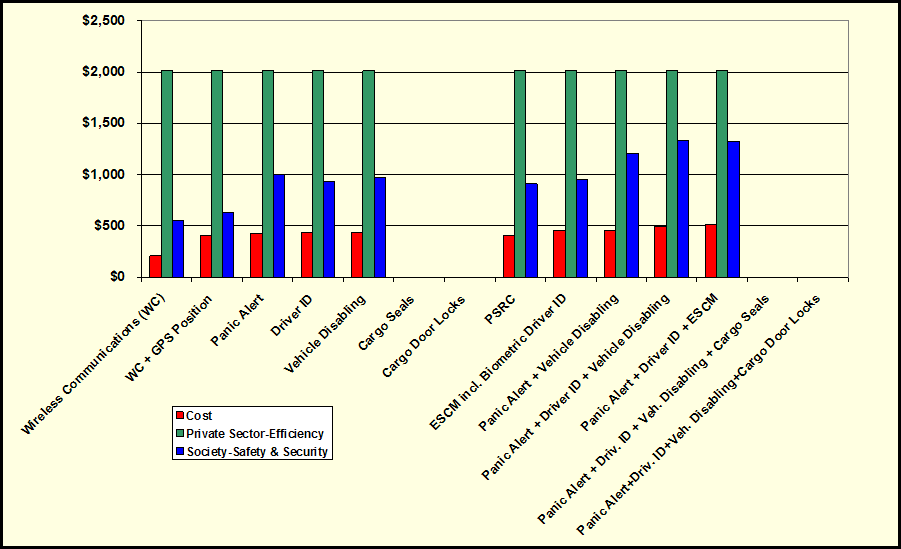
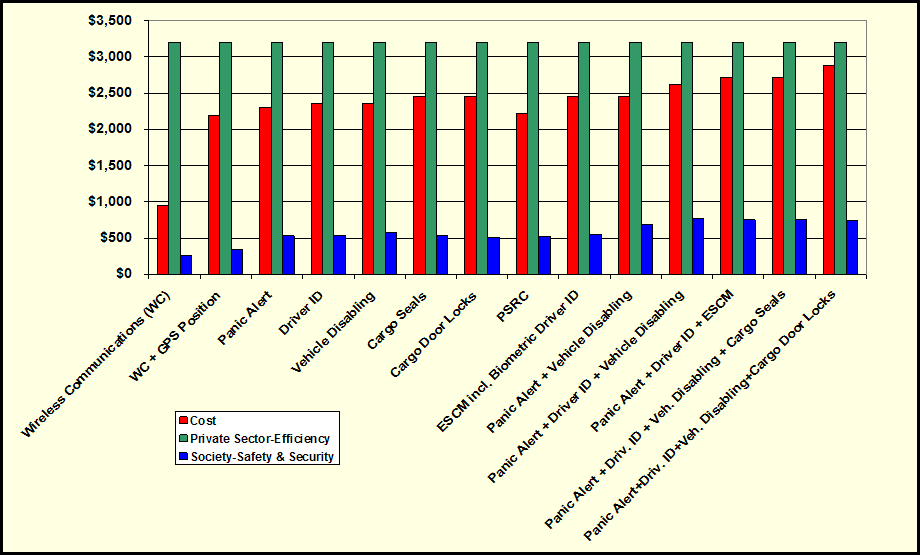
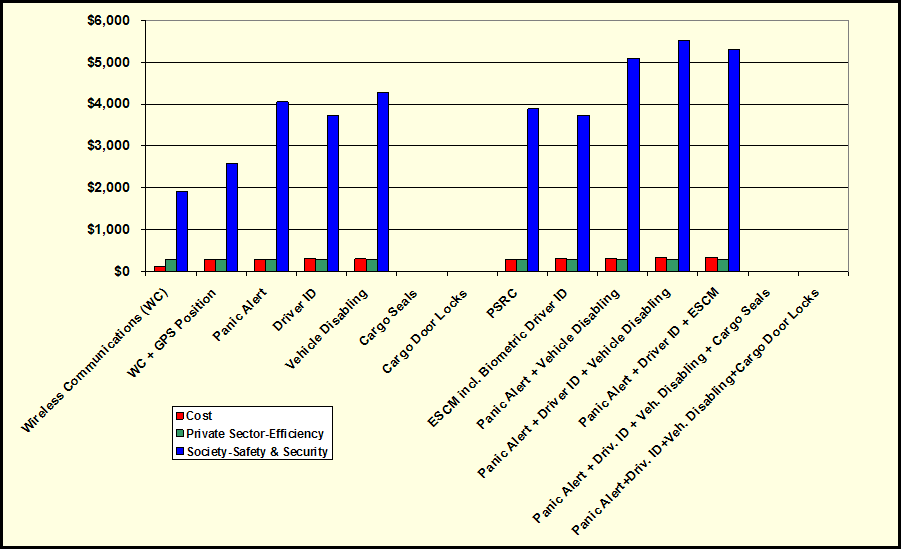
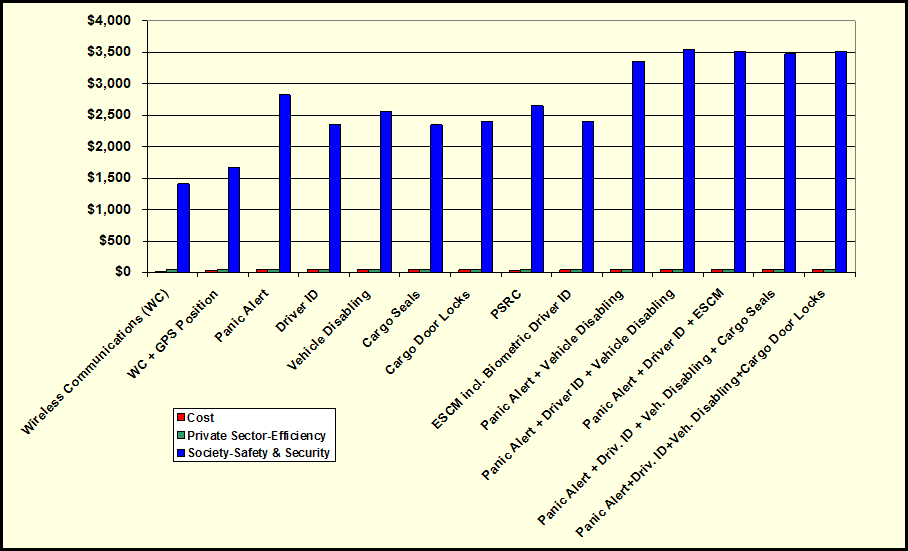
Within the framework of this evaluation, efficiency benefits are assumed to accrue to private sector motor carriers. Security and safety benefits are assumed to accrue to the general public. The costs of deploying the technologies, if market driven would be assumed by motor carriers, but if sufficient compelling societal benefits exist, then methods of cost sharing may be considered as a policy option.
As demonstrated from the analyses presented in this synthesis document, efficiency benefits outweigh the costs of deployment in all load types. This is true except for the majority of technology combinations above and beyond Wireless Communications with GPS positioning for Bulk Chemicals, and for the four technology combinations above and beyond Wireless Communications with GPS positioning for Truckload Explosives, which are at the low end of the range of potential efficiency benefits. Returns on investment for the technology combinations above and beyond Wireless Communications and GPS positioning may be marginally above the costs of deployment at the low end of benefit estimates, and therefore, may not of themselves drive adoption by motor carriers.
Security benefits are demonstrated to far outweigh deployment costs for all load types except the LTL sector, in which the types of materials carried and their quantities equate to relatively low potential consequences and the numbers of trucks to be equipped are relatively high.
Safety benefits of the technologies as calculated are relatively small in comparison the efficiency and security benefits. This is in part due to the functional nature of the technology systems themselves not being designed with a focused safety application. Overall though, the capabilities of many of the technologies do enable enhanced fleet and incident management capabilities, which can potentially translate into avoided crashes and improved response time and coordination in the event of a crash.
Table 8-16 presents the percentage of benefits realized by the private sector for each load type.
| Load Type | Percentage of Benefits |
|---|---|
| Bulk Fuel | 60% to 72% |
| LTL | 81% to 92% |
| Bulk Chemicals | 5% to 13% |
| Truckload Explosives | 1% to 3% |
Figures 8-1 through 8-4 illustrate the distribution of the private and societal benefits relative to deployment costs.
8.8 Findings
The efficiency and security benefit-cost and market potential analyses presented in this synthesis document represent the next level of integration of the detailed Efficiency and Security Assessments detailed in Volume III, Sections 2 and 3, which provided methodology and analyses of operational enhancements and HAZMAT risk assessment. This synthesis document presented the universe of HAZMAT carriers and trucks that represent the potential market for security- and efficiency-enhancing technologies for four primary HAZMAT shipment types. It also detailed the levels of investment required to reach full deployment market potential and the levels of expected benefit.
Following are the findings and conclusions derived from the analyses:
- HAZMAT Fleets: The analysis of HAZMAT trucking companies derived from the FMCSA-managed MCMIS database shows:
- Within the four load types, approximately 27,000 motor carriers are represented, operating 709 thousand trucks.
- Across the four load types, approximately one-quarter to over one-third of the carriers is a one-truck operation.
- Between 57 and 64 percent of the fleets operate 5 or fewer trucks and between 68 and 77 percent of fleets operate fewer than 10 trucks.
- Current Technology Usage: Based on the FOT Industry Survey conducted by the Deployment Team and referenced against three other recent industry technology adoption survey, the results indicate:
- Across load types, there is strong consistency in the level of use across technology types.
- The most used technology among the fleets is cell phones consistent across load types at 87 percent.
- The second most widely used technologies among the fleets are Satellite Communications, most often with GPS vehicle tracking, 59 to 63 percent for Satellite Communications, and 45 to 48 percent for GPS vehicle tracking.
- On-Board Computers are used in approximately 12 percent of trucks and 20 percent of trucks are from fleets using Web-based shipment tracking systems (a proxy for the ESCM test system). The percentages for the other technologies are estimated to be at most 13 percent of trucks, with most below 10 percent of trucks.
- As fleet size increases, the use of cell phones decreases and oppositely, the use of Satellite Communications and GPS tracking increases. This is partly due to the need for more integrated data collection and management capabilities to effectively manage larger fleets.
- Market Potential: Based on the MCMIS data, the following truck counts represent the universe of trucks in considering market potential:
- By load type, the distribution of trucks is: 115,026; 52,2793; 62,675; and 8,287 trucks for the Bulk Fuel; LTL-High Hazard; Bulk Chemicals; and Truckload Explosives load types, respectively.
- The technology suites tested in the FOT nearly all relied on the Wireless Communications with GPS positioning backbone. In terms of ROI, Wireless Communications with GPS positioning were the only technologies that demonstrated quantifiable operational benefits for the test participant's fleets. Therefore, ROI-driven market penetration is measured based on adoption of the communications and tracking technology capabilities.[41]
- It is assumed that fleets of 1 to 9 trucks would not migrate from basic cell phone/pager two-way radio communications systems to an integrated Wireless Communications system with GPS positioning due to a lesser need for technology-enhanced fleet management in this class of carriers and the overwhelming proportion (63 percent) of these very small fleets operate within 100 miles of their base terminal, requiring limited need for tracking capabilities.
- Elimination of these very small fleets from the potential market for Wireless Communications with GPS positioning removes approximately 13,000 trucks or approximately 2 percent of the market from consideration.
- Current use of technology put the estimated penetration into the market at 47 to 49 percent of total for the combination of wireless communications with GPS tracking.
- It is estimated that for technology costs over 3 years (including costs already incurred) for full deployment range from a low of $1.3 billion (for Wireless Communications only, resulting in an average of 14 percent in potential reduction in costs of terrorist attacks) to $3.6 billion (for multiple technology combinations using Wireless Communications with GPS tracking as the enabling core technologies, resulting in an average of 36 percent in potential reduction in costs of terrorist attacks). Of these total deployment costs, approximately 20 percent (for Wireless Communications only) to 94 percent (for multiple technology combinations using Wireless Communications with GPS tracking as the enabling core technologies) represent costs associated with technology units deployed above current use levels.
- Operational Return on Investment: The Efficiency Assessment detailed in Volume III, Section 2, derived significant (conservative) benefits in relationship to (upper tier) costs for motor carriers using Wireless Communications with GPS positioning capabilities. These findings are summarized as follows:
- Benefits through enhanced operations are estimated at: $486; $196 to 820; $160; $130 to 593; and $152 to 941per truck per month for Bulk Fuel, LTL-High Hazard, LTL-Non-Bulk, Bulk Chemicals, and Truckload Explosives loads, respectively.
- Estimated monthly costs for the technologies (including 3-year amortization of initial purchase and installation costs and monthly messaging, positioning and maintenance fees) were from $99 to $127 per truck per month, resulting in attractive benefit cost ratios across all four load types.
- Time period for payback on investment was 3 to 13 months for all load types, assuming the upper range of benefits and 3 to 34 months assuming a low range of benefits.
- To realize the full potential benefits, it is estimated that the HAZMAT trucking industry (at the high end) would have to invest an initial $543 million and incur annual service fees of $276 million per year. If the purchase costs were amortized over 3 years, total annual costs (including monthly service fees) would be $450 million. Offsetting these costs would be increase profitability, estimated to range from $0.9 to 1.7 billion per year.
- Even with attractive ROI and low payback periods, capital constraints, institutional inertia (comfort with doing business in fixed ways), and myriad low-cost communications options are likely to make penetration of this market a long-term enterprise, especially in the smaller fleet categories.
- Security Benefits and Costs: The Security Assessment, detailed in Volume III, Section 3, was guided by the expert inputs of a steering committee and a Delphi Panel. Using a structured risk assessment framework, the results of the FOT and the experts' opinions were processed into measures of relative effectiveness of technologies to address load-specific vulnerabilities, and ultimately to reduce potential consequences of HAZMAT-based terrorist attacks. These findings include:
- The combinations of technologies/suites tested within the FOT do have the ability to reduce the potential consequences by reducing inherent shipment vulnerabilities.
- The most efficacious combinations of technology averaged across all four load types are estimated to address 36 percent of potential costs of terrorist attacks.
- By load type, the reductions in potential costs of terrorist attacks, enabled by the technologies, range from: 15 to 36 percent; 13 to 37 percent; 12 to 34 percent; and 11 to 26 percent for Bulk Fuel; LTL High Hazard; Bulk Chemical; and Truckload Explosives loads, respectively.[42]
- Security benefit cost ratios are favorable for all load types, except LTL, in which the potential consequence and attractiveness of the LTL loads for use as a weapon of mass effect is relatively low and the number of trucks that would require being equipped is relatively high.
- Costs for the Public Sector Reporting Center (PSRC) do not include stateside equipment purchase, integration and training. These costs need to be closely examined based on ultimate architecture and future plans for upgrading enforcement legacy systems.
- Safety Benefits and Costs: The Safety Assessment, detailed in Volume III, Section 2, provides quantitative and qualitative descriptions of potential safety benefits focusing on enhanced driver monitoring capabilities, reduced exposure to crashes and enhanced HAZMAT incident response. These findings include:
- Qualitative opinion indicates that the technical capabilities of the test technologies, coupled with best practices in motor carrier driver/safety management and public sector incident response, show promise for enhancing the safety of truck-based HAZMAT shipments.
- The technical performance of the technologies within the framework of the FOT demonstrated enhanced ability to monitor drivers and vehicles and provide notification of emergencies with location and load characteristics in a more timely manner and potentially detailed manner than traditional methods (thus potentially enhancing emergency response).
- Through the use of proxies, potential benefits in terms of crash avoidance due to fewer miles driven and thus, reduced exposure, were estimated to be $5 million annually. No monetized benefit estimates were developed for enhanced emergency response.
- Combined Safety, Security and Operational Benefits and Costs: The combined benefit-cost findings are:
- The driving safety and security technology (Wireless Communications with position tracking)[43] is also the driving operational technology. It has been estimated that the investment in this enabling technology has the operational benefits strong enough to recoup investment and show a positive ROI in a relatively short period of time.
- Though the surplus ROI from the core enabling technology may provide the funding for additional technologies, this is not a given. Therefore, governmental or market intervention may be needed to realize full deployment of the additional security technologies.
- Under full deployment, the combined benefit-cost ratios, across all load types and technology combinations, range from 1.3:1 to 96.9:1.
- The percentage of benefits realized by the private sector for each load type is: Bulk Fuel – 60 to 72 percent of benefits; LTL – 81 to 92 percent of benefits; Bulk Chemicals – 5 to 13 percent of benefits; Truckload Explosives – 1 to 3 percent of benefits. The low percentages attributable to the private sector in the cases of Bulk Chemical and Truckload Explosives are attributable to the fact that the potential magnitude of a terrorist event using these materials is so high; the benefits due to vulnerability reduction are extremely high relative to benefits of improved efficiency.
24. ATRI, Trucking Technology Survey, conducted as part of the FOT, Hazardous Materials Security and Technology Survey Results Summary, January 2004.
25. ATRI – GartnerG2 survey of 150 motor carriers on adoption of in-vehicle technologies, Trucking Technology Survey – 2003; ATRI industry survey of 348 motor carriers to determine levels of technology adoption in 2000 and projections to 2003, in support of the North American International Trade Corridor (NAITC) Comprehensive and Coordinated Intelligent Transportation Systems for Commercial Vehicle Operations (ITS/CVO) Plan.
26. ATA Foundation, Motor Carrier Technologies – Fleet Operational Impacts and Implications for Intelligent Transportation Systems/Commercial Vehicle Operations, October 1999.
27. Monthly service fees cover hourly positioning and base number of messages per unit.
28. Costs include purchase and installation costs amortized over 3 years, plus ongoing messaging and maintenance costs.
29. ATRI – GartnerG2 Trucking Technology Survey, December 2002.
30. In estimating current levels of market penetration, the current deployment levels for the most limiting technology – Vehicle Tracking – was used.
31. Bulk fuel shipments include bulk shipments of: Class 3: Flammable/Combustible Liquids and Class 2, Division 2.1: Flammable Gases; LTL-High Hazard includes non-bulk shipments of: Class 2, Divisions 2.3A-2.3D: (PIH Zones-A-D, respectively), Class 4, Divisions 4.1-4.3: Flammable Solids, Spontaneously Combustible Materials, Dangerous When Wet Material and Class 6, Division 6.1: Poison Liquid-PIH Zones A & B, Poisonous Solids; LTL-Express or Non-Bulk Type Service includes non-bulk shipments of: Class 3: Flammable/Combustible Liquids; Class 7: Radioactive Materials; Class 8: Corrosive Materials; Bulk Chemicals includes bulk shipments of: Class 2, Division 2.2A: Anhydrous Ammonia; Class 5, Divisions 5.1-5.2: Oxidizers, Organic Peroxide; Class 6, Division 6.1: Poison Liquid-PIH Zones A & B, Poisonous Solids; Truckload Explosives includes bulk shipments of: Class 1, Divisions 1.1-1.6: Explosives and Blasting Agents.
32. Potential costs not included in the analysis are vehicle downtime for installation and training time for personnel. Through discussions with motor carriers and the technology vendor, installation would likely occur during schedule downtime for preventive maintenance. Training of personnel in the use of technologies would generally fall within usual new employee training/orientation processes or within ongoing carrier training/skills enhancement activities.
33. U.S. Office of Management and Budget, Circular No. A-94 – Appendix C – Discount Rates for Cost Effectiveness, Revised February 2004.
34. Battelle, in association with QUALCOMM, ATRI, CVSA, and the Spill Center, HAZMAT Safety and Security Field Operational Test Draft Final Report, June 11, 2004.
35. The costs for LTL are averages of LTL-High Hazard and LTL-Non-Bulk weighted by numbers of trucks in each category.
36. The Public Sector Reporting Center (PSRC) is not a commercial service, but it is built upon the provider's basic technology and service offering. The subscription rates for fleets range from approximately $1,200 to $2,500 per fleet. The PSCR cost component is calculated as: (number of fleets by load time x Subscription rate) / number of trucks in each load type. Costs do not include public sector hardware interfaces with the Spill Center. The costs per unit represent 3 years of subscription fees.
37. This is not a commercial offering; therefore, all vehicles are considered potential market. It is assumed that the fleets are not currently enrolled in the provider's base notification system for costing purposes.
38. The costs for LTL are averages of LTL-High Hazard and LTL-Non-Bulk weighted by numbers of trucks in each category.
39. The costs for LTL are averages of LTL-High Hazard and LTL-Non-Bulk Service costs weighted by numbers of trucks in each category.
40. The Public Sector Reporting Center (PSRC) is not a commercial service, but it is built upon the provider's basic technology and service offering. The subscription rates for fleets range from approximately $1,200 to $2,500 per fleet. The PSCR cost component is calculated as: (number of fleets by load time x Subscription rate) / number of trucks in each load type. Costs do not include public sector hardware interfaces with the Spill Center. The costs per unit represent 3years of subscription fees.
41. It is also assumed that wireless communications without the GPS tracking capability provides carriers ROI at the level estimated for wireless communications with GPS tracking.
42. Reduced costs were estimated by multiplying the reasonable worst-case consequence values from Table 6-5 by the overall technology-enabled vulnerability reductions.
43. Though not specifically tested in this FOT, wireless communications without GPS positioning capabilities is assumed to provide all of the operational and security benefits of wireless communications with GPS.
