
9. Public Sector FOT Evaluation
9.1 Public Sector FOT Overview
The Public Sector add-on FOT tested a model for enhanced information gathering, processing, and dispersal to law enforcement and emergency response agencies. This test was conducted under the auspices of the FMCSA-led HAZMAT Safety and Security FOT.
The Public Sector testing examined the potential improvements in public sector response capabilities utilizing a Public Sector Reporting Center (PSRC) as the information collection and dissemination point. The PSRC coordinated information gathered from technologies that are in various stages of development to create centralized information processing and command and control capabilities. The Public Sector testing identified quantitative and qualitative results and metrics concerning the testing of first response technologies and the PSRC concept. This overall system seems to be responsive to the following three public sector Functional Requirements developed by USDOT for the broader HAZMAT FOT:
- Requirement 2.2: HAZMAT driver identification and verification by roadside safety enforcement officers was improved by at least 28 minutes.
- Requirement 2.4: HAZMAT cargo route adherence by the dispatcher and roadside safety enforcement officers, as required, based on the quantity and type of HM being transported was improved by at least 3 hours.
- Requirement 2.11: Real-time emergency alert message notification by the dispatcher to local and state law enforcement officials and emergency responders was improved by at least 18 minutes.
The on-site Public Sector testing was augmented for this evaluation effort by data collected from technology testing from technology exercises and "staged event" testing from the full HAZMAT Safety and Security FOT (see Sections 4.2 and 4.3 of this synthesis document).
This add-on FOT to the HAZMAT Safety and Security FOT demonstrated a standardized approach to the data collection and dissemination requirements. This standardized approach seems to be efficient for the ultimate users (fire, police, emergency services, law enforcement and security agencies) of HAZMAT safety and security messages for prevention and response. The FOT demonstration for this technology solution for law enforcement and the emergency response community interfaced with the "carrier-side" technology systems. This FOT addressed some of the public sector hazardous materials safety and security needs.
Key organizations deploying the Public Sector component of this FOT included: Battelle; CVSA; QUALCOMM; and the Spill Center.
9.2 Public Sector Reporting Center
The Public Sector FOT leveraged the following technologies that were also deployed in the larger HAZMAT Safety and Security FOT:
- Satellite Communications
- Global Login
- Biometric Global Login
- Electronic Supply Chain Manifest
- Geofencing
- Panic Buttons (In-dash and Wireless)
The public sector architecture was comprised of a Public Sector Reporting Center; Data Silo relational database; Smart Agents providing exception decision rules; and a number of information dissemination technologies.
The PSRC was designed with capabilities for data acquisition, fusion, and distribution of HAZMAT shipment information to public sector enforcement and response agencies. The PSRC integrated Wireless voice/data Communications and Satellite-tracking technology with automatic routing of alert notifications to authorities and online access to highly specialized data. The results provided real-time monitoring of HAZMAT shipment information; increased load security; and enhanced law enforcement actions and incident response in the selected test areas.
PSRC allowed end-users a Web-based application to create and manage rules that specify what conditions would trigger the alert and send a notification message. The PSRC managed user contact information including e-mail, voice text messaging on cell phones, fax, and pager numbers. The PSRC was designed to provide enhanced user functionality via:
- Viewing recent alert notification messages and near real-time vehicle data.
- Sending manual alert notifications based on driver ID, route adherence, and emergency alerts.
- Identifying response inventory and deploying response resources remotely.
Figure 9-1 displays the complete system architecture for the Public Sector FOT.
9.3 Public Sector FOT Evaluation Testing
The HAZMAT Safety and Security Public Sector FOT is a logical extension of the "carrier-side" evaluation. This evaluation further expanded and examined the technology and system benefits to the unique requirements of relevant local, state, and national response and enforcement agencies that deal with hazardous materials. The Evaluation Team focused on law enforcement and emergency management response metrics and user perceptions regarding deployment of the Public Sector FOT technologies and systems designed to improve detection and response to prohibited or dangerous activities involving HAZMAT shipments.
The Evaluation Team used the following two primary evaluation methods – public sector interviews and field testing – developed through bilateral discussions between SAIC and Battelle held at the request of FMCSA. These methods were be used to assess deployment technologies and systems ability to improve response time and provide more accurate, detailed information to law enforcement and incident response agencies.
9.3.1 Public Sector Interviews
Through interviews with public sector participants in the FOT, the Evaluation Team collected qualitative information concerning the quality and timeliness of information provided by the test technologies and the PSRC. Additionally, the effort collected user perceptions of effectiveness, appropriateness to the enforcement operational environment, and policy options for system enhancements/improvements.
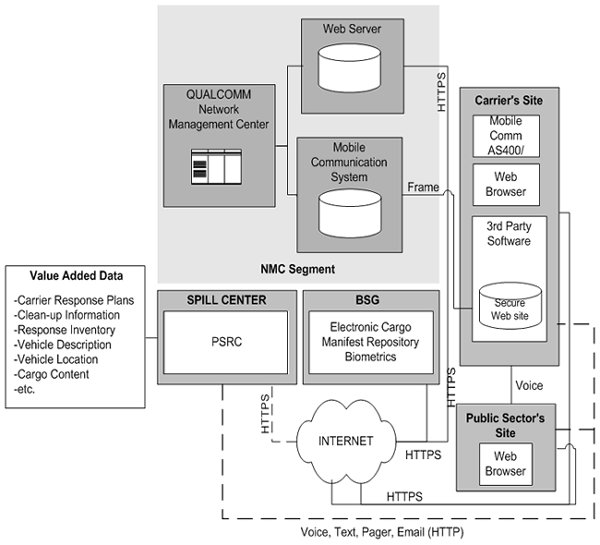
Figure 9-1. HAZMAT Public Sector FOT System Architecture
9.3.2 Field Testing
Through tailored testing, the PSRC technology was applied to four existing FOT motor carriers involving FOT Requirements 2.2, 2.4, and 2.11. The tests' objective was to assess whether the PSRC systems adequately met the public sector functional requirements with respect to generating customized alerts and handling data generated and delivered as part of the larger FOT, and to identify improvements in timeliness of alert notification.
The Public Sector FOT involved four of the nine carriers participating in the full-scale HAZMAT and Security FOT. The Public Sector FOT also involved state law enforcement and response agencies from California, Texas, Illinois, and New York.
Testing for the Public Sector FOT was conducted onsite at locations within each of the four designated participant states during February and March 2004. The exact testing dates were as follows:
- February 4, 2004 in Houston, Texas
- February 24, 2004 in Waterloo, New York
- February 26, 2004 at O'Fallon Inspection Station near O'Fallon, Illinois
- March 30, 2004 at Cox Petroleum in the City of Industry, California
Following is a description relating to the technology processes that were tested onsite for Functional Requirements 2.2, 2.4, and 2.11.
- Requirement 2.2: A state enforcement officer observed a driver performing the login procedure within the cab of the participant vehicle. To test the system, the driver purposefully failed the login process using Global Login or Biometric Login by exceeding the number of allowable login attempts without a successful login.
- Requirement 2.4: An "electronic fence" known as Geofencing was placed around a defined risk area or an exclusion zone. Alert notifications were triggered when the vehicle entered a prohibited area or when the vehicle leaves a predefined route. When a driver initiated a geofence violation, the polling rate, which is configurable to each specific motor carrier, was increased in frequency to track the vehicle's position, speed, and direction. Controlled tests were conducted where the driver purposefully violated pre-determined electronic fencing schemas.
- Requirement 2.11: This testing simulated a driver being involved in a compromising position such as a hijacking or theft. The driver pressed the in-dash Panic Button and/or the wireless remote panic. This pinpointed the location and time of the incident in order to aid dispatch and state authorities. The panic message was sent simultaneously to both the carrier dispatcher through the QUALCOMM NMC and the PSRC.
In depth descriptions for the four individual on site tests are contained in Volume III, Section 5: Public Sector Component.
9.4 Public Sector Evaluation Findings
The evaluation effort for this test focused on testing the two SOW-stated Public Sector FOT hypotheses:
- The response times for emergency and enforcement personnel to respond to a HAZMAT security or safety incident can be improved through the implementation of these technologies and the reporting center operational concept.
- The quality of the information provided to first responders will improve through the implementation of these technologies and the reporting center operational concept.
9.4.1 HAZMAT Response Time Improvements
The first hypothesis is that the response times for emergency and enforcement personnel to respond to a HAZMAT security or safety incident can be improved through the implementation of these technologies and the reporting center operational concept. The hypothesis is accepted based on the data generated field testing experiences at the four on site locations and comments from law enforcement and emergency response personnel.
The explanation for accepting the first hypothesis is broken down according to sub hypotheses for Requirements 2.2, 2.4, and 2.11.
Requirement 2.2
In the past, positive driver identification typically required a trip to the police station, a process that would take an officer between 30 minutes to as much as 2 hours based on law enforcement estimates. The biometrics or Global Login allows the officer to perform an on-site driver verification using over-the-air communications with selected database interfaces within approximately 1 minute.
Requirement 2.4
Under current conditions, it is often impossible for an enforcement officer to determine if a certain motor vehicle is "off route" or near a location where it should not be. For carriers without Satellite Communications with any visual mapping capabilities or vehicle location tracking capabilities, it is very difficult to maintain consistent tracking of a vehicle to make sure that it stays "on route" or out of unauthorized areas as designated by the carrier.
During the exit interviews for the full-scale HAZMAT FOT, carriers were asked how long it would take them to determine that a vehicle was out of route without Satellite Communications. The motor carrier participants estimated it would take at least 4 to 8 hours on average to determine that a vehicle was where it should not be without Satellite Communications. Therefore, it would be at least 4 to 8 hours before law enforcement would be aware of an "off route" or geofence violation without Satellite Communications or Geofencing technology present.
At the standard 1-hour positioning frequency, Geofence technology routed through the PSRC and Satellite Communications to visually follow vehicle location progress provides a significant time benefits for law enforcement to detect an "off route" or Geofence violating motor vehicle. It can take up to 1 hour to for the system to detect an "off route" or geofence violation based on the standard 1 hour positioning frequency. Once this violation is detected, the alert message is sent out within 1 minute to authorized stakeholders, including the motor carrier management, dispatcher, law enforcement, and first responder personnel. This translates to at least a 3-hour time benefit of Geofencing delivered alerts through the PSRC and Satellite Communications for tracking vehicle location progress versus motor carrier vehicles not involving these technologies.
Requirement 2.11
Without being able to utilize a Panic Button to alert a dispatcher or law enforcement that a safety or security incident is taking place, at best, a driver can use a cell phone to communicate that situation. There are many situations when it would not be practical for a driver to communicate via a cell phone. The driver could be in the midst of a vehicle hijacking, where it would be impractical and actually dangerous to attempt to use a cell phone. The driver could also be in a "dead zone" where cell phone coverage is not available. Without a cell phone, the driver would have to wait to get access to another phone to report the incident – if and when the opportunity occurs. Even with a cell phone distress call to dispatch, the dispatcher would still have to determine, record, and relay all the location information to appropriate law enforcement channels to initiate response action.
The best estimate of response time to a "panic alert" is to use the average notification time for law enforcement response to a HAZMAT spill. Estimates based on Operation Respond and COMCARE place the estimate at 20 minutes. According to the Center for Technology Commercialization, the "best estimate" is 27 minutes.[44] A panic alert takes a maximum of 2 minutes to be routed to law enforcement through the PSRC. This represents at least an 18-minute time benefit to using Panic Buttons over average notification times at this time.
9.4.2 HAZMAT Information Improvements
The second hypothesis states that the quality of the information provided to first responders will improve through the implementation of these technologies and the reporting center operational concept. The hypothesis is accepted based on the law enforcement interviews and field testing public sector reactions at the four on site locations from law enforcement and emergency response personnel. The explanation for accepting the second hypothesis is broken down according to sub hypotheses for Requirements 2.2, 2.4, and 2.11.
Requirement 2.2
Currently, law enforcement typically relies on information provided by the subject for identification. The individual may choose to identify himself or herself using fraudulent identification credentials. It is difficult to remotely verify an individual's identity and only sketchy information is available without a reliable means to verify identification. An officer must depend on visual identification to make a decision as to an individual's identity. In the cases of unauthorized drivers, those individuals might have forged identification to pass themselves off as legitimate drivers.
The Biometric Login or Global Login provides much more accurate, truthful information on a driver during roadside enforcement actions. With laptop access in remote locations, law enforcement can verify driver identity, and with ESCM capabilities, ensure that the correct driver is associated with the correct vehicle/cargo. ESCM manifests detail the entire supply chain transaction from shipper pickup to consignee delivery. The law enforcement officer can determine who should be in control of a shipment at the point of the remote vehicle stop.
Requirement 2.4
Currently, law enforcement relies on the motor carrier to provide details for an "off route" or Geofence-violating truck. Law enforcement information is only as detailed as what the motor carrier provides. In cases where a carrier has no Satellite Communications, precise vehicle location is impossible with only a rough estimate based on travel times would be available. For details on cargo contents, without ESCM, law enforcement must contact the motor carrier, who may or may not have precise details on what is being hauled. In some cases, the shipper would have to be contacted by law enforcement for precise cargo contents to determine what real risk is posed by a particular off route or Geofence-violating truck, depending on what type of HAZMAT is being hauled. Different HAZMAT classifications carry different risk levels associated with their transport.
Geofence alerts contain a precise location of the alert event. Satellite tracking allows for continuing monitoring a vehicle once an alert is received at an increased positioning rate. The PSRC approach is to provide exception-based off route or Geofence alerts to law enforcement or first responders when there is a real defined emergency. Geofencing technology allows each route to be configured according to each specific shipment type, allowing for a precise risk level to be ascribed to each shipment and route. The PSRC allows for law enforcement or first responders to select what types of alerts to receive, and contact by a certain method (phone, e-mail, fax, page, etc.).
ESCM allows for law enforcement to know what cargo is on what truck when responding to an off route or Geofence alert to better assess risk. There is no need to contact the carrier to obtain load information – the information is contained on the manifest when it is electronically accessed.
The PSRC delivers precise, manageable information to law enforcement and first responders when dealing with off route or geofence violating trucks.
Requirement 2.11
Currently, law enforcement does not receive a real-time "panic alert". The best law enforcement can hope for is a cell phone call placed after the fact, to describe apparent location and what occurred during the event.
Panic Buttons provide an effective way to transmit emergency event information directly to law enforcement through the PSRC. Panic Buttons utilize Satellite Communications to pinpoint exact location and forward that location information to the NMC and to the PSRC and ultimately to end users such as law enforcement. There is no searching for location information pertaining to an emergency event that requires immediate response to a precise location.
9.4.3 Conclusion
As a proof of concept, the PSRC demonstrates the ability to fuse and disseminate critical HAZMAT information in a timely manner to enhance enforcement response to security events.
On a basic level, the PSRC system successfully demonstrated that as a system. The PSRC has the ability to improve:
- The response times for emergency and enforcement personnel to respond to a HAZMAT security or safety incident through the implementation of these technologies and the reporting center operational concept.
- The quality of the information provided to first responders through the implementation of these technologies and the reporting center operational concept.
In expanding the PSRC concept to a full deployment scenario, significant institutional/procedural issues will need to be addressed. Among the more important of these is the administration of information and the notification process, i.e., ensuring that shipment information, alert notification levels (triggers), and key persons to be notified are current and complete. If not, the effectiveness of the system may be significantly eroded by alerts being directed to personnel or agencies that may not be involved in responding to given incidents, or that appropriate persons/agencies may not be alerted when actually warranted or that information provided is lacking or inaccurate. In either case, confidence in the PSRC and the ability to readily use alert and shipment background information provided via the PSRC is at stake. Addressing this will require coordination, continuity, and uniformity of processes among shippers/consignees, HAZMAT motor carriers and the enforcement/emergency response communities.
44. The Center for Technology Commercialization (CTC) serves as NASA's Northeast Regional Technology Transfer Center (RTTC), covering the six New England States plus New York and New Jersey . CTC acts as a gateway for the transfer of NASA and other federal technology to private industry. The CTC's Public Safety Technology Center (PSTC) is an informational clearinghouse focused on the development and uses of advanced technologies that can help reduce violent crime, promote officer safety, and impact public safety's ability to effectively combat crime and respond to terrorist threats.
